Between noon and three

…spare us in the youngest day when all are shaken awake, facts are facts, (and I shall know exactly what happened today between noon and three); that we too may come to the picnic with nothing to hide, join the dance as it moves in perichoresis, turns about the abiding tree. — W.H. Auden, "Compline"

Category: Homily

Trinity Sunday at All Saints, Ashmont

TourPhoto41_Candlemas-Benediction

I was honored to be invited to preach Trinity Sunday this year at the Parish of All Saints in the Ashmont neighborhood of Dorchester, just outside of Boston. This sermon was preached at the Solemn High Mass, at 10am. Music for the day included Stanford’s Communion Service in B-flat and F, and his Te Deum in B-flat Major.  Thank you to Fr. Michael Godderz and to the whole parish for your warm hospitality!

Collect: Almighty and everlasting God, who hast given unto us thy servants grace, by the confession of a true faith, to acknowledge the glory of the eternal Trinity, and in the power of thy Divine Majesty to worship the Unity: We beseech thee that thou wouldest keep us steadfast in this faith and worship, and bring us at last to see thee in thy one and eternal glory, O Father; who with the Son and the Holy Spirit livest and reignest, one God, for ever and ever. Amen.

Readings: Isaiah 6:1-8, Revelation 4:1-11, John 16:5-15

In the Name of God, Father, Son, and Holy Spirit, Amen:

“Why don’t you quit waffling, and take a stand already?”  How many of us have said this before, or have heard it said to us?  Take a stand: be for us, or be against us, but at least take a stand!  As a culture we don’t have much patience for people who can’t make up their minds.  And nothing is more frustrating than having to work with people who lack the courage to back up their convictions with deed as well as word.  Take a stand!

The Church makes its share of stands too, and today we make what is perhaps the chief of all Christian stands: Trinity Sunday, when we affirm unequivocally that the God we worship is one God in three Persons, whom we know as Father, Son, and Holy Spirit.  All Christian prayer, all Christian doctrine, and all Christian hope depend in many ways on this stand most of all: God is one, and God is three, perfect Trinity in perfect Unity.

What is it like to make a stand for the Trinity?  What is it like to stand, and to build, on this great, monumental Doctrine?  The moment we try, a strange thing happens: we lose our balance, and end up facing a different direction than when we started!  What do I mean by that?  The moment we try to think of the Father, we are forced to consider his Son, his only Son, whom he loves above all else.  And the moment we turn to the Son, our eye is immediately turned to the Holy Spirit, the Spirit whom Jesus promised will lead us into all truth.  And the moment we consider the Holy Spirit, we are turned back to the Father, the one whose truth the Spirit reveals: which sends us right back to the Son.  To try and stand on the Trinity is like trying to step on a ride at the fair which is already moving: we get turned around from the moment we take our first step.  We can easily lose our balance, and if we’re not careful, or if we focus too long on any one point, we can catch a nasty case of vertigo and get thrown clean off.  If the Trinity is the firm ground where the Church makes its stand, then what are we to do when we discover it is continually moving around?

Take another example.  There comes a point in every person’s life when we hit “rock bottom.”  Maybe it has happened to you or to someone you know, or if it hasn’t yet, don’t worry, it will.  Maybe a cancer diagnosis.  Maybe you’ve failed an important test.  Maybe it’s getting fired, or getting caught, or declaring bankruptcy.  Maybe it’s a divorce, or maybe you’ve finally admitted to yourself that you’re an alcoholic.  One man in recovery once told me that, the moment he realized he had a problem was a moment in which suddenly found himself with an overpowering fear, fear that he was slowly killing himself, and that he was powerless to stop it.

Rock bottom.  Whatever it is for you, you know it when you’re there.  There is no lower that you can go.  “Rock bottom” sounds an awful lot like bedrock, like solid ground.  But the experience is always more like freefall, down an endless abyss into the void.  What do you do when you find yourself there?  How do you regain your balance?  How do you reorient yourself back towards life, and light?  It’s a very different scenario, but the question is the same as with the Trinity: how can you make a stand from a moving reference point?

Take another case.  Recently I met a woman who was totally in love.  The man in question was also totally in love with her.  He had proposed, but she was nervous about saying Yes.  She said, “Whenever I think about him, I think about how happy he makes me.  And whenever I think about my life, I think how glad I am that he’s in it.  I can’t imagine myself without him.”  “That doesn’t sound so bad,” I said.  She replied, “Yeah, but aren’t I supposed to be able to get along without him, if this is going to work?  As it is, I feel like I’m in a whole new world, and nothing is really recognizable anymore.  All my old hopes and goals suddenly look different with him, and I’m considering all sorts of new things that I never would have dreamed of before.”

I wanted to get to the bottom of this, so I arranged to meet with the man too.  I don’t know what I was expecting, but I was surprised in any case, since he said almost the same thing that she did.  He said, “I want to be with her for the rest of my life, she’s always teaching me something new about myself.  And when she’s around, it’s like I am somebody I never knew I could be.  I don’t know why, but she loves me, and I like myself better because of it.  Life is richer somehow, there’s less pressure to be someone I’m not, and I feel like I’m discovering new things all the time.”

Of course they were both saying the same things.  Not that they had surrendered their identities to each other, but that, in love as they were, they found that something new and unknown was growing among them, leading them further into unknown territory, and they needed each other to figure out what that was and what it meant.  “All you need is love,” the Beatles sang.  But these two love birds prove that, like being at rock bottom, love is a difficult foundation too.  It’s hard to stand on love, because it’s constantly leading further on, opening onto new vistas, new possibilities, new depths of understanding and devotion.

So: It’s impossible to make a stand on love.  It’s impossible to make a stand at rock bottom.  And it’s impossible to nail down the Holy Trinity.  All of them move constantly out of focus, all of them are just beyond reach, all of them require some help from outside of ourselves to engage.  And yet, the Trinity is still where the Church takes its stand.  Our whole religion is bound up in this mystery.  What is this about?

The person at rock bottom, in freefall, has nowhere to stand, cannot climb out, cannot stop falling, cannot grab hold of anything.  And so, the Trinity does not present itself as merely some crutch to help us cope, some toehold for us to cling to.  Rather the Trinity reaches down to grab hold of us, never letting go, even in our darkest hour offering another vision, another possibility for life, cleansed from sin and free from death.

The couple in love find that love is not something they possess, but rather something that makes a new world for them, constantly unfolding with more delight, more challenge, more opportunity.  Likewise the Trinity is not something we can possess, but rather the very life of God himself, who claims us for his own, drawing us ever onward into his grace, feeding us with his own body and blood and infusing every day with more wonder, more joy, more gratitude.

Tracing a line from Father, to Son, to Holy Spirit, and back around again, can be dizzying, just like that ride at the fair.  If we try to master the contours of the doctrine, we will get thrown off.  Rather the point is, that the Holy Trinity is the constant invitation of God to be near him in all his saving and redeeming work.

Yes, the Church makes its stand on the Trinity, but not because it is the final and irreducible “this-far-and-no-further” of Christian doctrine or the culture wars or whatever.  The Church makes its stand on the Trinity because it is the starting point, and the source of all hope.  God the Father, God the Son, and God the Holy Spirit, takes hold of us wherever we are, lifts us out of our ruts, washes us from our sin, and places us in a new country, bright and green, filled with his own eternal life.

Take a stand on the Holy Trinity: come and worship, and let God sweep you away to who knows where.  You may not recognize where you end up, but you will have taken the surest route to the Kingdom of God.

In the Name of the Father, and of the Son, and of the Holy Spirit: Amen.
The Good Shepherd

This sermon was preached at 8am, 11:15am, and 5:30pm, on the Fourth Sunday of Eater, at St. Michael & St. George, 17 April, 2016. At 9:15am, Bp. Smith made his annual visitation to the parish, and confirmed a class of youth and adult confirmands. A few were also received into the Episcopal Church.

Collect: O God, whose Son Jesus is the good shepherd of thy people; Grant that when we hear his voice we may know him who calleth us each by name, and follow where he doth lead; who, with the and the Holy Spirit, liveth and reigneth, one God, for ever and ever. Amen.

Readings: Acts 9:36-43, Psalm 23, Revelation 7:9-17, John 10:22-30

In the Name of God, Father, Son, and Holy Spirit, Amen:

Election season seems to be drawing on towards fever pitch, and everywhere you turn there’s someone claiming that he or she will be the best candidate to lead this nation. In schools too, exam season is drawing near, and deadlines for college decisions loom. We try to prepare our young people to be leaders, leaders we ourselves might be willing to follow.

Likewise today is the fourth Sunday of Easter, and we reflect on just what kind of leader we have in Jesus Christ. Last week we heard him challenging us to follow him on the hard road which his resurrection opens. Today we hear him claiming the mantle of the Good Shepherd.

The Good Shepherd. What does that mean? If we were raised on children’s stories from the English countryside, it might evoke for us visions of Little Bo Peep, rolling green hills, and gurgling streams: a pastoral landscape, vibrant and peaceful, where shepherding is easy and flocks can graze to their heart’s content. The shepherds Jesus would have known, however, didn’t have it so easy. Good pasture is hard to come by in the Middle East, and requires constant wandering, constant exposure to the elements, constant danger of coming into conflict over watering holes and routes of passage.

The shepherds Jesus knew did not have an easy lot. He is the good shepherd. But that does not mean an easy life for the sheep, rather it does mean that they can trust their Shepherd to lead them through thick and thin, to be near them in all their wanderings, and to defend them with his life if need be.

But Jesus the Good shepherd was not simply a shepherd to his disciples only. He is your shepherd too, and my shepherd. And, like sheep in Middle Eastern flocks, perhaps the chief thing that means for us is that we can allow our trust to rest in him. We can give him our trust, and let it grow under his leadership. He will honor it, and lead us in the way he has for us: not to harm us or to destroy, but to lead us into life, to lead us into joy.

Plenty of people claim to speak for Jesus the Good Shepherd, and there are plenty who claim his mantle. But do they lead his flock to life, or to death? Jesus always leads his flock further into life, snatches them even from the jaws of death, lays down his own life so that you and I might no longer fear even the power of death. He seeks us out even in the dark places where we find ourselves, He seeks us out even in crevices where we try to hide. Once we place our trust in the Good Shepherd, he himself will honor that trust, and lead us into life.

Where is he leading you? Where is he leading me? We may as well ask, where do we most need the power of his resurrection in our life? That is where he is leading you. Let him lead you there. Turn over to him your fears, your failures, your doubts. He is faithful, forgiving, and leads you into life.

But why should we trust him in the first place? We might object, “It’s all very well and good for some priest to say, ‘Trust the Good Shepherd and it will all turn out all right, but why should I bother? It’s just a bunch of religious talk.” Friends, this is where our Good Shepherd shines most brightly of all. Our Good Shepherd, Jesus Christ, who leads us into life, and offers his own resurrection power to us in all those areas where we are most deathly, most afraid, most rotten; this Good Shepherd is a good shepherd chiefly because he became for us a good sheep. He became for us the very lamb of God: a lamb to seek out all the lost sheep, and offer himself to death even for your sins and for mine. He is a good shepherd because he is a good sheep, because he is himself the Lamb of God that takes away the sins of the world.

His innocence and his goodness may seem strange to us who are so well acquainted with our own struggles, our own temptations, our own sins. Even if we can accept that he is the lamb of God who died in our stead, it can be hard to accept that such an innocent Lamb can regard sinners with anything less than contempt. And yet his innocence is exactly what gives him the strength and the power to regard us kindly, with compassion, to draw us ever onward towards “green pastures” and “quiet waters.” His innocence is exactly what gives him that strength and power.

Yes, Jesus Christ is the Good Shepherd, who is even my shepherd, my own, and yours too. He is a good shepherd because he is also the Lamb of God, full of tender compassion for all who have gone astray. This Good Shepherd, Jesus Christ, is who sits upon the throne of heaven, appearing gloriously as the victorious lamb, who was slain and rose again, and reigns for ever. He forgives our sin, he leads us over all the rough places and dark valleys of our lives, leading ever kindly on, further into his own eternal life.

Won’t you trust him? Trust his voice — His voice, the voice of the one who died for you and rose again, whose designs are for your life and your joy, always to share in his own. Trust him, and see what he can do with your heart. It will not always be easy, but it will always lead further into his heart; His heart — which is your home and mine.

In the Name of God, Father, Son, and Holy Spirit: Amen.

Easter Evening, 2016

The following sermon was preached at 5:30pm on Easter Sunday, at the Church of St. Michael & St. George.

Collect: Almighty God, who through your only-begotten Son Jesus Christ, overcame death and opened to us the gate of everlasting life: Grant that we, who celebrate with joy the day of the Lord’s resurrection, may be raised from the death of sin by your life-giving Spirit; through Jesus Christ our Lord, who lives and reigns with you and the Holy Spirit, one God, now and forever. Amen.

Readings: Isaiah 25:6-9, 1 Corinthians 5:6-8, Luke 24:13-49

In the Name of God, Father, Son, and Holy Spirit, Amen:

The road to Emmaus. This has always been one of my favorite Easter episodes. It’s evening of Easter Sunday.  These two disciples have already heard the good news, reports going through their company that Jesus has risen from the dead.  There is uncertainty in the air.  Can it be true?  As they say on the road, they had hoped that Jesus was the one who would redeem Israel, and yet he was crucified in a public spectacle only three days ago.  They need some air, they need to get away, and so they decide to leave Jerusalem and walk to a familiar town, Emmaus, a day’s journey away.  Perhaps some distance will help them understand, perhaps a change of scenery will clear their heads.

On the way, Jesus meets them as they go.  As with Mary Magdalene earlier this morning, Jesus surprises his disciples by catching them unawares, absorbed as they are in the emotional demands of the moment.  Equally amazingly, these disciples don’t recognize him any faster than Mary did.  They find it unbelievable that he hasn’t heard about Jesus of Nazareth and his crucifixion, so they tell him.  He finds it unbelievable that they still don’t understand, so he explains the scriptures to them again, as he must have done a thousand times while he was with them: the Messiah was meant to suffer and die, and be raised up again.  They reach their destination, and they beg their new friend to stay with them, rather than going on as he seemed intent on doing.  So he does, and they eat together.  Finally, as he breaks the bread over supper, they recognize him as Jesus, and he suddenly departs.

It’s a story full of deeply human characters and emotion, entirely believable from a psychological perspective.  Grief, coping, encounter, journey, friendship, hospitality, there’s a lot here to relate to.  The specific observation I want to make tonight is that among the many familiar human aspects of the story, there is also a lot of explaining going on.  The disciples explain to Jesus the last few days in Jerusalem.  The risen Jesus explains to them the Scriptures.  The disciples explain to Jesus their plans to stay the night at Emmaus, and, in the course of agreeing to stay with them, and blessing and breaking the bread, Jesus explains his own priorities: namely, to be with them where they are, and to reveal himself as the bread of life, broken for the salvation of the world.  As if all these explanations aren’t enough, he disappears as soon as they recognize him, and they a left with more questions than answers.  So they rush all the way back to Jerusalem, no doubt arriving in the middle of the night – the same hour as the Resurrection by the way, early that morning 24 hours before – and tell their story to Peter and the other disciples.

More questions than answers.  Explanations leading onto further investigation, further investigation leading onto further experience, leading onto further life and love and beyond.  The point here is that, when it comes to the Gospel of the Resurrection of the Son of God, the final meaning is always a step beyond the last explanation we’ve heard.  When it comes to the Gospel of the Resurrection of the Son of God, the final meaning is always a step beyond the last explanation we’ve heard.

Why?  Why is it that we can never quite seem fully to nail it down?  For the same reason the nails of the soldiers could not keep Jesus on the cross, or the stone keep him in the tomb.  This God of ours, who comes to earth from heaven, dies at our hand, and rises from the tomb, this God is always his own explanation, and his own final meaning.  There is no mastery of his Gospel apart from the knowledge of himself, the personal knowledge of who he is — which is to say, the personal experience of his grace and love.  There is no mastery of his Gospel apart from the knowledge and love of himself.  And as a Person, there is always more to him than we might see at any given moment, just as there is always more to the other people in our lives.

Thanks to Easter Sunday, the Christian life is a fundamentally adventurous one.  No explanation is finally sufficient of itself, for God himself is his own meaning and his own explanation.  No portrait can be complete for Jesus, who bursts through the tomb, through every limit and every convention.  There is no explaining the extent of his mercy or the wide breadth of his creativity.  There is no grasping the depth of the wellspring of his grace, or his capacity to forgive.  There is no telling where he might take us or what might be next.  This God is our God, and he is always one step ahead of us, calling us to follow him further up and further in, through the tomb, through the Garden, to Emmaus, his own Ascension, Pentecost, and beyond.  What’s next?  Where will he take us?  How will we recognize him in an hour, tomorrow, next year?  There is no telling.  His final meaning is always a step beyond the last explanation we’ve heard.

And yet no matter where we are on our own roads to Emmaus, no matter what sense we’ve been able to make of the last few days, of our own lives, or the talk of his Gospel, Jesus Christ meets us on the road, listens to us explain to him whatever sense we’re able to make of him, and stays with us when we ask.  He stays with us, eats with us, shares himself with us – and then goes on ahead of us to draw us further on to where he is.  He has led the way through life and death, hell and heaven, and he calls us further we know not where.  And yet we know that where he is, there he longs for us to be also.

Will you ask Jesus to stay with you this Easter Sunday?  He comes to us on whatever road we walk, and offers himself at this Altar to be the true nourishment of our souls.  Will you ask him to stay with you?  Will you prepare a place for him in your heart?  Will you follow where he leads?  Will you trust he goes on ahead of you to prepare a place for you?  There is always more to him than we can grasp now, and yet his whole purpose is for us to know him forever, to dwell in his love till the ages of ages.  He stays with us; he goes beyond us.  Won’t you follow him on this unknown adventure?  Know that wherever he leads, his love will be our end, our support, our map; his resurrection our guarantee, our gate; and his glory our inheritance and our home.

The Lord is risen indeed! Come, let us worship. Come, let us live — in the surprising, beautiful, ever-widening world of his eternal life.

In the Name of God, Father, Son, and Holy Spirit: Amen.

“Everything just feels right there.”

St. Louis Abbey

The following homily was preached on Sunday, March 6, 2016 (the fourth Sunday of Lent), at a service of Choral Evensong at the St. Louis Abbey, sung by the CSMSG choir as part of our continuing relationship with the monks of that Community.  I officiated and preached, and we were all the grateful recipients of warm hospitality from the Abbot and brothers. “A good time was had by all!” I think this is one of the best things we do here at CSMSG, and I pray this relationship continues a long and happy one!

Collect: Gracious Father, whose blessed Son Jesus Christ came down from heaven to be the true bread which giveth live to the world: Evermore give us this bread, that he may live in us, and we in him; who liveth and reigneth with thee and the Holy Spirit, one God, now and for ever. Amen.

Lessons: Romans 8:11-25; John 6:27-40

In the Name of God, Father, Son, and Holy Spirit, Amen:

A friend of mine is a parish priest in Denver, Colorado.  Just this weekend he returned from making a Lenten retreat at a nearby monastery.  In the course of telling me how it went, he praised the quiet, the mountains, the hiking, the other guests; but most of all he appreciated the community and the life they led.  He summed up his experience by saying, “I’m convinced it’s one of the most sacred and beautiful places on earth for me.  Everything just feels right there.”

Everything just feels right there.  His words resonate with me, and I suspect with a lot of people.  There are places we go in life where everything just feels right.  Monasteries seem especially able to communicate this.  There is something fundamentally right about the work of God which is carried out here, something deeply beautiful about a community’s life ordered as a school of the Lord’s service.  They are places which are resonant with the Spirit calling as deep to deep, where “the final revealing of the sons of God” often seems to be at the very brink.  The church, the grounds, and most of all the members of the community themselves, impress themselves on the visitor as icons of the way things ought to be.  I always find it remarkable how quickly visitors start to feel at home in a monastery, even on their very first visit; and I have to think that a large part of that is a response to the feeling that here, things are as they ought to be.

Of course, this side of heaven, things are rarely as they ought to be, even in a monastery.  And in fact, the more things appear to be just as they ought, the more vigilant we must be, not to let evil and vice creep in unnoticed.  Parishes are the same way, and families; cities and states and nations too.  It is often very easy for a generous visitor to see a new country as the portrait of its own ideals.  But its citizens can always tell a different story.

Why is it that visitors see the good, while citizens see all the rest?  Are they simply deluded?  I don’t think so.  I think rather that there is simply something about being a guest in a place, that clears the vision and allows the good to shine through.  Likewise, there is something about being a citizen of a place that highlights its weaknesses, its challenges, and the work that still has to be done.

Which of these aspects is the more true?  The grace witnessed and experienced by the guest, or the mundane, ordinary life of the citizen?  Probably a little of both.  The English spiritual author G.K. Chesterton once observed that our “spiritual sight is stereoscopic, like [our] physical sight: [we] see two different pictures at once, and yet see all the better for that.”

The world wants to see contradiction and hypocrisy in the Church because so far we do not yet exhibit the holiness and perfect unity in love which our Lord promised and for which he prayed the night before his death.  Likewise we can be dissatisfied with our vocations, wherever they may plant us, because it is much easier to see grace at work abroad than in the complicated and confusing humdrum of our own lives.  The place where everything is as it ought to be, where “everything just feels right,” is very frequently somewhere else, somewhere farther on ahead of us, which we may visit from time to time but cannot yet call our own.

What, then, are we to do?  How do we answer the world?  How do we resolve our own contradictions?  Where can we go to be finally and forever at home?  Our lessons tonight suggest that the best answer to these questions is to be always at prayer.

All may not be right with the world or with ourselves, but in prayer we are moved by the Spirit into the presence of our heavenly Father, who is our eternal home.  In prayer the two contradictory visions of our spiritual sight overlap, and we see in three dimensions. Our sin: not just our fall from glory, but also the occasion of our redemption.  Heaven: not just a promise for the end of time, but also our strength and nourishment even now as the Spirit moves within us.  Though the world about us fall to pieces; though we ourselves be racked by temptation, disquiet, and uncertainty; in prayer we are joined to Our Lord’s own eternal offering of himself to his Father, even as we are also joined to the Father’s gift of his Son for us and for all creation.

In prayer, we are always at home — even if we be thousands of miles away, even if we be separated from our families or broken from their fellowship.  In prayer, the groaning of whatever suffering we experience in this present life is joined to the agony of Our Lord and the birth pangs of the Spirit.  In prayer we begin to be made new.  All might not be right with this world, with ourselves, with whatever place it is we are.  Yet in prayer,  however agonizing it might be for us, in prayer we are at home: everything is as it ought to be, we are on the doorstep of heaven, and the One who dwells there recognizes us for his own.

As Lent draws on towards Holy Week and the Paschal Mystery, let us resolve to be people of prayer: which is to say, let us be guests of heaven.  Let us throw ourselves on Heaven’s hospitality.  And so heaven’s Host will wash our feet, bind our wounds by his own, give us his peace which passeth all understanding, and feed us with his own Body and Blood.  So we shall be both guests and citizens at once, heirs of his eternal life.

In the Name of God, Father, Son, and Holy Spirit: Amen.

“Blessed is he who comes in the Name of the Lord.”

The following sermon was preached on Sunday, February 21, 2016 (the second Sunday of Lent), at the Church of St. Michael & St. George.  Services today, as all through Lent, begin with the Decalogue (Ten Commandments) and Penitential Rite (Summary of the Law with Confession), in which each commandment is read aloud followed by the whole congregation saying together, “Lord have mercy and incline our hearts to keep thy law.” Following all the commandments we say the general confession and hear the words of pardon. This takes the place of the Confession later in the service.

Collect: O God, whose glory it is always to have mercy: Be gracious to all who have gone astray from thy ways, and bring them again with penitent hearts and steadfast faith to embrace and hold fast the unchangeable truth of thy Word, Jesus Christ thy Son; who with thee and the Holy Spirit liveth and reigneth, one God, for ever and ever. Amen.

Readings: Genesis 15:1-18Philippians 3:17-4:1; Luke 13:31-35

In the Name of God, Father, Son, and Holy Ghost, Amen:

A few years ago I met a priest who had been a guest preacher at Eton College Chapel in England.  As you may know, Eton College is one of the world’s great boarding schools, where boys from 13 to 18 years old have been educated in the shadow of Windsor Castle since the reign of Henry VI, in 1440.  The school has sometimes been called “the nursemaid of the empire,” and it has been the alma mater of monarchs, statesmen, and churchmen alike (both the present Prime Minister and Archbishop of Canterbury are alumni, to name two examples).  Since its founding, daily worship has been offered in the school chapel, according to all the seasonal changes and chances of the Book of Common Prayer.

This preacher whom I met had arrived at the chapel early, since he wanted to check a reference in his sermon against the Prayer Books in the chapel seats (which of course were then — and still are! —  the Book of Common Prayer of 1662).  He chose the nearest prayer book, and on opening it, the pages fell naturally to the “Table of Consanguinity,” the page that lists all the persons in a person’s family whom he or she is not permitted to marry.

This amused the preacher, and as he scanned the familiar list, he noted some writing in the margin: next to the line saying that a man may not marry his grandmother, some poor homesick boy had written, “Lord have mercy upon us, and incline our hearts to keep this law!”

Of course the boy was making a wordplay on the lines we just spoke earlier this morning: they are part of our “Penitential Rite” which we use at the beginning of our services during Lent, and which are spoken with at least the same frequency in the English prayer book.  “Lord have mercy upon us, and incline our hearts to keep this law.”  Whether reciting the Ten Commandments or steeling ourselves against the charms of Grandma, it’s a wonderful prayer to keep in our back pockets and at the tips of our tongues!

In our Gospel reading today, Jesus is also engaging in a little wordplay.  First he calls Herod a fox, which is funny enough: this Herod was not his father: his father was the Herod who talked himself into a fruitful alliance with the Romans, who had engaged in massive building plans, negotiated with the three wise men, and left his kingdom far stronger than he found it.  This Herod, the son, was no great politician.  He had presided over the fracture of his father’s kingdom into much smaller bits, an outright takeover bid by new Roman Governors, and couldn’t manage to keep a lid on the intrigue in his own house let alone his kingdom.  Jesus is making fun of Herod by calling him a sly fox.  But then he continues, by referring to himself as a hen!  Foxes and henhouses, the implication is clear: Herod is out to get him.  Jesus reflects that as much of a fool as Herod might be, Jerusalem will still be his doom, even as it was the doom of all the prophets before him.

Jesus concludes his rueful reverie with yet another wordplay, this one a little more biting: “Behold, your house is forsaken, and I tell you, you will not see me until you say, ‘Blessed is he who comes in the name of the Lord.'”

“Blessed is he who comes in the Name of the Lord.”  First of all Jesus is referring back to Psalm 118, one of the great liturgical psalms used in Jewish feasts, in which the whole people of God is summoned to praise the Lord, “whose mercy endureth forever.”  “Blessed is he who comes in the name of the Lord” is one of the concluding verses of that Psalm, and serves to point the whole singing congregation towards the saving activity of God on behalf of his people.  It is one of the great summaries in Scripture of the whole purpose of the prophets.

Blessed is he who comes in the Name of the Lord.  By saying that people will not see him until they say this line, Jesus is identifying himself with that tradition of prophecy and praise.  But more than this, he is also foreshadowing his own triumphal entry into Jerusalem.  In true prophetic fashion, his witty play on words serves a real predictive purpose: this is exactly the chorus that the crowds will shout on Palm Sunday: “Blessed is he who comes in the name of the Lord!  Hosanna to the Son of David!”

Of course the irony, which Jesus knows all too well, is that the crowd will not crown him king except with a crown of thorns, and they will not set him on a throne but nail him to the cross.  The even deeper irony is that, though they do this to mock him, their coronation is a true one: the Lord of Glory, who comes in the Name of his Father, does reign from that tree: from that cross he works the salvation the prophets had promised, and truly is it said of him, “Blessed is he who comes in the name of the Lord.”

Jesus’ wordplay here is not just the tired and somewhat caustic commentary it initially appears to be.  His wit plays the whole prophetic and religious tradition of his people off of his own upcoming triumphal entry, passion, and crucifixion.  In a moment of sly humor, Jesus makes a wonderfully cheeky comment about his own future and the nature of his gospel.

What about you and me?  “Blessed is he who comes in the name of the Lord” has some resonance for us too, just like the homesick Etonian and the line “Lord have mercy upon us, and incline our hearts to keep this law.”  We repeat “Blessed is he who comes in the name of the Lord” at every celebration of the Holy Eucharist, whether quietly at a midweek service in the chapel, or to music at this choral mass on Sunday morning.  It comes immediately following the Sanctus, when we repeat Isaiah’s great vision of the Lord enthroned in glory with the three-times acclamation “Holy, holy, holy, Lord God of hosts.”

When we sing “Blessed is he who comes in the name of the Lord” in church we are doing two things: first, we recall the act which Jesus accomplished on our behalf upon the cross and give thanks for the salvation it works for us; and second, we also turn our attention towards the coming Eucharistic Prayer, and recognize Jesus’ presence among us under the sacramental signs of bread and wine.  In effect, we are saying,  “Thank you for what you did for us on the cross; and thank you for the nourishment we are about to receive, the fruit of that same redemption.”  Singing, “Blessed is he who comes in the name of the Lord” locates us as recipients of God’s grace, and throws us on the Name of Jesus as the one through whom we receive it.

But this isn’t all.  There is more wordplay to offer.  “Blessed is he who comes in the name of the Lord.”  It is a witty remark by Jesus which reflects on prophetic tradition and predicts his own triumphal entry and crucifixion.  It is pithy line by which you and I remember his sacrifice and prepare to receive the ongoing nourishment of his body and blood.  But it’s not just a way of reflecting on the past and preparing for the present.  It is also an anticipation of the future.

“Blessed is he who comes in the name of the Lord.”  You and I, with all the baptized, have put on Christ as a garment by the power of the Holy Spirit.  Day by day, in Lent especially by our individual disciplines, we are being conformed to his image and growing into the fullness of his stature.  When God the Father looks at each of us on Judgement Day, He will see the likeness of his Son and the virtue of His sacrifice, not our own meager efforts.  On that day, as we enter into the joy of our Master, the whole chorus of angels will sing of each one of us, “Blessed is he who comes in the Name of the Lord,” and all heaven will laugh at how well the wordplay fits for each of the redeemed.

“Blessed is he who comes in the name of the Lord.”  What am I trying to say with this whole wandering series of reflections on wordplay?  Only a very simple point, which some of you have been hearing me make all week long.  That is, that the Christian religion is not a sad or a depressing thing.  Sure we discipline our souls and bodies, especially in Lent, and of course we mourn our sins.  But the whole brilliant wonderful reason for doing all this is that, thanks to God, our sins do not have the last word, they cannot speak the last judgment against us.  The power of sin and death have been defeated by him who faced them on our behalf.  And all that’s left, he deepest truth about heaven and earth and each one of us, far deeper than our sin and failings, is the mirth, the good cheer, the laughter of God.

There’s a wonderful line in the classic film, “Becket.”  Richard Burton, playing Thomas Becket, the recently appointed new Archbishop of Canterbury (who did not go to Eton College, by the way) has just given away all his former possessions to the poor.  The Bishop of London, his more worldly friend, is scandalized by his profligacy, thinking it merely a clever political ploy to win favor with the crowds.  But Becket reassures him by laughing and saying he never felt better.  He says, “I’m simply enjoying all of this.  I’m beginning to believe he’s not a sad God after all.”

Friends, we do not serve a sad God, but one who delights in laughter and good cheer, whose abiding mirth is a far firmer foundation than anything sin and death can throw at us.  This Lent, let us rejoice to lay aside the sin that clings so close, to walk with Jesus on the way of the cross, to see all of heaven opening before us, and to say with prophets, saints, Angels, and all the redeemed, “Blessed is he who comes in the Name of the Lord.”

In the Name of God, Father, Son, and Holy Ghost: Amen.

Oh no, Father, I give thanks to God…!

Collect: Almighty God, who dost govern all things in heaven and earth: Mercifully hear the supplications of thy people, and in our time grant us thy peace; through Jesus Christ our Lord, who liveth and reigneth with thee and the Holy Spirit, one God, for ever and ever. Amen.

Readings: Jeremiah 1:4-10; 1 Corinthians 13:1-13; Luke 4:21-30

“For we know in part, and we prophesy in part. But when that which is perfect is come, then that which is in part shall be done away.” In the Name of the Father, and of the Son, and of the Holy Spirit, Amen:

This is a true story:

Once there was a very old monastery on top of a very tall mountain. It was so near the peak that some parts of the monastery had to be connected to each other by means of ancient, rickety, rope plank bridges over chasms dropping far below. The community had grown old, and they had also grown just a little bit too comfortable. One day their abbot died, and the head of their order sent a much younger replacement, a new abbot full of reforming zeal.

The young abbot worked hard to get everyone in shape, and he worked especially hard on one particular brother, who had, over the years, grown several cassock sizes larger than he had been before. This brother worked very hard, and enjoyed some success, but never enough to satisfy his new abbot.

One day, he was walking from the cloister to the chapel over one of their rope bridges, when suddenly the wood underneath his feet buckled and broke, and he fell through — only stopping from certain death by getting stuck around his middle. The monk cried out for help, and his brothers with their abbot all rushed to his aid.

When they had pulled him out of the hole and gotten to safety, the abbot said, predictably, “You see, brother! You could have lost your life, you’ve just got to get in better shape!”

The monk replied, “Oh no, Father, I give thanks to God I’m this big! Because if I were skinny like you, I’d have fallen straight through that hole!”

Everyone immediately fell to pieces laughing, and they were all much gentler with their brother from then on, the Abbot chief among them.

This is a true story, about one of the communities on Mt. Athos in Greece. I was totally charmed when I heard it, and I’ve been looking for an excuse to tell it ever since. But it’s not just a charming story: friends, I submit to you that this brother’s response is the entire fulfillment of the Law, and the heart of the Gospel. This is not some sort of fuzzy, “I’m okay, you’re okay” nonsense; gluttony is a sin after all, and this brother probably could have stood to lose a few more pounds. Rather it is about the entire orientation of our lives as the giving of thanks to God the Father, including our flaws, imperfections, and yes even our besetting sins.

In today’s Gospel, the people of Nazareth are about to toss Jesus over a cliff because they are offended at his teaching. First of all, they can’t figure out the source of his inspiration: “Where did this man get all this? Isn’t he Joseph’s son?” And second of all, what he is telling them about the prophets’ mission beyond Israel goes against the prevailing conventional wisdom of their day. They were expecting a wonder worker, since they’d heard the reports from his healings in Capernaum. They were prepared for that kind of dog and pony show. But they were not prepared to hear someone – a local, even – tell them they were all wrong, and that he would be the one to set them straight.

This scene in Nazareth, from the beginning of Luke’s Gospel is a microcosm and a foreshadowing of the rest of the Gospel, particularly as Jesus falls afoul of the Pharisees, and goes to be crucified. But if we leave it here, Jesus can look to us only like the zealous, reforming abbot, demanding more than his people are able or willing to bear. And we can see ourselves as this struggling brother, aware of his need but without much direct help except in moments of acute crisis.

In reality, you and I might very well be this poor monk, struggling with whatever it is we wish to leave behind. But Jesus is not just another reforming abbot. When the Son of God became human, he assumed all of human nature into himself, including its weaknesses and imperfections. As he went to the cross he bore the sins of the whole world. And as he died there, He completed an entire life which had consisted chiefly in giving thanks to his Heavenly Father: in his own private prayer, in his preaching, in raising Lazarus from the dead, the night before at supper and again in the garden; and then even on the cross itself he finally gave his life as a final thank-offering back to the Father. He bore an enormous burden, and yet he always gave thanks.

What about you and me? It’s awfully hard to give thanks in the midst of our various challenges. Thanking God is often the last thing that comes to mind in a particular crisis, and when it does, we often give thanks for whatever good things we can find, not for the trials themselves which we face. And yet one of the great Christian paradoxes suggests we might benefit from doing just that: “O Felix Culpa,” O Happy Fault — the Church has learned to give thanks even for the sin of Adam, because by it God has given us such a savior as to save us all from sin and death forever.

Forever. However dimly we can see ourselves now, however imperfectly we understand God’s work in our lives, however incomplete the work of grace remains in us, God in Christ has knit himself to us, and his Spirit is our life. Former Archbishop of Canterbury Rowan Williams recently remarked in an interview, “There is no competition for space between God and his creatures, no either/or. And the way for you and I to be godly is not to grasp at the perfection of Divinity but to rest in the humility of being creatures.” Jesus has shown us how, and by our baptism his righteousness becomes our own. The paradox continues: the Happy Fault leads to the Godly Creature.

When we rest in the humility of being creatures, giving thanks to God for every part of our lives, we can easily look like fools. Humility doesn’t pay out in this world, and neither does gratitude. Giving thanks and living humbly is not a recipe for fame and fortune. But it is a recipe for building relationships that encourage and sustain life. It is a recipe for living into what it means to be a human creature. And it is a recipe for catching glimpses, through the glass of our mortality, into the distant realms of God’s heavenly kingdom. We do not yet see clearly how it shall be when we get there. But we know that when it comes, we will be drawn into the perfection of His love who opened its gates once for all upon the cross.

Meanwhile, with those monks on Mount Athos, let us laugh and be gentle with one another, giving thanks to God in all things.

In the Name of the Father, and of the Son, and of the Holy Spirit: Amen.
First Sunday after Christmas

nativity

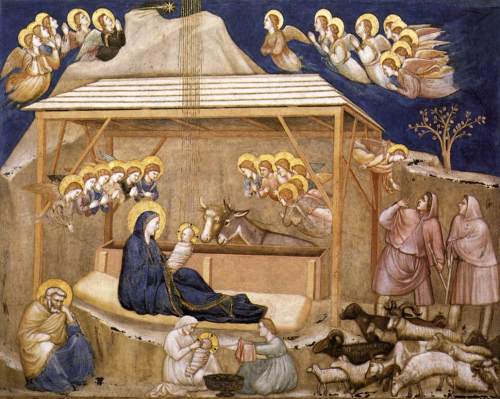
The Nativity. Giotto, c. 1320. Church of San Francesco, Assisi.

The following sermon was preached on Sunday, December 27, 2015, the first Sunday after Christmas, at the Church of St. Michael & St. George. This Sunday we reverted to the “summer” schedule of services, holding two at 8am and 10am rather than the slate of three at 8, 9:15, and 11:15. The 5:30pm service remains as usual.

Collect: Almighty God, who hast poured upon us the new light of thine incarnate Word: Grant that the same light, enkindled in our hearts, may shine forth in our lives; through the same Jesus Christ our Lord, who liveth and reigneth with thee, in the unity of the Holy Spirit, one God, now and for ever. Amen.

Readings: Isaiah 61:10-61:3; Galatians 3:23-25; 4:4-7; John 1:1-18

“In the beginning was the Word, and the Word was with God, and the Word was God.” In the Name of God, Father, Son, and Holy Spirit, Amen:

Our Gospel passage from John today is one of those several passages we get this time of year which seem to thunder out with a special resonance all their own.  You’d be hard-pressed to find a more famous passage or a more influential text than the prologue to John’s Gospel.  Beloved by philosophers and theologians, preachers and praying Christians throughout the ages, it has shaped the Church in profound ways.

For centuries, this was the so-called “Last Gospel,” read after the dismissal at the end of every mass.  It also serves as one of the chief sources for the doctrine of the Trinity, and the nature of Christ.  One of my favorite possessions is a series of commentaries on the four Gospels compiled by Thomas Aquinas in the 12th century and translated into English by John Henry Newman in the 19th: it consists of meditations on the Gospel texts by several dozen of the chief saints and doctors of the early church.  These 18 verses of the prologue to John make up slightly less than 2% of the Gospel, but so important a place did it hold in the praying lives of these ancient writers that more than 12% of their commentary is devoted to it.  This passage continues today as one of the most often-quoted summaries of Christian belief, and as one of the most inspiring of religious sentiments.  Queen Elizabeth herself quoted it in her own Christmas message this year: “The light shines in the darkness, and the darkness has not overcome it.”

For all its popularity and profundity though, this morning I only want to make two observations on this text.  First, that we’re getting it at Christmastime, and second, that we’ve gotten it twice now: once on Christmas Day, and again this morning, on the first Sunday after Christmas.  Why Christmas?  And why twice?

First of all, as I’ve often said before, here and in other contexts, Christmas can be an intensely theological, intellectual exercise, full of overlapping symbolism and densely interwoven metaphors.  The same can be said of John’s Gospel.

The Baby in the manger might very well be the answer to all our questions, the end of all our striving, the Mind of God and his eternal Word.  But there is no question he himself can answer: He cannot even speak yet!  And there is no rest he himself can offer: He cannot even sleep through the night yet.  To hear such a rarefied Gospel at Christmas is a way of reminding us that we do not come to his cradle in order to “figure him out,” or even to consider his message.  We come to Jesus’ cradle as we would come to any other cradle: to allow our affections to be warmed by the sight of a baby, and for our hearts to grow, creating a place for him in our love.  This is John’s point too: “To all who received him, who believed in his name, he gave power to become children of God.”  The cradle is the point where our striving, our figuring, stops, and our loving begins; where we ourselves are born afresh, children of this newborn baby by whom the stars were set in their courses.

But twice?  Why should we hear the same thing twice in such quick succession?  If you’ve spent any time in church at all, you will have noticed that redundancy is a fairly common occurrence.  They say preachers have only one sermon (and I’m afraid you’re getting mine yet again!).  We have two or three crosses in most processions, legion vestigial references to long-past fashions and liturgical patterns.  We bless everything multiple times in the course of a service, and we kneel, stand, sit, and cross ourselves often with seemingly inscrutable logic.

Redundancy is everywhere in the church.  But remember John’s point: Jesus’ cradle is where our striving stops and where our loving begins.  And Love is full of redundancies.

In love, how many times is too many to express affection?  How many times is too many to be patient, to be kind?  How many times is too many to forgive?  How many times is too many to act with tenderness?  Make no mistake, love is a fundamentally redundant exercise; there is nothing efficient or precise about it, there is no end product, there is no final goal, only its own fulfillment.  It is its own reward, its own product, its own end.

It sounds like a lovely thing when I put it that way, but in practice it is actually deeply unsettling.  I don’t know how many times I’ve heard couples either dating or already married say to me, that they don’t know how to recognize themselves anymore, they’re saying and doing things they never imagined themselves saying and doing.  Lots of things for good, but also lots of things that hurt each other.  The truth is that love unsettles us.

This child in the manger demanding nothing but love is a conundrum.  We may prefer the delightful poetry of love to the brass tacks of the way the world works, but at the end of the day we have to admit, it’s a relief to have metrics of efficiency and precision to fall back on, to know that we have done our duty.  Love of any sort defies those sorts of metrics.  A child does not count the number of good night kisses he receives from his parents and present them with a quarterly report.  A bride does not keep a quota of the flowers or notes she receives from her groom, to alert him when more becomes wasteful or unnecessary to her.  A widow does not track her dreams of her departed husband, or wish for them to stop, even though they cause her pain on waking.  Our favorite metrics of accomplishment and productivity do not make much sense when it comes to love.

At the cradle in Bethlehem, they fail entirely.  And that’s as it should be.  The Baby in the manger does not come to make the world a more efficient machine, more capable of producing results; at least not the kind we can analyze or sell.  He does not come to gratify our desires or to fill our appetites.  The Baby in the manger comes not to make our lives better, but to make them right; and that means that we are going to have to give up wome of our most highly cherished ways and means.  Jesus demands love, first and last, and that means that our favorite metrics will need to take a backseat to his, the chief of which is the Cross.

How willing are we to make sacrifices for the love of God?  How willing are we to make sacrifices for the people in our life?  Reputation, honor, influence, regard, possessions, even hopes and ideals; all of them are subject to the cross.  If we are tender with the Christ child at his cradle, we must be prepared to follow him to the cross.  If we are tender with each other in his name, we must be prepared to lose everything in the course of our loving, and still keep on loving all the same.

So what am I saying?  The point here is that the child who is born has come to make children of us all.  The wood of his manger leads us to the tree of his Cross; his swaddling bands lead us to his shroud in the tomb.  His life ends the death in which the world had languished long; his death brings us all eternal life.  Let us then hasten to his cradle to adore him, and, loving him in all things and above all things, find our souls refreshed and delivered, true children of God and citizens of Paradise; wounded by the same love which is our life, but in its scars beholding his glory: Glory as of the only Son from the Father, full of grace and truth.

In the Name of the Father, and the Son, and the Holy Spirit: Amen.

Advent IV

The following sermon was preached on December 20, 2015, the Fourth Sunday of Advent, at the Church of St. Michael & St. George. Lessons & Carols for Christmas took place that evening in addition to the regular 5:30 Eucharist, and the Church began preparing for Christmas.

Collect: We beseech thee, Almighty God, to purify our consciences by thy daily visitation, that when thy Son our Lord cometh he may find in us a mansion prepared for himself; through the same Jesus Christ our Lord, who liveth and reigneth with thee, in the unity of the Holy Spirit, one God, now and for ever. Amen.

Readings: Micah 5:2-5a; Hebrews 10:5-10; Luke 1:39-55

In the Name of God, Father, Son, and Holy Spirit, Amen:

Over then last few weeks, we’ve been talking a lot about preparation: preparation for Christmas.  Last week John the Baptist preached the good news of repentance to prepare for Jesus coming.  The week before, the prophets united in their witness to history itself preparing the way for Jesus.  And the first week of Advent, meditating on the Four Last Things, our own mortality, we prepared the way for considering just what kind of life the baby in the manger comes to gives us.

This week, we have a very different kind of preparation going on in our Gospel text.  Mary, pregnant with Jesus, goes to spend some time with her Aunt, who is pregnant with John the Baptist.  Together, the two of them will spend time preparing to give birth, no easy task for either of them: Elizabeth by reason of her advanced age, and Mary by reason of her youth.  It will be a challenging time for them both.  And yet from the first moment that they greet one another, their interaction is marked not by fear or uncertainty, but by overriding joy.  Listen to Elizabeth: “When Elizabeth heard the greeting, the babe leaped in her womb; and Elizabeth was filled with the Holy Spirit.”  She blesses Mary, and Mary replies by blessing God, in one of the most famous, well-loved songs of all the Scriptures: “My soul doth magnify the Lord, and my Spirit hath rejoiced in God my Savior.”  Pregnancy for Mary and Elizabeth will be a long road, full of its own unique challenges.  And yet their preparation is marked by unbridled, unalloyed joy.

What about you and me?  If we’re frank with ourselves, we’ll have to admit that sometimes our own preparations for Christmas are distinctly lacking in joy.  Why is this?  I don’t think it’s anything we need to feel guilty about, only to name and consider.  If we’re like Elizabeth, perhaps it’s because, with time’s relentless advance, it’s hard to get excited about something we’ve done or been around so frequently in the past.  Repetition can certainly lead to dryness, and the long drawing down of years can remind us of all we’ve lost: people no longer in our lives, plans foiled, hopes withered.  And not just age either, but our own personal disappointments and failures can reveal themselves in particularly stark relief at this time of year, while the sting of our own besetting sins can bite especially sharply.  All of these can stifle Christmas’ freshness, all of these can put joy far from our minds.  Add them to a noisy, frenetic holiday culture, and it’s easy to see why Elizabeth’s and Mary’s joy might seem to come just a little bit out of left field at this time of year.

Even so, Joy is absolutely the essential fourth component  of our Advent preparation.  Consider: the Four Last Things, mortality, death, and the end: merely step one in a process that leads to eternal joy.  This is a world that is passing away.  It cannot last.  While we mourn the deaths of family and friends, while we mourn our own declining skill and ability, we know that our God is eternal, he lives forever, and that his whole purpose is to join all creation to himself in unending life: as the psalmist puts it, “the singers and the dancers shall say, ‘All my fresh springs are in you.’”  Even so in God shall our own lives spring up forever in the glory of his heavenly city.  Joy is the purpose and end of our contemplating the Four Last Things.

Likewise as we consider the messages of the prophets, preparing the way for the Messiah: without exception they lived in trying times.  They proclaimed their messages in various and differing ways, but one of their common treads was that the current state of affairs was not as God intended it, and that He would correct it in a way no one anticipated.  No one anticipated the Exodus from Egypt, and yet God led his people across the Red Sea and into the Promised Land.  No one anticipated a king like David, who would unite the tribes and lead Israel into a Golden Age of peace and prosperity.  No one anticipated the exile into Babylon and the destruction of the temple as the way God would show he was serious about righteousness.  And yet in every case, the prophets had been there saying this would take place.  In every case, God used those moments to draw nearer to his people than he had ever been before, to increase their joy and show them a better way to love him.

Even so in our own day.  It’s easy to look around and wonder how we’ve gotten into this scenario, it’s easy to despair of the future.  And yet time and time again, the prophets show us that just when things look bleakest, there God is doing a new thing, drawing us closer to himself, granting us deeper joy, showing us a better way to love him.  Isaiah writes, “The people who walked in darkness have seen a great light; those who dwelt in a land of deep darkness, on them has light shined.”  Even so for us today.  Though we dwell in a land of deep darkness and every lamp go out, the promise remains true, and joy is its seal.

Likewise a third time, with the sermons of John the Baptist still ringing in our ears from last week.  “Repent, prepare the way of the Lord.”  Our sin keeps us from approaching Christmas as we ought, our failings keep us from properly being able to greet the child in the manger.  Yet joy is the purpose of repentance too: the better we know our sin, the more freely we can ask forgiveness, the more ably we can live a virtuous life.  And yet the purpose of it all is not mere fidelity to the law; the purpose is to enter without reservation into joy.  The purpose of repentance is to hear our Lord saying when we come to die, “Well done, thou good and faithful servant, enter into the joy of your master.”

Today Mary and Elizabeth show us that, more than anything else, our Advent preparation is about joy.  Joy in the eternal life of God, which Christ shares with his Father from before the foundation of the world, and into which he is preparing to admit us too.  Joy in the loving purposes of God throughout all the changes and chances of life, designed to bring us closer to him by every means necessary.  Joy in the fruit of repentance, which draws us away from our sin and into the divine fellowship for which we were created.  Far from impeding our joy, the circumstances of our lives work together with one voice to direct our way to rejoice in the coming of Christ.  Far from cutting across the grain, joy in the Christ child draws us beyond the mire of our individual pains and failings, towards the fulfillment of God’s purposes for our selves and the world.

Today Mary and Elizabeth greet each other with joy.  They bless each other and they bless God for the wondrous miracles which they carry in their wombs.  This Fourth Sunday of Advent, as Christmas approaches, let us be joyful too.  Whether it be easy or difficult, let us rejoice in the freshness of the life to which God calls us.  Let us rejoice in the beauty of his loving purposes.  Let us rejoice in the surety of his forgiveness.  So the Child in the manger will come to each of us and find in our joy a mansion prepared for himself.

In the Name of God, Father, Son, and Holy Spirit: Amen.