Between noon and three

…spare us in the youngest day when all are shaken awake, facts are facts, (and I shall know exactly what happened today between noon and three); that we too may come to the picnic with nothing to hide, join the dance as it moves in perichoresis, turns about the abiding tree. — W.H. Auden, "Compline"

Category: Uncategorized

Do not stay on your sickbed.

The following sermon was preached at S. Stephen’s Providence, at 8am and 10am on Sunday February 8, the Fifth Sunday after the Epiphany.  The mass setting was the premier of a work by Steven Serpa, sometime member of the Schola at S. Stephen’s and currently a doctoral candidate at University of Texas, Austin.  He calls it his Missa Brevis ‘Eya martyr Stephane’ after the medieval carol which provides the musical inspiration for the work.

Collect: Set us free, O God, from the bondage of our sins and give us, we beseech thee, the liberty of that abundant life which thou hast manifested to us in thy Son our Savior Jesus Christ; who liveth and reigneth with thee, in the unity of the Holy Spirit, one God, now and for ever. Amen.

Readings: Isaiah 40:21-31, 1 Corinthians 9:16-23, Mark 1:29-39

“Now Simon’s mother-in-law lay sick with a fever, and immediately they told him of her. And he came and took her by the hand and lifted he up, and the fever left her; and she began to serve them.”  In the Name of God, Father, Son, and Holy Spirit, Amen:

Today’s Gospel gives us a rare peek into the domestic life of Jesus and his first disciples.  Simon Peter had a mother-in-law who lived in the same town just a short distance from his own house.  She was sick.  Simon and his brother Andrew, obviously fond of her, tell Jesus about her illness.  He goes to her immediately and performs his second miraculous healing in the Gospel of Mark.  Mark, in his characteristic style, is breathless to tell us what happened, piling clause on clause: “and this, and that, and then this.”  The whole thing is a touching scene of familial devotion.

What is really unique, however, is what Simon’s mother-in-law does after she is healed: she gets up and serves them.  In other healing, the person healed goes home, praises God, gives thanks, tells their neighbors, talks with the priests, or decides to follow Jesus.  But in this case Simon’s mother-in-law gets up from her sick bed and serves them.  How does she serve them?  The text tells us that evening is advancing.  Maybe she serves them dinner.  Maybe she washes their feet.  We don’t know.

What is certain is that it is her own particular response.  Just as Mary’s reply to Gabriel, “Be it unto me according to thy word,” is not mere passive assent but a supreme act of personal agency; just as Mary Magdalene, washing Jesus’ feet with her tears and drying them with her hair is to her credit through every generation; so also with Simon’s mother-in-law.  Her response to her healing is to get up and serve Jesus and his disciples.  It is a free act, the first choice of her new life, free of fever and sickness.

Her actions were typical for women of the period.  Keeping a household fed and in order would have been a familiar task, and a heroic one.  But getting up from her sickbed to serve Jesus and his disciples began a new thing.  By this act she enters into a new kind of relationship with the one who healed her, and with Peter and Andrew her family.  Jesus for her is no longer just someone her kids talk about.  Her sons-in-law are no longer just fishing industry drop-outs.  She has experienced healing firsthand, and by serving she makes herself part of the household of the one who healed her.

What about you and me?  Some of the most significant moments in our lives, some of the most powerful stories we tell about ourselves, are of times when we have experienced firsthand the forgiveness of God: Divine healing and restoration in parts of our lives we had long since consigned to hell, or to Judgement Day at the very least.  Some people today even continue to experience miraculous recoveries from illness.  Wherever we are in our lives, each of us can probably identify at least one or two moments when we have known firsthand the grace of God.

The magnitude of our healing is always clearly visible by comparison with the depths to which we had sunk.  Addicts in recovery know this better than most.  Like Simon’s mother-in-law bed-ridden with fever, so we can find ourselves dead in sin, unable to achieve even the smallest good by reason of our being mired in destructive habits and misaligned priorities.  In these moments, it takes a Savior to bring us to our senses, to give us the medicine of grace, and to lead us in a better way.

When this kind of healing happens, it is cause for rejoicing, and for response.  As a priest one of my most treasured privileges is to hear, occasionally, a first confession.  The pure, unmitigated joy that a penitent shows when his or her own specific sins have been absolved is nothing short of miraculous (and contagious!).  To me it always speaks volumes that their next impulse is to amend their lives with loving enthusiasm, out of thanks to Christ who gave himself up to death that they might live.  Our forgiveness, our healing, always demands a response to our Physician.

That response, whatever it is, is always an expression of liberation from death.  It puts us in a new relationship to the one who heals us.  Maybe you remember the show, “Rescue 9-1-1” narrated by William Shatner.  It documented 9-1-1 calls, and the stories of the patients and their families with the rescue team and health workers who nursed them back to health.  In every case, Patients and Rescuers both  expressed clear affection and familial devotion for these new people in their lives, in addition to the gratitude and satisfaction we might expect.  It is the same with us and Jesus.  Our healing brings us into a new relationship with him, and with everyone else whom he has also healed.

What is this new relationship?  For Simon’s mother-in-law, it meant being incorporated into a larger household than she had at first, the household of her healer and redeemer.  But more than this, she is sometimes regarded as the first Deacon.  The Greek word which we translate as “she served them” is diakonei the same root word which describes the first seven official “Deacons” at the beginning of Acts.  Simon’s mother-in-law is the prototype of the protomartyr, Stephen, our patron here and the patron of Deacons.  Our Lord healed her from a deadly illness, and she served them; Stephen served in the Lord’s name, and died for his sake, whereupon he received the martyr’s crown of eternal life.  They are mirror images of one another.

What about us? What do we become when Jesus heals us? Each of us is inclined, by personality and by gift of the Holy Spirit, to respond in different ways.  But what is common to us all is that we are brought into closer relationship with Jesus and with all the redeemed in the body of his Church. Closer, more in touch, more deeply bound to God and to one another, more responsible for each other’s welfare and integrity.

In a special way, Simon’s mother-in-law lived the words which Jesus will preach later in the Gospel of Mark: “Whoever would be great among you must be your servant … For the Son of Man also came not to be served but to serve, and to give his life as a ransom for many.”  She makes no further appearance in the Gospels, and we are left to surmise that she lived the rest of her life in this pattern of response to the healing Word which Jesus spoke to her.  That Word formed the foundation of her life from then on.

It is the same with us.  The Word which speaks forgiveness and healing into our lives remains a constant companion our whole lives long.  At times comforting, at times unsettling, it continuously refreshes us even as it continuously calls us into a closer relationship with the One who speaks it, and with all who hear him speaking.  It does not leave us the same, but draws us ever on: to new heights of joy, to new depths of humility, to new deserts of repentance; to new gardens of higher innocence, to a new household of deeper love.

What do we take from all this?  Do not stay on your sick bed! The Word of life is spoken, the Son of God is risen from the dead.  Do not stay on your sick bed.  It is comfortable, its contours are familiar, it is a world in which we flatter ourselves to think we are sole kings and undisputed monarchs, masters of our own destiny, and deserving of all honor and indulgence. But the sickbed of sin leads only to death: to stay there is to be deaf to the Word, and to consign ourselves to silence, isolation, and the grave.

Instead, hear the Word of forgiveness and healing: “Take up your mat and walk.”  Get up from your bed, and serve the Lord who heals you.  Take hold of the new life his forgiveness brings.  See the great multitude who are now your brothers and sisters, who share in the joy of eternal life.  See them, and love them.  We are all members of the household of God, and therefore members of one another.  Let us love one another, serve one another, and so join our voices to all those everywhere who echo the Word of life: Speaking healing into the lives our neighbors, and living to the praise of his Name who makes us his own forever.

In the Name of God, Father, Son, and Holy Spirit: Amen.
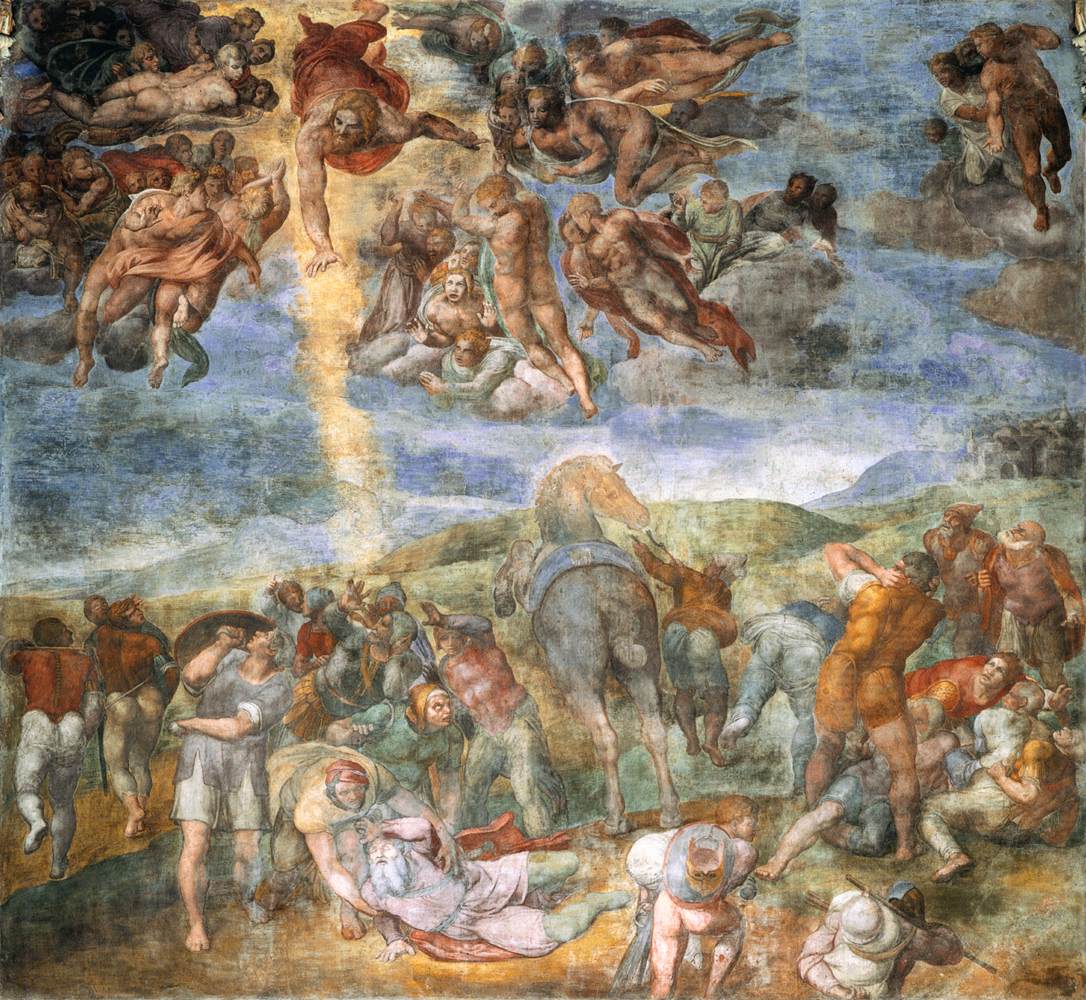
The Conversion of St. Paul

The Conversion of Paul, Michelangelo, 1545. Sistine Chapel.

The Conversion of Paul, Michelangelo, 1545. Sistine Chapel.

This Sermon was preached at 10am on Sunday, January 25, 2015, at S. Stephen’s Church, which was kept as the festal mass for the Conversion of St. Paul.  Today is also the third Sunday after the Epiphany, which propers were kept at 8am.  Music at the 10am was Herbert Howell’s Office of Holy Communion (Collegium Regale), with the Peter Philips anthem Beati estis.

Collect: O God, who by the preaching of thine apostle Paul, hast caused the light of the Gospel to shine throughout the world: Grant, we beseech thee, that we, having his wonderful conversion remembrance, may show forth our thankfulness unto thee for the same by following the holy doctrine which he taught; through Jesus Christ our Lord; who liveth and reigneth with thee, in the unity of the Holy Spirit, one God, now and for ever. Amen.

Readings: Acts 26:9-21, Galatians 1:11-24, Matthew 10:16-22

In the name of God, Father, Son, and Holy Spirit, Amen:

Today we keep the feast of the Conversion of St. Paul.  It’s a day when we have a lot to be grateful for: apart from the events of Our Lord’s own life, death, and resurrection, and the descent of the Holy Spirit at Pentecost, today’s feast probably has more significance for church history and the development of western civilization than any other event in history. Paul’s letters and missionary journeys are simply amazing, the stuff real legends are made of: shipwrecks, imprisonments, dramatic miracles and mass baptisms, church councils, even an address to the Roman Emperor himself.  He is the great missionary apostle, and he laid the foundation for the Gospel in Europe – and by extension, to us too.

But today we keep the feast of his conversion specifically. We know the story — it’s one of those few Bible stories that still seems to have purchase in an age where many struggle to remember even such pivotal characters as Moses and John the Baptist.  Paul, then called Saul, was on his way to Damascus to persecute Christians there, when all of a sudden a great light appeared to him on the road, and he fell from his horse struck blind.  A voice calls to him, and he learns it is Jesus, whom Saul is persecuting.  He continues to Damascus, but not to arrest anyone – rather to be baptized by Ananias whereupon he regains his sight, and then receives instruction in the faith for a period of several years.  The rest is history.

When we think of conversion these days, it’s easy to think of math, or of chemistry: something gets changed, from what it was before, to a different value or unit, or even to a different substance altogether.  It’s easy to think the same thing about faith, and there are plenty of televangelists and authors of so-called Christian books out there to sell you this idea, and line their own pockets in the process.  The conversion of Paul is often the poster child of this impulse: a “Damascus Road Experience” we sometimes hear people say, and even say ourselves.  But Christian conversion is not an instantaneous change into some other unit or substance.  Nothing could be further from the truth.  “I once was blind but now I see” — words by John Newton from Amazing Grace, and they are certainly true for Paul.  But neither Paul nor John Newton ceased to be Paul or John Newton.  Their sins were forgiven, and they were made members of Christ’s Body in baptism; but even if Paul had a new name, he didn’t cease to be who he was.  The same faith, the same righteousness, the same zeal which had characterized his whole life so far, remained undiminished.  And the very same faith, the very same righteousness, the very same zeal was put to use in spreading the Gospel all over the known world.

The Snake Oil Salesman seems to be a uniquely American weakness.  I’m sure it occurs everywhere around the world, but here it seems to have a special hold on us.  The Snake Oil phenomenon takes many forms, but it always boils down to getting something for nothing; taking a magic pill that fixes all your problems; changing lead into gold for nothing but the gold already in your pocket.  The Snake Oil Salesman always makes us poorer.  And yet so much of the time, we want religious conversion to be just like one of the Snake Oil Salesman’s magic bottles.  And like many people who have been bamboozled by magic ointments, we can go to great lengths to convince ourselves that it has worked.  How many stories do you hear about sudden and radical changes in someone’s life thanks to the direct intervention of God’s grace?  And how many stories do you read about influential people in that category who have been brought low by the revelation of their all-too-human weaknesses?  Reading Paul’s letters, it’s easy to see he was probably not any nicer of a person after meeting Jesus on the Damascus road than he was before.  It’s obvious that none of his personal qualities were altered in any way.  If anything, everything he was before was merely intensified, not reduced or changed into some other more palatable substance.  Why do we expect religious conversion to work any differently with ourselves?

And still we long for the possibility of being different, of being better people.  As much as Paul stayed the same person after his conversion as he was before, still it is incontrovertible that he did in fact change, in some clearly perceptible ways.  What made the difference for him?  What makes the difference for us?

Many of you know I was on retreat this last week, something I try to do annually but don’t always have the time to do.  I’m very grateful to have been given the time this year, and I’m very grateful for your prayers while I was away.  The place I go for this is a monastery called Christ in the Desert, high in the mountains of northern New Mexico.  It is a Benedictine community, following the Benedictine Rule according to “The Strict Observance.”  You may know that one of the chief hallmarks of monastic spirituality is a commitment to what they call “conversion of life.”  One of the things this means for them is that conversion is a lifelong process: not an instant transition from one category to another, but a daily decision to live for Christ over self, and to do the daily hard work of seeking him first over all.  It is a process of continual repentance, and therefore of continual humility.  They will be the first to tell you that they haven’t “arrived” yet, and nor will they until they see God face to face in heaven.  You and I have to go through a similarly long, similarly arduous process, of continually putting to death the old self, of continually admitting our faults, failings, and sins, and of continually accepting God’s grace to make us more and more like him: so that we are more and more able to recognize his will and to do it.

This is part of what makes Christian conversion different from so many Snake Oil ointments.  But what about Paul?  He actually did see Christ face to face on earth, and however disciplined and consistent he might have been, this was still a watershed moment.  What makes it a moment of conversion?

Certainly he changed his mind about Jesus, from thinking he was a false Messiah to owning him as the Incarnate Son of God. But there’s more to it than this.  On the Damascus Road, Paul has seen Jesus in glory, and now he knows the One who calls him.  For us the task is the same: to know the One who calls us.  This is conversion: not a magic pill to make us nice, or righteous, or whatever, but the opening of our eyes to see and know him who calls us out of darkness into his marvelous light. [1]  We do this by making choices to put Christ first above self, to seek him in all things, to believe his word, to accept the gifts he offers, to serve him in all the places where he himself has said he is to be found, taking responsibility for our sins and humbly asking forgiveness.  In making these choices (hard choices!) every day, year in and year out, we set ourselves about the task of conversion.  Far from becoming something we are not, it makes us more and more what we were created to be, in the image and likeness of God.

Does all this sound familiar? It might: Patience, humility, being focused on someone else, eschewing possessiveness, practicing generosity, credulousness, hopefulness; endurance to the end.  This is exactly the way Paul describes Love in the famous passage from 1 Corinthians 13, read at so many weddings and even funerals.  To work towards our conversion is to work towards knowing the One who calls us; but even more than this, it is to love him, and to dwell in his love for us, for our neighbors, and for the world.

Before the road to Damascus, Paul knew about righteousness.  He knew the Scriptures, he had great faith, and he was very zealous for the kingdom of God.  But what happened on that road, and what we celebrate today, is that he was given also to know the Love of God, and to see it face to face in our Lord Jesus Christ.  That made the difference to him, and that makes the difference to us.

“So now faith, hope, and love abide, these three, but the greatest of these is love.” [2]  At the beginning of this new year, at the beginning of a new term, let us commit ourselves to a continual conversion of life, becoming more and more proficient in the love of God.  So “our hearts shall be enlarged, and we shall run with unspeakable sweetness of love in the way of God’s commandments.” [3]  So may we finally come to our heavenly home, and behold Him face to face who is our Redeemer, Brother, and Friend.

In the Name of the Father, and of the Son, and of the Holy Spirit, Amen.

[1] 1 Peter 2:9
[2] 1 Corinthians 13:13
[3] Rule of St. Benedict, Prologue. Translated by Abbot Justin McCann, OSB, 1951.

The Baptism of Our Lord

The following sermon was preached at 8am and 10am on Sunday January 11, 2015, at S. Stephen’s Church in Providence RI.  This was the first Sunday after the Epiphany, and the propers were for the Baptism of Our Lord.  Music for the Ordinary was the Communion Service in G minor by Searle Wright, and the offertory anthem was Lauridsen’s setting of O nata lux.

Collect: Father in heaven, who at the baptism of Jesus in the River Jordan didst proclaim him thy beloved Son and anoint him with the Holy Spirit: Grant that all who are baptized into his Name may keep the covenant they have made, and boldly confess him as Lord and Savior; who with thee and the same Spirit liveth and reigneth, one God, in glory everlasting. Amen.

Readings: Genesis 1:1-5, Acts 19:1-7, Mark 1:4-11

In the Name of God, Father, Son, and Holy Spirit, Amen:

Many of you may know an old story people sometimes tell about religion.  It goes something like this:

Four blind men are in a room with an elephant, but they don’t know it’s an elephant.  Their task is to figure out what it is.  One catches hold of the trunk, and tells the others it must be a snake.  Another one has the leg, and says no it can’t be a snake, it’s a tree.  The third has the ear, and declares it must be some kind of great winged bird.  The fourth has the tail, and says the others are all wrong because clearly it’s just a bit of string.

The point of the story is usually to say that this is what the world’s various religions are about: that God is the elephant, and that each religion, like each blind man, has just a piece of the truth, and together they’ll come up with something like the whole picture.  It’s a useful story as far as it goes, and helps us to see that even radically different interpretations of the same thing have some value.  It also warns us against thinking we can figure out the whole story on our own.

But the trouble is, the way this story is usually told conveniently forgets that elephants can speak for themselves.  The moment it blows its trumpet, the game is up: the joke is on the blind men, and they know the elephant for what it is.

In the same way, our religion is a revealed religion.  We believe that God can speak for himself, and has told us who he is.  There are several ways God does this, and our Eucharistic Prayer B makes a convenient list.  First God speaks in creation, communicating a desire that there should be something rather than nothing, and that the something should be full of light and growth and order and fruitfulness.  Second, God speaks in human persons, in calling a people to be his own.  He speaks in the prophets, whom he calls to bring his people close to himself, in an ever-closer bond of intimacy and love.  Finally, though, God speaks chiefly of all by his Word made flesh, Jesus Christ, his Incarnate Son, dwelling among us to reveal his glory.  Today we celebrate his baptism at the Jordan by John the Baptist.

Through the centuries, Christians have found a number of meaningful ways to reflect on this event.  It is in marks the beginning of Our Lord’s earthly ministry, the beginning of three years of teaching and healing which will culminate in his crucifixion and resurrection.  It is also the moment when God himself enters the waters, just as Noah had ridden out the flood, and as Moses had led the people of Israel across the Red Sea on dry ground.  By this sign, Jesus recalls the old covenants and looks forward to their fulfillment.  Third, in this event  Jesus is commissioned for his work by the voice of God, and anointed by the Holy Spirit to be the prophet promised of old.  Finally Jesus’ baptism is viewed by the Church as one of only a very few moments in all of Scripture when the whole Trinity is revealed: Jesus the Incarnate Son, named by the voice of the Father in heaven, while the Spirit as a dove descends to rest upon him.

All of these images and avenues are compounded together in the Church’s prayer, and our experience of this feast is always one in which we are caught up afresh in all its interweaving patterns of grace.  Because to be honest, there is really a lot going on here, a lot being spoken; and as we all know, for better or for worse, language shapes us very deeply.

This summer, a five-year old boy was quoted in an English book review saying, “Words are food we eat with our eyes.”  It’s a brilliant insight, and may as well be extended to include eating with our ears too, and feeding one another with our pens and our mouths, and with our actions too, which we say speak louder than words, and they do.

The world is not a silent room with a mystery object in the center inviting our inquiry.  It is full of speech, full of ongoing dialogue which feeds, nourishes, and in a very real sense creates us.  What kinds of words do we consume? What kinds of words do we speak?  Internet, music, billboards, films, novels, television, radios, magazines; flyers, newspapers, videos, campaigns, education, commercials; every kind of media imaginable is constantly feeding us words, sounds, images.  Every one of them, with every action we undertake, every relationship we cultivate; all of it is some kind of language which we speak, hear, learn, and inwardly digest.

What kind of people do we become, nourished by the language we consume?  It depends on what we eat.  But somehow, all together and inexorably, all these many and various languages articulate who we are in relation to everyone and everything else: in our cities, our vocations, our families, even within our selves.

We are surrounded by language which builds up, tears down, distracts, enriches, beautifies, or terrifies.  And in every case, whether good or bad, the language we hear and the language we speak makes some kind of claim about the nature of the world and our place in it.

In the middle of this maelstrom of language and meaning, the baptism of our Lord takes on added significance.  Here is a new kind of speech (actually an old kind of speech, the oldest there is, and yet always the freshest): the speech of God, within the Trinity, pouring out into the world.  Today the Son stands in the water of creation; He is given for the world by the Father, as the Spirit descends upon him.  Everything falls silent before the Christ as he comes up out of the water.  The voice from heaven speaks, “This is my beloved Son, in whom I am well pleased.”

As we ourselves are baptized into Christ, we are baptized into his own relationship with the Father and the Spirit.  In Christ, we too become the people God speaks into the world, along with the prophets, the people of Israel, the whole Church around the world and across the ages, and all creation.

At the baptism of Christ, God himself speaks.  Our ears are opened, and we are blind no longer.  We are not in a silent room, grasping into the dark.  We see that the question is not figuring out what it is that’s out there, but rather how to join that ongoing, eternal dialogue of love from which springs the world, ourselves, and all that is.

In the baptism of Christ, we see the answer: being baptized ourselves, we become Our Lord’s brothers and sisters, sons and daughters of God.  As such, our life consists at its deepest level in continuing the speech of God: receiving its nourishment, communicating its strength and vitality, dwelling ever more richly in the eternal eternal dialogue of Father, Son, and Holy Spirit.

If this seems a hard task, it’s no wonder: it is difficult to learn a new vocabulary, difficult to learn eloquence in a new language.  It requires courage to speak where we may not be understood.  And yet this is both our task and our eternal life.  Thanks be to God he continues to feed us with the riches of his Word, with the vitality of his own Body and Blood.

In the Name of the Father, and of the Son, and of the Holy Spirit, Amen.

The Angelus

V: (+) The Angel of the Lord announced unto Mary,
R: And she conceived by the Holy Ghost.

Hail Mary, full of grace, the Lord is with thee: blessed art thou among women, and blessed is the fruit of thy womb, Jesus.
Holy Mary, Mother of God, pray for us sinners, now and at the hour of our death, Amen.

V: Behold, the handmaid of the Lord:
R: Be it unto me according to thy word.

Hail Mary…

V: And the Word was made flesh,
R: And dwelt among us.

Hail Mary…

V: Pray for us, O holy Mother of God:
R: That we may be made worthy of the promises of Christ.

Let us pray:
We beseech thee O Lord, pour thy grace into our hearts: that as we have known the Incarnation of thy Son Jesus Christ by the message of an Angel, so by his (+) cross and passion we may be brought unto the glory of his resurrection; through the same Christ our Lord, Amen.

“…Let it be to me according to your word.”

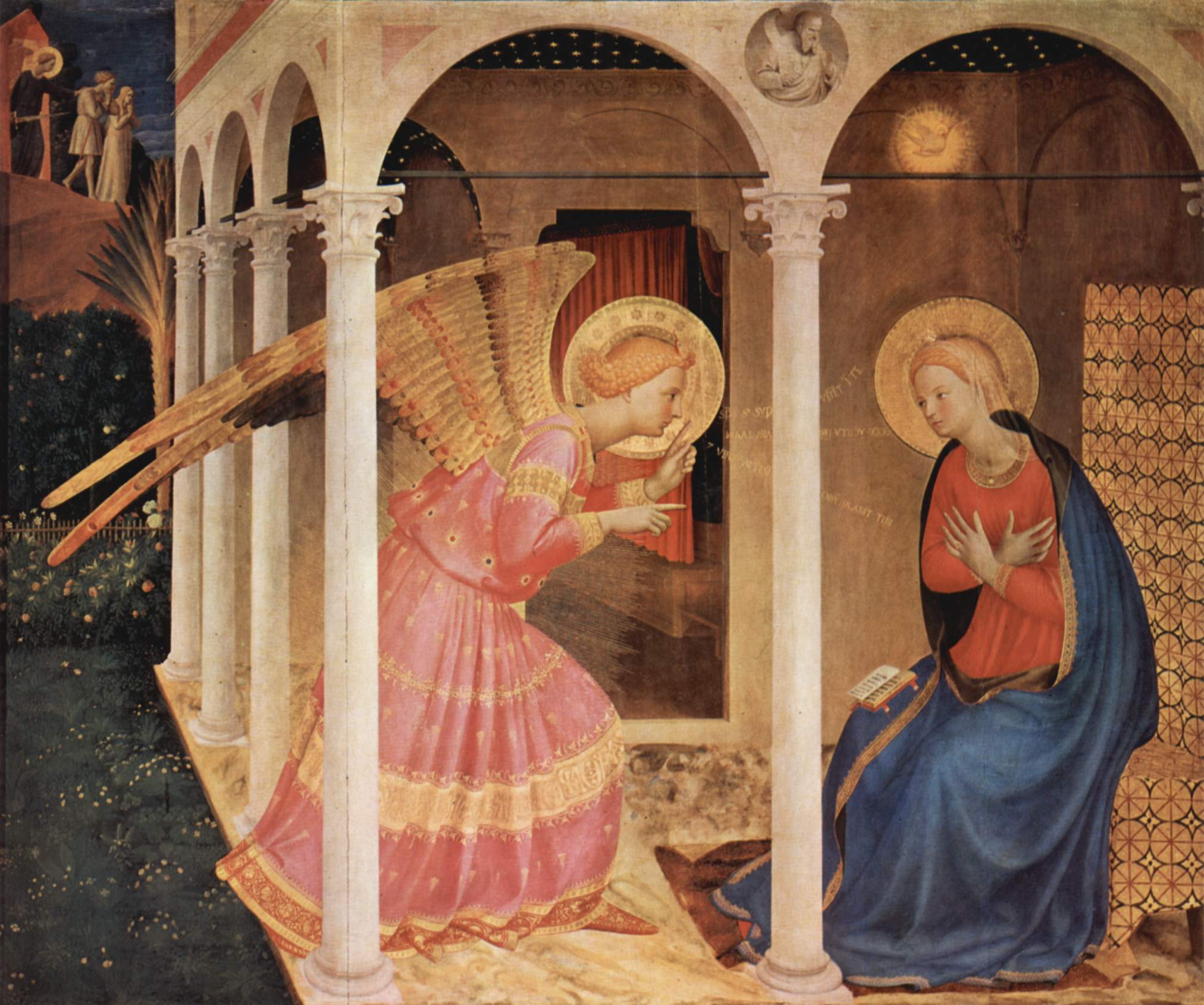
Fra Angelico, The Annunciation. 1433-4.

Fra Angelico, The Annunciation. 1433-4. San Domenico, Cortona.

This sermon was preached at the 8am and 10am masses at S. Stephen’s Church, Providence, on Sunday December 21, 2014, the fourth Sunday in Advent.  The mass setting was Duruflé’s Messe Cum Jubilo and the offertory anthem was Parsons’ Ave Maria.

Collect: We beseech thee, Almighty God, to purify our consciences by thy daily visitation, that when thy Son our Lord cometh he may find in us a mansion prepared for himself; though the same Jesus Christ our Lord, who liveth and reigneth with thee, in the unity of the Holy Spirit, one God, now and for ever. Amen.

2 Samuel 7:1-11, Romans 16:25-27, Luke 1:26-38

In the Name of God, Father, Son, and Holy Ghost, Amen.

Many of you may know that every day in the Lady Chapel here at S. Stephen’s begins with the Angelus.  If you are not familiar with this short devotion, it is simply a pattern of prayer which meditates on the miracle of the Incarnation from the perspective of Our Lady.  It consists of a series of three short responses interposed with the Hail Mary, and a final set of petitions asks God to give us some portion of the same grace which filled Mary.  Most of the text comes from the first chapter of Luke’s Gospel, which we’ve just heard chanted, along with a few bits from a few other places.  If you don’t know the full text, you can easily Google it, or look it up on Wikipedia.  If you have smart phones, you even have my permission to look it up now!

I ask all of my students to memorize the Angelus (and, for that matter, anyone else whose arm I can twist!) because I am convinced it contains in a nutshell the whole of the Christian mysteries, and the entirety of Christian prayer.  If you can’t find it on your phones, you can also find it in the chapel after mass, or just email me and I’ll send you a copy.  It’s worth memorizing, or as someone from 8:00 suggested, print it out and put it in your wallet or your purse.  Pray it throughput the day: for help, in thanksgiving, whenever it occurs to you.

The name “Angelus” comes from the first word in Latin of the first set of responses.  “The Angel of the Lord announced unto Mary, and she conceived by the Holy Ghost.”  In Church tradition, Mary is at prayer when the angel appears to her.  In art she is often depicted sitting or kneeling, with her prayer book open in front of her.  The fact that this is her posture when at the angel’s Annunciation the Holy Ghost overshadows her connects prayer with the Incarnation in a very profound way.

Every time we pray, we open ourselves to the possibility that God will overshadow us, and that we will be incorporated somehow more and more fully into the promises of God from ages past and into his ongoing plan for the redemption of the world.  Every time we pray we assume the posture of Our Lady when she became the Mother of Our Lord.  Every time we pray we are connected to the Incarnation of the Second Person of the Trinity, the Son of God, born for us and our salvation.

“The Angel of the Lord announced unto Mary:” in continuing with the Hail Mary we join in that angelic greeting.  We salute the beginning of the world’s redemption.  “And she conceived by the Holy Ghost.”  We adore the child in her womb, and we pray that his life might carry us through our own death.

If possible, Mary’s response to Gabriel is even more astounding than the Angel’s salutation: “Behold, the handmaiden of the Lord, be it into me according to thy word.”  In art it is usually clear that Our Lady is surprised to see the angel; in some pieces she even looks fearful and unsure.  And yet there is great strength in her response.  “Behold, the handmaiden of the Lord.”  She echoes Isaiah’s response to his vision of God in heaven,  “Here am I, send me.”  This is also in the same vein as Samuel, as a boy in the temple, hearing the voice of God, and replying “Speak Lord, your servant listens.”  “Behold, the handmaiden of the Lord.”  Responding in this way places Mary squarely within the prophetic tradition.  Meditating on her words helps us take hold of our own responsibility to do the will of God in the world.

But the second part of her reply is even more freighted with meaning:  “Be it unto me according to thy word.”  Be it unto me — another way of saying, ‘Let it be.’  “Let it be to me according to your word.”  This is the same verb tense and voice which God himself uses at the very beginning of Genesis to create the world: “Let there be light; let there be a firmament in the heavens; let the waters be gathered into one place, and let the dry land appear.”  “Let it be to me according to thy word.”

It’s easy to be confused about Mary’s response.  These days many people seem to see it as merely a passive, powerless assent to the frightening message of a powerful angel.  But make no mistake.  “Be it unto me according to thy word” is the supreme act of personal agency, connected as it is with God’s own creation of the world ex nihilo, from nothing.  In the beginning, the earth was barren and void.  At the Annunciation, Mary is virgin and innocent.  Her “Let it be” begins an entirely new creation, as human flesh, formerly subject to all the laws of mortality and decay, is now knit forever to God himself, in whom is life eternal, unending and unbegun.

“Behold, the handmaiden of the Lord, be it unto me according to thy word.”  To pray these words is to embark on an amazing journey through heaven and earth and back again.  It is to contemplate the mystery of our salvation, and it is to receive its promise.  We return to the Hail Mary with eyes wide in amazement at what God has wrought through Our Lady’s response.

But amazement is not enough.  The Angelus continues with a brief commentary on the Annunciation from John’s Gospel: “And the Word was made flesh, and dwelt among us.”  Our amazement at what God has wrought becomes articulated in the central doctrine of the Christian Gospel: that in Jesus, God himself has become flesh and dwells among us.  We are not left merely to wonder at the grand scope of our thoughts.  We are not allowed to think ideas about God are enough.  We are brought face to face with the reality that the Word which spoke creation into existence, which spoke through the prophets and gave hope to the Israelites in exile; the word which had promised salvation from the moment Adam and Eve first left the Garden: the Word has become flesh, a human person, Jesus Christ.  This short commentary forces us to see that at a certain point our prayer must leave the world of ideas behind and enter the way of Love: the way of sacrifice and death, repentance and forgiveness.

The Angelus returns us to the Hail Mary, and our amazement has turned to gratitude, as we bless Our Lady for her role in bringing about such a Savior.

The devotion begins to wrap everything up with a humble petition: “Pray for us, O holy mother of God, that we may be made worthy of the promises of Christ.”  Promises we have already begun to receive, which have taken root in us in our baptism, which are nourished in us by the other sacraments.  We strive our whole lives long to be worthy recipients of these gifts, much as we strive our whole lives to return faithfully the love of our family and those closest to us.  As we strive to requite the love which we have received, this petition reminds us that we do so in the company of Our Lady who continues to abide with us in the communion of the saints, all of whom pray for us.  They pray in her footsteps, and their continuing prayers for us help us to be people in whom the Incarnation of Our Lord is manifest today: as it was manifest in them in their own lifetimes, and chief of all made manifest in that manger in Bethlehem with ox and ass, straw and wood, angels and shepherds, and Our Lady at the center with her Child.

Finally the Angelus concludes with a collect in which the whole circle is completed: Annunciation and Birth to Suffering and Death, to resurrection and eternal glory.  We pray that we might be incorporated into this pattern of grace, that we might at last join the Archangel Gabriel, Our Lady, and all the saints and angels, in the eternal contemplation of Our Lord’s saving death and resurrection.

The Angelus is a short prayer: you can say the whole thing – slowly even – and be finished in a minute or less.  And yet it contains the seeds of the entire Christian mystery, and the fullness of Christian prayer.  The event which it commemorates, Gabriel’s visit to Mary, no doubt took a similarly brief period of time.  Yet in those few moments, salvation began for the whole world, a new creation dawned, and God was made flesh.

As Advent draws to a close this year, and Christmas draws near, I commend to all of you the discipline of praying the Angelus.  (If you don’t have the text, let me know and I will get it to you.)  As we pray it together, and rehearse in our spirits the saving deeds of God, may we be brought near to Bethlehem, join our Lady in prayer, and hear the Angel’s message.  May we offer ourselves as a manger for our Lord, and be made new as he is born in our hearts.

In the Name of God, Father, Son, and Holy Ghost: Amen.

Reading Scripture, Reading Life

This sermon was preached at 8am and 10am on December 7, 2014, at S. Stephen’s Church.  It is written for Advent 2, which is traditionally associated with themes of Judgement, and which more recently has focused on John the Baptist.  Both themes present an opportunity to reflect on Scripture, and about we understand God to speak within it and within the lives of those who read it faithfully.

Collect: Merciful God, who sent thy messengers the prophets to preach repentance and prepare the way for our salvation: Give us grace to heed their warnings and forsake our sins, that we may greet with joy the coming of Jesus Christ our Redeemer; who liveth and reigneth with thee and the Holy Spirit, one God, now and for ever. Amen.

Readings: Isaiah 40:1-112 Peter 3:8-15aMark 1:1-8

But, in accordance with his promise, we wait for new heavens and a new earth, where righteousness dwells.

One of the classic ways Christians have approached Scripture is to read it prayerfully, paying attention to the many layers of meaning present within it.

Traditionally, there are four such layers: the first, and the foundation of the others, is the “literal” level:  What does the text say?  Who are the main characters?  What are they doing?

The second layer is the realm of analogy and various other kinds of literary devices:  What metaphors are in play, with what kind of symbolism?  Does this verse or that verse build on foreshadowing from previous chapters or previous books?  Does it look forward to promises yet to be fulfilled?

The third layer of meaning is that of morality: How do we interpret our moral lives based on the prescriptions or illustrations from this book or that episode?  How do we articulate the kinds of things we understand God expects of us?

The final layer of meaning is often labeled the “anagogical,” or the mystical.  It is the summit of the other layers, and it is a way in which we are brought out of ourselves into closer union with God himself, through the Scriptures his Spirit inspires.

Every subsequent layer builds on what came before.  They are cumulative.  We cannot have one without the other.  In all our Bible reading, we have to begin with the first layer, with what the text says, in order to get to the others in their turn.  (Incidentally, I think a lot of trouble in the church comes from the mistake of elevating one particular layer of scriptural meaning over and above all the others.)  All of them work together as a complex whole: teaching us the purposes of God in the world, instilling in us more and more the holy fear of God, exhorting us to put away sin and be made holy, bringing us out of ourselves and setting us on a track further up and further into the mysteries of God, as we move from this world to the next.

Reading Scripture this way is not an easy project, however.  There are plenty of seeming contradictions in the text between one layer of meaning and another, between a particular passage and a similar one later on.  In those circumstances, the Church has learned a very practical solution.  We cannot simply dismiss Scripture out of hand, particularly when we place so much stock in the Holy Spirit to speak within it.  In circumstances of difficulty, contradiction, and paradox, the Church has learned not to skim over or ignore, but to sit up and take note.  From at least the time of Origen in the second century, and perhaps earlier, the Church has understood these moments as essential clues: clues that the most apparent meaning in the text is not the final one.  In places where Scripture seems not to make sense, or to contradict itself, classic Christian wisdom has seen a sure-fire clue that the Holy Spirit is drawing us further into a deeper mystery.

One of the clearest examples is John the Baptist.  At the beginning of John’s Gospel, the Pharisees ask him point-blank if he is Elijah — whom Scripture promised would come again to prepare the way for the Messiah.  John the Baptist replies — equally point-blank — that he is not Elijah.  At the beginning of Mark’s Gospel, however, which we’ve just heard chanted, all the imagery indicates that John the Baptist really is the second Elijah: living in the wilderness, preaching repentance, calling people to return to the Lord.  At another point in Mark’s Gospel, Jesus himself seems to indicate, beyond a shadow of a doubt, that John the Baptist was indeed Elijah: in chapter nine, he says that “Elijah has indeed come,” and that people treated him just as badly the second time as they did the first time.

What do we make of this?  Is John the Baptist really Elijah, or isn’t he?  This seeming contradiction points us to a third way.  Both possibilities are true, and are meant to show us that the prophetic word, the promise that God would forgive, redeem, and save his people, is not just hot air, not just so much rhetorical imagery, but that it will be fulfilled in a flesh and blood person — who is the Son of God, our Lord Jesus Christ.  The question, “Who is John the Baptist?” points us to God’s answer in Jesus, leads us towards the baptism of the Holy Spirit, and incorporates us into the mystical body of Christ, the household of God.

If all this sounds a little far-fetched, or a little too complicated, all we have to do is look at our own lives.  You and I are full of many of the same difficulties and contradictions that we see in Scripture.  We say one thing and do another.  We have ideals for our lives and hopes for our society, and our weaknesses and sins keep us from achieving either of them.  Everywhere we see good intentions for better futures; everywhere we see self-interest and human flaws contributing towards destruction and chaos instead.

We hear promises like in today’s reading from Isaiah: in which the glory of God is revealed, the rough places are smoothed, the valleys raised, God’s justice spreads abroad, and he cares for his people as a shepherd for his sheep.  We hear these promises and we look around: we do not often see evidence of God’s justice, we rarely see gentleness prevailing in anything; and the glory of God often seems drowned out by bombs and poverty and dishonesty.  How do we read our lives?  How do we read our world?

One option is to dismiss the promises of Scripture, and say they cannot be true.  Too many choose this option, and it is always sad.  Another option is to live in denial about the suffering of our world, and to throw ourselves into the glittering images of a future utopia.  Too many choose this option too, and it always misses the point.

But there is a third option, the difficult option: to see in all of our present difficulties and contradictions the working of the Holy Spirit of God, guiding us through our current thorny ways, pointing us towards a higher truth, a greater promise.  The Holy Spirit neither dismisses hope nor denies suffering, but redeems them both in the person of Jesus Christ.  Whenever we are most confused, most pressed into a corner by the tension between our faith and our world, it is a sure sign that God is near: working his higher purpose, working to draw us nearer to him, to incorporate us all the more fully into himself and his purposes for the world.

How do we take hold of the promise?  How do we find forgiveness for our sins?  Heed the teaching of John the Baptist: repent and be baptized; ask forgiveness, and be washed in the water of new life.  Above all, love him whose way John the Baptist came to prepare.  Love him in whom are met the hopes and fears of all the years (as the Christmas carol puts it).

Soon we will meet him today again at the altar, in the Sacrament of his Body and Blood.  It is the Sacrament of death and sacrifice, of resurrection and new creation.  It is the sacrament of love: his love for you and me, poured out upon the cross.  All contradictions, all paradoxes, all conflicts of meaning, come together there, in one person, Jesus Christ.  Let us love him.  So may our confusion and our dis-ease find their answer.  So may our mission be made clear.  So may we be made ready to meet him when he comes again.  So may we rejoice in his kingdom, where righteousness finally dwells.

In the Name of the Father, and of the Son, and of the Holy Spirit.

Amen.


What is your elevator pitch?

This sermon was preached at 8am and 10am on 23 November 2014 at S. Stephen’s Church, for the feast of Christ the King.  Music at the 10am solemn mass was Domenico Scarlatti’s Messa breve “La Stella”

Collect: Almighty and everlasting God, whose will it is to restore all things in thy well-beloved Son, the King of kings and Lord of lords: Mercifully grant that the peoples of the earth, divided and enslaved by sin, may be freed and brought together under his most gracious rule; who liveth and reigneth with thee and the Holy Spirit, one God, now and for ever. Amen.

Readings: Ezekiel 34:11-16, 20-24, Ephesians 1:15-23, Matthew 25:31-46

In the Name of God, Father, Son, and Holy Spirit.

Well we’re fresh from election season, and there seem to be a few more sound bites than usual.  Commercials too, with Thanksgiving and Christmas not too far off.  Most of these have the character of an “elevator pitch” — short, pithy statements, meant to communicate what you’re about in the time it takes to ride an elevator.

They’re used for more than just ads and politics.  Some of my students tell me they’re encouraged to put this kind of statement at the tops of their resumes or on cover letters.  Elevator pitches are the kinds of things we might say about ourselves when first meeting a new colleague, or when catching up with a friend we haven’t seen in a long time.  In all these instances, the “elevator pitch” is a way of presenting a narrow, highly organized slice of ourselves such that it opens onto more, and invites people further in to whatever it is we’re offering.

Today’s passage from Ephesians is an elevator pitch.  The whole thing is rendered in English as only one sentence.  Phrase piles on phrase, clause on clause, as Paul sets forth his chief points right at the beginning of the letter.  It’s as if Paul were breathless with the urgency of it all, and finishes with a grand cosmic statement of the unity of all creation, and the Kingship of Christ over all.  The rest of Ephesians is an expansion of this elevator pitch, and Paul develops these statements into a thorough argument about the nature of grace, the mission of the church, and the scale of the Gospel: encompassing every aspect of the heart, every category of human relationship, and all things in heaven and on earth.  We’ll hear an even shorter version off this elevator pitch a little later on this morning, when the choir sings the Te Deum: “Thou art the king of glory, O Christ, the everlasting Son of the Father.”

Today’s readings are appointed for the same reason we’re singing the Te Deum.  Today we keep the feast of Christ the King.  In itself, this feast is an elevator pitch, and reflects the time it was first celebrated.  You may already have read in your Kalendars, or in last week’s Parish Notes, that this feast was first declared in 1925, as a response to the growth of fascism in Europe.  It asserted the kingship of Christ over all earthly rulers, and reminded Christians that their final loyalty was to Him, and not to any authority this world might claim.

Today, Christ the King might sound somewhat less timely, old-fashioned even.  The doctrine of Christ’s kingship is sometimes offensive, especially to those who hold painful memories of ill-placed imperialism undertaken by Christians who forget that Our Lord’s kingdom does not belong to this world alone.  Similarly it can sound like far too removed a claim, that somehow, from far beyond the stars, Christ rules even over the present, which is so patently full of darkness and pain.  Just like the elevator pitches we make about ourselves, “Thou art the King of Glory, O Christ,” is a narrow statement, which others are free to accept and learn more, or to reject and have no more to do with.  For those outside the Church, and for many even inside, it can appear as a tiny keyhole, extremely difficult to see through to the other side, let alone to pass through with our minds and hearts intact.

And yet this is what we celebrate today: in Paul’s words, that God the Father, having raised Christ from the dead, “Made him sit at his right hand in the heavenly places . . . put all things under his feet, and has made him head over all things for the church, which is his body, the fullness of him who fills all in all.”  What happens when we unpack that elevator pitch?  What happens when we peer through that keyhole?  What is life like on the other side?

When by faith we manage to pass through, the whole world opens up so exponentially that, on turning around to see where we came from, our whole lives seemed the keyhole.  It was not small after all; we were, our world was.  When we are willing to own Christ enthroned in Glory, we begin to see his glory shot through the whole world.  A painting becomes a window into eternity.  A landscape becomes an icon of tenderness.  Our friends begin to reveal the face of God.  Strangers begin to look familiar, and they appear to us as Christ himself.

In the Kingdom of Christ, our joy increases, but so does our responsibility.  As every thing and every creature and every person takes on added depth of spiritual richness, reflects a greater and greater heavenly light, you and I are more and more duty-bound to love them according to the love of him who sits enthroned in glory, who gave himself up to death for us and for the whole world.  In that death there is a victory to end all victories; for Christ to have conquered death means He is king in deed and not just in word.  But it also means you and I have no excuse for allowing death to retain the upper hand in our lives and in the lives of our fellow human beings.  When our eyes our fixed on the King of Glory, we see that our task in this life is not merely to carve out a pleasant corner for ourselves, doing good where we can and suffering hardship when we must.  Rather our task is nothing less than to strive with all our hearts and all our minds and all our strength against whatever pockets of darkness remain, in our lives and in our world.

This requires that you and I pay attention and notice where we are complicit in sin, where we are culpable for preserving the power of the kingdom of death.  It requires that we name our failures, and ask for forgiveness.  It requires that we stand with confidence on the word of our King, who honors our repentance, and encourages us with the promise that his victory is ours too.

“Thou art the King of Glory, O Christ” is an elevator pitch which opens up the world: under his rule it is a far larger, far more cohesive place than it could ever be under any other ruler.  Under his rule the living and the dead are knit together in one fellowship.  Angels and all the ranks of heavenly creatures share in their company.  All the furthest reaches of the universe, and the tiniest subatomic particles are linked in harmony with one another.  The greatest achievements of art and music, the most stunning feats of courage and valor, the quietest, most gentle whispers of a mother to her child, are the common inheritance of all.  The power of sin and death have been broken, and Life is freely offered to everyone.  Wherever we go in his dominion, whatever our life’s work, whomever we find to accompany us on the way: under the Kingship of Christ, everything is seeded with glory, and we witness it at every turn.

On this feast of Christ the King, let us give thanks for such a king as this.  Let us pray that his kingdom be manifested in full, even as it is now in part.  Let us work, to strengthen the bonds of our fellowship with all the citizens of Christ’s Kingdom: that even as he fills all in all, so he may dwell in us, and we in him, to ages of ages.

In the name of the Father, and of the Son, and of the Holy Spirit, Amen.

We will remember them.

Newly mustered Brown students march through Soldier's Arch on their way to fight in World War II.  The arch is a memorial to their departed fellows from the First World War.

Newly mustered Brown students march through Soldiers Arch on their way to fight in World War II. The arch is a memorial to their departed fellows from the First World War.

+ + +

This sermon was preached at 10am on 9 November 2014 at S. Stephen’s Church.  There was a Solemn Requiem and Act of Remembrance in observance of Remembrance Sunday, the Sunday falling nearest to Armistice Day (November 11).  Music was a polyphonic setting of the plainchant Missa pro defunctis by Giovanni Francesco Anerio.  For more information on Brown during WWI, see this entry in the Encyclopedia Brunoniana.

Collect: O Almighty God, grant we beseech thee, that we, who here do honor to the memory of those who have died in the service of their country, may be so inspired by the spirit of their love and fortitude that, forgetting all selfish and unworthy motives, we may live only to thy glory, to the service of all mankind and in the interests of peace, through Jesus Christ our Lord. Amen.

Readings: Isaiah 2:1-5, Romans 8:31-39, John 15:9-17

In the Name of God, Father, Son, and Holy Spirit.

Just around the corner from here, a few steps up Thayer Street, there is a monumental stone arch.  It doesn’t cry out what its purpose is, and you might be forgiven for passing by and not noticing.  But next time you’re there, look up.  You’ll see an eagle with outspread wings surmounting a plain pediment and a classical architrave.  The archway itself is flanked by wreaths.  Just above it, two angels bear this message: “To the men of Brown who in the world war gave their lives that freedom may endure.”

Even though the United States did not formally enter the War until 1917, students and faculty began volunteering for service as early as 1915.  In 1915 and 1916, the campus raised funds to send two ambulances to France, and a number of students volunteered to go over with them.  In 1917, Brown’s ROTC was reorganized as the Student Army Training Corps, and the whole University shifted course to prepare for war.  Campus buildings were transformed into barracks and mess halls and the academic calendar was reordered to carry on through the summer, giving training in tactics and engineering to continue the fight in Europe.

By the end of the war, some nineteen hundred students, alumni, faculty, and staff had served in the armed forces, forty-one of whom gave their lives.  It’s a chilling number, but small compared to larger universities in this country and to all sorts of schools and institutions in Europe.  Oxford University’s graduating class of 1913, for example, lost 31% of its members to death in combat.  If that number seems high, remember that on the first day of the Battle of the Somme — the first day! — England alone lost more than 60,000 soldiers.  The battle would eventually claim more than one million lives.  By some estimates, the Great War involved 65 million military participants, with military deaths approaching ten million.  That’s a rate of nearly one in six.

Today is Remembrance Sunday, the Sunday falling nearest to the signing of the armistice which ended the War, on November 11, 1918.  This year marks the hundredth anniversary of the beginning of the war, and remembrance celebrations are marked with special significance.  But what is it that we remember?  And why do we do it?  The last remaining veteran of the War died in 2012.  Most of the nations involved are now allies or partners of one sort or another.  Is there any purpose left in continuing to remember?

Yes there is.  On Remembrance Day we remember first of all those who have died.  It is fitting that the Armistice occurred so close to All Souls Day, when we have the prayers of the dead already echoing in our minds, prayers which we repeat today.  They gave their lives for their countries.  Whether they were on the right side or the wrong side, whether we agree with their politics or not, they did give their lives in service to their country.  More than this, many of them gave their lives for their friends.  As many veterans remark, in foxholes, soldiers fight less for nations and more for the person crouching next to them.  In the face of such malice and destruction as war brings, memory of home and loved ones can fade.  In those moments, sometimes the only link a solider has with humanity and with the promise of goodness is his comrade in arms.  The rest of us are amazed to read stories of courage and valor in which a soldier rescues his fellows, or saves their lives by spending his own: for the sake of people whom he has known only a short while, and whom he would likely never have met otherwise.  We remember their sacrifice, and we give thanks: thanks for such clear examples as these, which echo the sacrifice Our Lord made for all of us.

We remember their sacrifice.  We remember also that it was nations that sent them to war, nations made of people just like us.  We are justly proud of their sacrifice.  But we must never forget that their blood is on the hands of those whom they were sworn to serve, just as much as it is on the hands of their enemies.  We remember them, so that as a nation we will never again allow ourselves to be dragged into carnage such as they faced.  We remember, so that we may repent, and commit ourselves anew to the work of building peace.

Sacrifice and repentance.  These are two reasons that we continue to remember, long after the last veterans are gone.  But more than their sacrifice, more even than our responsibility to build peace, we remember their names.  We remember that they were persons, like you and me: with the same fears and hopes, the same families, the same aspirations.  Why?  Why fixate on their humanity?  Because in remembering, especially remembering in prayer, we build a kind of communion with them.  We refuse to allow death and destruction to have the upper hand.  Though they felt alone and abandoned in the barbed wire fields and mustard gas, we refuse to leave them there.  We remember them.

A friend of mine once visited a war museum in Washington DC.  As he went through the rooms, he came upon a video with interviews of veterans.  One was asked how his faith played a role in his survival through the war.  He replied candidly, saying,  “It didn’t. I could not pray in that hell.”  My friend was moved by this, and went on to the next room.  There he saw a young lady clearly on a school field trip, pressed against the glass of a diorama of the trenches.  She was very quiet, and my friend noticed her hands together.  She was praying.  When she finished, my friend asked, “What are you doing?”  She replied, “That man said he could not pray in the trenches.  So I am praying here for him.”

To remember certainly means to recall information.  But more than this, there is a way in which remembering literally re-members, restores limbs which had been severed.  Today we remember all those who died outside the normal realm of human affection and society, who lost their lives in the horrible machine of war.  We remember them, and we pray for their peace, knowing that in their peace is also finally our own.

We remember their sacrifice, we remember in penitence, and we remember for the sake of knitting together the communion of the living and the dead.  There is also one more kind of remembrance we will engage in today.  As the music of the Sanctus concludes, and the celebrant carries on with the Great Thanksgiving, we will all remember the sacrifice of Our Lord’s own body and blood, made for the forgiveness of sins.  In continuing this perpetual memory, the Holy Spirit descends upon us, and we find present in our midst the Lord Jesus himself, under the signs of bread and wine.  We make our communions, and find that we are brought into communion with him, together with all the redeemed from every age.  This remembrance is the summit and culmination of all our remembering.  In this sacramental memory, we enjoy a foretaste of the coming kingdom: in which God shall be judge of all people, and we shall beat our swords into plow shares, and our spears into pruning hooks; where nation shall not lift up sword against nation, and neither shall we learn war anymore.  The foretaste of that kingdom is sweet, and we long for its final consummation.

In the meantime, let us resolve to remember: that when that day comes, we may greet it as one people, united in prayer, restored by grace, ready at last for the peace of God.

In the name of the Father, and of the Son, and of the Holy Spirit.

Amen.

What do we make of death?

A sermon for the Feast of All Souls, 3 November 2014 (transferred)

This sermon was preached at the 6pm Solemn Requiem for All Souls Day.  The mass setting was the plainchant Missa pro defunctis, with minor propers.

Collect: O God, the Maker and Redeemer of all believers; Grant to the faithful departed the unsearchable benefits of the passion of thy Son; that on the day of his appearing they may be manifested as thy children; through Jesus Christ thy Son our Lord, who liveth and reigneth with thee and the Holy Spirit, one God, now and for ever. Amen.

Readings: Wisdom 3:1-9, 1 Thessalonians 4:13-18, John 5:24-27

In the name of God, Father, Son, and Holy Ghost, Amen.

In recent decades there seems to have been a groundswell of interest in remembering the dead.  Inspired perhaps by the Vietnam war memorial, nearly every subsequent monument to war or some other tragedy includes a list of names.  Annual celebrations at the Tomb of the Unknown Soldier draw ever greater crowds.  In pop culture, the dead are decidedly in fashion: we are fixated on zombies, hauntings, and murder investigations, as any channel surfing will tell you.  In many corners of the church, remembrance of the faithful departed encroaches on All Saints’ Day, when in many parishes the celebrations for that feast include the lighting of candles, the reading of names, the giving of offerings, or some other token for remembering the departed.  Strangely, our society’s haste to remember the dead is accompanied by a parallel, almost cataclysmic drop in the offering of requiems for the departed, and in the celebration of the feast of All Souls.

There are probably lots of reasons for this, but somewhere in the mix I think there is a confusion of categories.  The feast of All Saints holds in special focus what is often called the Church Triumphant: those persons in whom the grace of God is so clearly and powerfully active that they have been brought to glory, and now contemplate “in full light God himself, triune and one, exactly as he is.”  You and I are members of the Church Militant, struggling daily against the powers of sin and darkness.  It is tempting for us to think about all who have died as having instantly received their reward, brought into the full light of God as new members of the Church Triumphant.  Part of this is out of compassion: we want the best things for our departed loved ones.  Part of this is out of self-interest: we want the best things for ourselves.  Part of this is out of fear: we are afraid of death, and of what life looks like beyond it.  Part of this is out of impatience, extending our culture of instant gratification even to the life of the world to come.  But whatever our temptations, this is not always the case.  There is a third category of the Church, by far the largest of the three: that is the Church Expectant, made up of the vast multitude of the dead who die in the Lord.  They rest from their labors on earth.  They await the final victory of the Lamb, when there will be a new heaven and a new earth, and we will all see God.

What does the Church Expectant look like?  What happens when we die?  The honest truth is that none of us knows.  Or at least not with any great specificity or expertise.  Because of our lack of knowledge, we turn to all manner of coping mechanisms.  We can be defiant about death, or live in denial that it will come for us too.  We can be afraid of it, and take refuge in living a life of few risks.  We can be angry, and lash out against our friends and neighbors when death advances too closely.  We can also glorify death, and worship it if we so choose.  All of us, sooner or later, indulge in these and other ways to cope.  Yet none of them helps us to be reconciled to the reality of death; none of them helps us to survey its contours with any greater accuracy.

What is our response?  How does the Church Militant probe the darkness of the grave?  We turn to the Liturgy, to the place where Our Lord’s own death and resurrection are made manifest in our midst.  At funerals, and especially in this solemn requiem for All Souls, we contemplate the promises of God in Scripture, and sing the canticles of the Church.  We let them mold our imaginations, and give shape to our prayers.  We are not shy about our fear of death, our anguish at the loss of loved ones.  We are explicit about our desire for their good, and our hope that our love for them, and theirs for us, will not diminish with death, but rather grow. We name them at the altar, and with their names echoing in our ears and in our hearts, we receive the Sacrament of our Lord’s Body and Blood, our foretaste on earth of triumph in heaven.

Yet even in the Liturgy there is darkness.  In his book The Spirit of the Liturgy, Pope Benedict remarks that, while incense is rightly associated with our prayers, with the Eucharistic sacrifice, and with the ongoing worship of God in heaven, it also functions in a darker way.  The cloud of incense obscures our vision.  It confuses our senses.  It reminds us that, while God comes to us in the Sacrament, we do not and cannot yet see him face to face.  It is significant that at mass we have to pass through the rood screen and into the cloud in order to make our communions; today, even more poignantly, we pass by the catafalque on the way.

What am I trying to say?  As this earthly life ebbs into another, as our senses fail and our powers of understanding weaken, as death looms large and makes its presence known in our lives and even in our worship, we are brought to a point where we can have no confidence in our own strength and courage.  All of our coping mechanisms fall short.  Even our fear subsides before the great immensity of death, and we are left with something like powerless astonishment.  When we are brought to such a point as this, we know we can do nothing of our own.  We can only lean on him who said, “Lo, I am with you always, even unto the end of the Age.”  And we have to entrust our departed loved ones to his care.

This is not to deny the hope of the resurrection, or to diminish our yearning for that Day when the trumpet shall sound and the dead shall be raised, judgement be given, and we join the angels in the eternal contemplation of the full glory of God.  But it is to say that, just as we make our communions within the cloud of incense, so does Our Lord meet us within the veil of death.  He is a trustworthy guide, and a faithful friend.  He has gone before us, and has marked the way.  He leads our departed loved ones across Death’s plains, through its valleys, and over its peaks.  He will lead us too in the way that we must go, to the place where his Father — our Father — waits above.

In the meantime, while we are still on this earth, we resolve not to run from death.  We see in it the shadowy foreboding of our own mortality, and we hear in it the distant song of the saints.  Above all we pray.  We pray for all the faithful departed.  We carry their names to the altar, we speak them in front of the earthly icon of the heavenly throne, we commend them to the care and keeping of the One who calls all of us out of darkness into his marvelous light.  In our prayer, the Spirit is living and active, binding the whole Church together: Triumphant in heaven, Expectant in death, and Militant here on earth.  In our prayer, we are strengthened for our duties in this life, and we enjoy in spirit that fellowship of unity and peace which on the Last Day we will enjoy face to face.

So let us pray, in Christ’s Name, and for his sake.  So let the living and the dead be forever united, bound together in faith, in hope, and in love.  So may we all, as one Body, come to our eternal rest in the endless splendor of our God: Father, Son, and Holy Spirit.

Amen.

“Put on your mask!”

The following is a brief “homilette” preached at the Low Mass on Halloween in the Lady Chapel at S. Stephen’s Church.  31 October, 2014.  This was preached extemporaneously, and the following is a rough transcript from what I can remember.

Halloween is a holiday when, among other things, we have a good time putting on masks. (I have a Frankenstein mask somewhere that’s decades old but still gets satisfying looks when I put it on).  But we hear in pop psychology that masks are not all that helpful – “Take off your masks,” they say, and “Be the real you.”  This is good advice, as far as it goes.  But from the Church’s perspective, the unsettling thing about masks is not that they obscure the truth, rather that they enable it to come out in a way that it might not otherwise.  There’s nothing untruthful about Halloween and our delight in the silly or even the macabre.  In a lot of ways we are in fact the costumes we wear: son, daughter, student, priest.  These are very deep identities, in addition to being roles we play.  It can all get very confusing, as all of us know.  Which costume am I wearing today?  How do I know if there’s anything really there, underneath all the layers?  In Christ, the answer is Yes, there is a costume that goes far deeper than any others we’re accustomed to wearing.  At our baptism, we are clothed with Christ himself, the visible image of the invisible God, in whose image we are made and whose own character is the truest thing about each of us.  Our whole lives long we strive to grow into that costume, till at last it becomes our wedding garment, for the great wedding supper of the Lamb in heaven.  May this face, whose brow is scarred by thorns, be always the one that we see in the mirror, and always the one that others witness upon us.  May we find in it our truest selves and our strongest love.  Amen.