Between noon and three

…spare us in the youngest day when all are shaken awake, facts are facts, (and I shall know exactly what happened today between noon and three); that we too may come to the picnic with nothing to hide, join the dance as it moves in perichoresis, turns about the abiding tree. — W.H. Auden, "Compline"

Anniversary of the Dedication, 2023

St. Mark’s in the morning sun, from the steps of the high altar.

This sermon was preached on October 8, 2023. At St. Mark’s, we keep the second Sunday of October as the Anniversary of the Dedication of the Church. Today the Eucharist is offered in thanksgiving for all departed founders, architects, builders, pastors, and benefactors of the parish, whom we name aloud at the Offertory.

Collect: Almighty God, to whose glory we celebrate the dedication of this house of prayer: We give you thanks for the fellowship of those who have worshiped in this place, and we pray that all who seek you here may find you, and be filled with your joy and peace; through Jesus Christ our Lord, who lives and reigns with you, in the unity of the Holy Spirit, one God, now and for ever. Amen.

Readings: 1 Kings 8:22-30, 1 Peter 2:1-5,9-10, Matthew 21:12-16

_______

In the Name of God, Father, Son, and Holy Spirit, Amen:

This is always one of my favorite Sundays, because it means the preacher’s task aligns with one of my favorite subjects: the actual physical building of the church. Churches in general, and St. Mark’s in particular, are full of many successive layers of symbol, intention, and experience, making them unique among the buildings of any given city, region, or country.

Like all good art, celebrating churches as physical buildings is not merely for experts and technicians, but for everyone, and especially for the people who make our home here. This building preaches as well or better than any preacher, including myself, and I hope this morning merely to help us all hear a little better the sermon this building preaches continually.

For a framework, I’m going to draw more heavily than usual on an author beyond the scriptural text. Maybe you’ve heard of the famous American architect, Ralph Adams Cram. Roughly contemporary with Frank Lloyd Wright, Cram was just as prolific a builder — principally of church buildings, but of others too: much of Princeton University is his design, and the old campus of Rice University; also St. John the Divine in New York, and other cathedrals, schools, houses, and universities across the country, including a few skyscrapers too — and all this while also serving as a professor at MIT and writing extensively about art, history, society, and church building.

In one of his major books on the subject [Church Building, 1901], Cram suggests a church — any church, whether a tiny village chapel or a great cathedral — has four major qualities essential to its integrity as a church. He orders them from the first and most important to the least, but I’ll begin the other way around, from the last to the first. All are essential, but Cram was particular about the order, in order that first principles might remain first.

Fourth in his list of essential “qualities of a church” was, in his words, “The arrangement of a building where a congregation may conveniently listen to the instruction of its spiritual leaders.” Okay, that much may be obvious, but it’s worth noting nonetheless. “The arrangement of a building where a congregation may conveniently listen to the instruction of its spiritual leaders.” Practically speaking, that means the lectern and pulpit you see before you, in St. Mark’s marvelous acoustic. And what is it that the congregation hears at St. Mark’s? A sermon, lessons from Scripture; the prayers of intercession we offer, the words of the Eucharistic prayer; also the hymns we sing and the anthems offered by the choir. The organ speaks, too, and the piano, and the harpsichord, and when we gather in this church we hear all of these individuals, texts, instruments, and the resonating building itself, speaking in harmony.

There is no single message that these all give voice to. To borrow a musical image: like the Gospel itself, St. Mark’s speaks and listens in polyphony, not in melody, and certainly not in monotone. Still, there is an underlying harmonic structure, which speaks underneath it all. And what it speaks is the ancient hymn of the thankful church, Te Deum Ladaumus, “We praise thee, O God.”

Next in Cram’s essential qualities of a church is, in his words, “The creation of spiritual emotion through the ministry of all possible beauty of environment; the using of art to lift people’s minds from secular things to spiritual, that their souls may be brought into harmony with God.” 

For Cram, listening, noting the underlying harmony of so many voices, was not enough; a church worth the name ought to evoke in each individual person, through “the ministry of all possible beauty,” their own desire, not just to enjoy the sound of harmony, but to be part of it, to be part especially of God’s harmony. Any barn, any auditorium, can be rigged so a congregation can hear readers, preachers, and musicians. But for Cram a church had to be more, had to, by its very beauty, evoke the desire to enter a larger world, to enter God’s world.

I can’t speak for anyone but myself here, but when I step into this church from off the street, I am always brought up short by the stillness of the space, by the way light from the skylight over the apse plays through the chancel; by the greens and reds and blues and golds of the creation windows bringing out the deep reds and browns of the pews and the floors; by the great chancel arch framing the space; and, though it’s still off being restored, by the dazzling kaleidoscope of the rose window ushering in the setting sun.

It’s clear to me this whole space is alive, even when it’s empty; that its heart beats to the same rhythm that drives the harmonies spoken here when it’s full. I’m sure you have your own favorite corner, or pew, or pillar, that inspires you in similar ways. I don’t think I’m alone when I say, what it evokes is not simple enjoyment, though it is that; there is a kind of deep gratitude, a peace larger than my own making that seems to well up within me, and I am drawn beyond myself into the mysterious depths the building begins to reveal.

Cram’s next essential quality of a church is, in his words again, “The providing of a place apart where may be solemnized the sublime mysteries of the Christian faith.” Now we get to the specific rites a building such as this hosts, and their purpose. 

“The providing of a place apart where may be solemnized the sublime mysteries of the Christian faith.” You can be baptized in a bathtub, and the sacrament is no less valid or true. But there is something really significant about having a place, a specific place, where not just I am baptized, but where dozens and hundreds and thousands are; in old churches, where a hundred successive generations have been incorporated into the Body of Christ.

Behold the font, at the back of the church: a beautiful object, certainly, but more than that, the place where souls are hid with Christ in God. Look at the altar, the freestanding one we use most Sundays, or the high altar we’re using today. Not just so much beautiful stone and wood, though certainly that: here is an anchor from earth to heaven, its feet in Berkeley, California, but its head on the farther shore of that great crystal sea that flows around the throne of God.

St. Mark’s is a place apart, where in the name of God we solemnize the sublime mysteries of the Christian faith, mysteries in which we locate the salvation of our souls and the renewal, the redemption, the healing of the whole world. These are the solemn pageantries we offer day by day, week by week, year by year, in which life – our own lives first of all, but also creation more broadly – is offered, lifted before the throne of God, for God to do with according to his loving purposes.

So we come to Cram’s first and foremost of the essential qualities of a church. If the other three have been familiar to us, this first may be less so; it may be the most difficult for modern, 21st century residents of the Bay Area of California to imagine. But for Cram it was so important that without it everything else falls to pieces.

And that is, in his words, first and foremost, “A church is a house of God, a place of His earthly habitation, wrought in the fashion of heavenly things, a visible type of heaven itself.” He’s echoing here the patriarch Jacob at Bethel, in the book of Genesis, who says, “How dreadful is this place! This is none other but the house of God, and this is the gate of heaven.”

There are few ideas more core to Old Testament theology than the idea that the earthly temple is a mirror of the heavenly temple; and, by extension, that earth itself is a mirror of heaven. The two are connected. Temples, shrines, places of worship — official or unofficial, large or small, grand in Jerusalem, rustic on hilltops, or miniature in homes, are God’s dwelling first, and, if mine at all, then mine second.

I said a few moments ago, that the feet of St. Mark’s altar are in Berkeley, and its head in heaven. But under this first and most important of Cram’s qualities of a church, the reverse is true: its feet are firmly rooted in heaven, and here in Berkeley we simply witness the long extent of its reach. When I walk into the empty church and am struck by the heartbeat of so many voices in harmony, the voices are mine and yours, the readers, the scriptural and musical texts, the organ; but the heartbeat is God’s. When we come to the altar and kneel at the rail, it may be Blake Sawicky wearing a chasuble and distributing Hosts. But the priest is Christ, the fare is Christ, and the occasion is Christ’s — his last supper, his sacrifice on Calvary, and his wedding banquet at the completion of all things. We are guests at that table, guests whom God welcomes into the family of his only Son; whose acts of love on the cross we repeat, heavily stylized though they may be, in the Sacrament of the Eucharist.

Yes, it’s crucially important that this church be first and foremost God’s house, before it is any of our own. Why? Well, if for no other reason, there is the purely pragmatic one — this being God’s house saves us from the traps of egotism waiting to catch us unawares in the other three qualities. Listening, evoking emotion, solemnizing our faith, all of these can quickly make our religion about us and the marvelous thoughts and experiences we’re having, if we forget that first of all, when we enter St. Mark’s we enter a place that is God’s before it is ours.

But even more importantly than that, remembering that this is God’s house first makes it clear to whose honor and glory it exists, and who it is who receives the faithful service we offer, service we offer either here in this place itself, or as a result of having been here.  This is God’s house, first and foremost, a mirror of the heavenly temple. Like creation itself, its work will not finally be complete until the mirror is burnished to such a polish, to such a clear, such a perfect reflection, that glass, silver, senses themselves pass away and we step wholly and completely into the image it reflects.

There’s an old painting I love, and I can’t remember the painter or the title, or else I’d find a print somewhere and hang it up in the narthex. It’s probably the saccharine sort of thing only a priest would love, but bear with me a moment — it shows the inside of the church, from the perspective of the very back wall, looking far forward in the misty distance towards some glorious liturgy being offered at the altar, which is bathed totally in light. We can’t really make out the specifics of what’s happening, it’s too far away, and anyway it’s much too bright. 

What we can see is a woman in the dim foreground, on her knees in the last pew, many empty ones in front of her, suffering from some unknown grief, praying and leaning against a pillar for support. She is pointed towards the altar, but she’s so absorbed in her grief it’s not clear she’s even aware of what’s happening up front. But she doesn’t have to be aware, because just behind her, radiating the same golden glory as the altar, is Jesus himself — whatever is happening up front can take care of itself, but he’s there in the back for her; he holds her steady, ministers to her as the angels must have ministered to him in Gethsemane. It’s just a painting, but it’s truer than any treatise: this is God’s house, and all who seek him here, in whatever way they can, will find succor.

So we give thanks for this church. We give thanks for the founders, architects, builders, pastors, musicians, and benefactors who have done so much to leave us such a beautiful legacy. We give thanks for the sermon this legacy continually preaches: that this is none other than the house of God, and here is the gate of heaven; that there is traffic, concourse, love between heaven and earth; and that what is created will be brought to its fulfillment in the nearer presence of its Creator. And we give thanks for all whom this mystery has touched here, whose lives now bear the unmistakable imprint of heaven.

So may St. Mark’s be the place where what we seek we find, where what we ask is granted, where the door is opened onto another shore and a greater light; where we offer the solemn pageantry of the sublime mysteries of the Christian faith; where our hearts are lifted to beat in harmony with God’s, and where every voice joins the great polyphonic hymn of angels and saints, “Holy, Holy, Holy, Lord God of hosts; heaven and earth are full of thy glory; hosanna in the highest.”

Amen.
The room where it happens

This sermon was preached on Sunday, August 6, 2023, at St. Mark’s, Berkeley, the feast of the Transfiguration.

Collect: O God, who on the holy mount revealed to chosen witnesses your well-beloved Son, wonderfully transfigured, in raiment white and glistening: Mercifully grant that we, being delivered from the disquietude of this world, may by faith behold the King in his beauty; who with you, O Father, and you, O Holy Spirit, lives and reigns, one God, for ever and ever. Amen.

Readings: Exodus 34:29-35, 2 Peter 1:13-21, Luke 9:28-36 

_______

In the Name of God, Father, Son, and Holy Spirit, Amen:

It’s a delight today to keep the Feast of the Transfiguration on a Sunday — it more often falls on a weekday, and at St. Mark’s we observe it with a low mass in the chapel. But this year we keep it with all the Sunday festivity we can manage. And there’s a lot here to keep: last year on this feast I observed that it’s a moment like in so many stories, the hero in disguise reveals himself for all to see. It’s hard to get clearer than a dazzling light and a voice from heaven. 

But this year, I want to spend a little more time considering the inverse, that here is a moment of startling clarity for the reader, for you and me — but for the disciples on the mountain with Jesus, it was an intensely disorienting experience. So much so, that the effect on them seems to be utter stupefaction, blindness, even, and they are almost completely dumbfounded — as I suppose you and I most certainly would have been too, in their shoes. 

Peter, James, and John, these seem to be Jesus’s closest friends among the twelve, and he takes them with him on a few other occasions of great importance. They’re the three who witness his raising to life of Jairus’s daughter, for instance, and they’re the ones he asks to keep awake with him in the Garden of Gethsemane the night he was betrayed. 

As a result, these three enjoyed a privileged view into Jesus’s mission and personality. They seem to have been his closest earthly friends, people who knew him better than most. So it’s striking that they are frequently so hapless, that they simply cannot see what’s happening in front of them. 

Peter, their spokesman, consistently misses the point: here at the transfiguration, he offers to build three dwellings, one for Jesus, one for Moses, and one for Elijah, but says nothing about the thundering voice they’ve just heard or the blinding light in which Jesus’s appearance is changed. We know it made an impression on him, because in today’s second Lesson, a much older Peter, much closer to death, reflects on the transfiguration, citing it as evidence for the trustworthiness of the Gospel he is preaching. But at the time, on the mountain with James and John, he misses the point. Even John, often referred to as being “eagle-eyed,” far-seeing, deeply perceptive, says nothing about it, leaving it out of his gospel entirely. 

We live in a world where we place a premium on knowing things, on knowing things and being close with people who are principal agents. If you’ve seen the musical Hamilton, you’ll remember the song where the young Hamilton wants to be “in the room where it happens.” 

Peter, James, and John are certainly in the room where it happens, but they don’t fit very easily into a world like this with expectations like ours. They have an enviable proximity to Jesus, but at the most critical moments, they’re asking the wrong questions, they’re entirely wrong-headed, or else they just fall asleep. 

I can’t blame them: the transfiguration in particular was clearly a stunning occasion, blinding in brightness; strange to see Jesus’ face changed, stranger still to see these two saints of elder days suddenly present in the flesh and chatting with Jesus, and then nothing short of terrifying to hear the voice speak in thunder from the cloud. No wonder they behave as though in a stupor. 

But still, any modern influencer worth their salt would have pushed through all that and pulled out their phone to start live-streaming, or at least to take a few photos. Why were the disciples so liable to be taken by surprise, hadn’t they learned by then to expect something remarkable? And couldn’t they muster at least a little more mental presence for the event, so the rest of us who weren’t there can benefit? 

Even so, the transfiguration is an event that the Church subsequently has drawn much benefit from. The Christian tradition has understood it over the centuries in many and various ways, chief of all as a foreshadowing of Jesus’ coming death, complete with sleepy disciples, the top of a mountain, and two figures on either side. Other writers make much of Moses and Elijah being present, as figures of Law and Prophecy. Others note that this is one of the small handful of theophanies in the Bible, when the full triune Godhead appears visibly to people on earth: Jesus the Son, the voice of the Father, and the cloud representing the Holy Spirit. 

Yet other authors make much of the topic of conversation between Jesus and Moses and Elijah. In our NRSV translation, they are speaking of Jesus’s “departure,” which he is about to make in Jerusalem. But in Luke’s Greek, it is not just any departure, nor just any death. The word is literally “exodus” — Moses and Elijah are speaking with Jesus about the exodus he is about to make in Jerusalem. And this of course tracks with long Christian tradition for Jesus’s passion, death, and resurrection to be another exodus: this time not through water only, but making a way through death itself, so that all who follow can pass safely through to their eternal promised land in the nearer presence of God. 

All this commentary is extremely interesting, and if you’re like me, you’d like the disciples to have at least something more intelligent to say on the subject than “let’s make three tents,” just as the party is breaking up. As it is, all we really have in Scripture is their stupor, which, frankly, is not very much to go on. 

But then, despite how much it sometimes appears this way, the disciples are not in fact idiots — they are in the room where it happens, and they are dear friends of the one who does most of the happening. If we find their responses disappointing, if we find it difficult to learn much of use from them, it might be a good indication that we have some self-examination to do ourselves, some uncovering about what is motivating us and what is shaping our desire to learn. Is it simply to be armed with more facts and insights, to increase our satisfaction with our own cleverness? Or is it to grow in love of him who made us, who calls us out of darkness into his own marvelous light? 

Because in truth, the disciples’ stupor teaches us at least as much about what it means to follow Jesus as any of the rest of the insights subsequent tradition has drawn from this event. And what it teaches is simply that there comes a point in following Jesus, probably more than one, where we do not know the answer; where we are in the middle of some experience that is so strong, so intense, that we cannot make sense of it. Everyone around us might have made sense of it, and they may be full of advice for what we ought to do with it. But for us in the middle of whatever it is, the larger picture is missing, and no attempts to explain it really avail. 

It’s a different kind of moment for every person. For some it may be the news that their cancer is back. For others it may the loss of a job, or the beginning of a job. Or a change of house or living or family situation, or an overwhelming weight on the conscience. For some it’s the sudden discovery of a vocation, while for others it’s the loss of vocation. Maybe it’s a long series of unanswered prayers, or a spectacularly unexpected answer to a prayer. Maybe it has to do with where you experience God; or maybe it’s an encounter with love, or grief, or stress, or an emotion that’s particularly strong for you just now. Whatever it is, it’s impossible to see the whole thing in any kind of perspective, and all you can do is lie stupefied before the immensity of the thing. 

If you know what this is like, you can have some empathy for Peter, James, and John. No amount of working around it or working through it is finally effective, because it’s the sort of thing that fundamentally stops your capacity to function, to sense, to make sense of whatever it is. 

For the disciples, being brought to this moment is not a mark of failure, but is exactly the point. If we want to learn who Jesus is, the nature of creation and our place in it; if we want to contemplate the full depth of the love of God, there will come a point when our sensory faculties, our language, our reason, our intellect, will finally no longer avail. Not because we have to turn them off in order to accept these doctrines, but because their full truth so fills and overflows our capacity to receive them that we cannot but be blinded the closer we get to them. In the stupor of Peter, James, and John, they behold the unveiled glory of God. 

I’m not suggesting that we will necessarily follow suit. But I am suggesting that being okay with our own blindness at times is no bad thing, and that in fact it is the necessary precondition to receiving all that God has to offer us. 

So if you are feeling blind at the moment, at a loss for words or explanation, don’t be in too great a hurry to figure it out, to push through, or to move on. Sit there a while, consider building a dwelling under that cloud, offer hospitality to whatever and whoever you find there. When the cloud finally rolls away, you may find that you have been transfigured: that you have encountered God without knowing it, that you have passed from death to life, that your eyes can now see in ways they couldn’t before. 

God grant that when that happens, we give thanks for the blindness that gave us sight, for the stupor that carried us through the gates of life, and for the Son whose radiance enlightens our minds and inflames our hearts. 

In the Name of God, Father, Son, and Holy Spirit: Amen.

“If these were silent, even the stones would cry out”

This sermon was preached on Palm Sunday, 2020, April 5, at St. Mark’s, Berkeley. This is the fourth Sunday of public services suspended due to Coronavirus; the recording of the service can be found on the St. Mark’s website, here. I realize I’m well behind in posting sermons, but hopefully this can serve as something of a fresh start; as time allows I’ll start filling in the (substantial!) gap.

Collect: Almighty and everliving God, in your tender love for the human race you sent your Son our Savior Jesus to take upon him our nature, and to suffer death upon the cross, giving us the example of his great humility: Mercifully grant that we may walk in the way of his suffering, and also share in his resurrection; through the same Jesus Christ our Lord, who lives and reigns with you and the Holy Spirit, one God, for ever and ever. Amen.

Readings: Isaiah 50:4-9a, Philippians 2:5-11, Matthew 26:14-27:66

_______

In the Name of God, Father, Son, and Holy Spirit, Amen:

On Palm Sunday, I always find myself a little bit uneasy: we rejoice with the crowd in the Gospel, carry palm branches, and sing Hosanna to the Son of David. And then, not more than a few minutes later, we’re all shouting “Crucify.”

I’m not the first person to note the radical shift in tone in today’s liturgy, many have already commented that we’re taking a fairly extreme emotional journey today. In some corners of the church, the journey from palms and donkeys to scourging and the cross is so stark, the celebrant and sacred ministers even change vestments in the middle.

It’s not a new comment, but I do want to spend a moment here this morning. If we’re all shouting “crucify” just now, what were we so thrilled about before? What were the Hosannas for? There’s no question the crowds in both Gospel passages are made up of largely the same people. Why the sudden shift? Is it really so easy to adulate and adore in one breath, and then to shout murder in the next? Of course it is, as anyone knows who watches professional sports, or who follows politics. Someone will say, ‘Oh that’s different, we know better now.’ But I’m not so sure. Crowds have a mind of their own, and it’s amazing what a mob will perpetrate that individuals would recoil even from contemplating.

There were people who warned Jesus: in Luke’s account of the triumphal entry, there are Pharisees in the crowd, and they seem to know what kind of trouble gets stirred up when a mob starts forming. “Teacher,” they say, “tell your disciples to stop.” And Jesus replies, “I tell you, if these were silent, even the stones would cry out.”

This year of course the crowds are silent. There are no hosannas in the streets, there is no “crucify” coming from the square; only a small few here in church, and otherwise we are scattered across the many places where you’re watching from home. This year the crowds are silent, and so the stones take up their part. What do they cry?

Stones are perhaps wiser than the rest of us mere mortals. They have long memories. This road Jesus travels, from Jericho to Jerusalem, has seen its share of pain and suffering. These stones had seen desperate refugees fleeing the city’s destruction by the Babylonian army. They had seen David escaping Jerusalem after his son Absalom usurped the throne. They had seen the arrival of Joshua’s army, and before that they had seen Abraham leading his son Isaac to sacrifice. These stones have drunk blood, and no doubt they would again. Would this crowd be the next, if Rome’s hand fell hard? Or would it be this man on a donkey?

The long scale of geologic time helps make the perspective stones offer. Buildings which to us seem solid and everlasting, stones know are anything but. Even if the builders’ art is perfect, and every stone stacked upon another endures for an age, stones remember the quarry, and before that the hill, where for countless eons the earth has moved and shifted. Imperceptible to any lifespan, the shifting earth has introduced cracks and faults by the million deep within even the firmest rock. Stones know, the strongest building is no monolith, but a perpetual trapeze act of balance and motion, no less complex, no less tenuous, for taking longer to play out. The slightest shift in the earth, just as much as the strike of a ruthless, conquering army, will cause the whole thing to collapse. The stones on Jesus’ way didn’t need the fickleness of a crowd to remind them of the fragile impermanence of their lives.

It’s not only earthquakes and conquests they’re aware of, either, but the long slow drip of the elements, too: moisture, wind, even changes in temperature, all have their effect. Any stone must know it’s only a matter of time before the elements do their work, and a rock is reduced to soil. Oh they know it will take ages, but stones must be proud that the living things around them grow, draw their sustenance, and bear fruit from the residue of their long endurance.

Are there stones in your heart? I’m sure there are in mine. Some have been there forever, some are new. Many I have collected and piled there, many have been dropped in by others. A few I have polished smooth and bright and cherished as if they were gems, and a few others are sharp enough that brushing against them scrapes and cuts. But stones they all are, heavy, burdensome, impediments at best and obstructions at worst. Can anyone build from these stones? Can they ever be worn into soil? If they topple, could they take my soul with them?

Today the streets are silent, the crowds are all in their homes, and the stones finally have their chance to cry out. What do they cry? Do they recognize the one for whom the crowds would shout Hosanna? Can they hear his voice who called them into being? Do they join the crowd, shouting as if for a conquering hero? Or do they rather cry out their premonition that a death is coming?

In a week’s time, a soldier will dig a foundation pit among these stones, a small one, for a single post. A man will come, losing his footing on the gravel, carrying a wooden cross. And here where they have dug they will nail him to it and raise it up. The stones will have their fill of blood once again. This blood falls like Abel’s so long ago, unjustly killed by a jealous brother. But where it lands it does not sear, it does not salt with death, as Abel’s did and so many others since. This blood lands like rain, watering the earth, filling it with plenteousness. And where it touches stone, it cracks: the work of a thousand ages accomplished in a single moment; the stone of the tomb, of every tomb, broken forever and its door left wide: all the dead released from their prison, and where there was barren stone, there is now a heart of flesh, bearing fruit to eternal life.

Yes this is the death these stones have been waiting for, the death that will make them the very first witnesses to the resurrection of the Son of God, before even the angels, from inside the tomb. And this year, with the streets silent, they cry out: “Behold the lamb of God, behold him who takes away the sins of the world. . . He will wipe away every tear from your eyes, and death shall be no more, neither shall there be mourning nor crying nor pain any more, for the former things have passed away.”

In silent streets, in heavy hearts, hear the stones cry out. May their cry light a flame of hope in all of us, a flame growing to a blaze, which the darkness shall not comprehend, till the Sun of Righteousness rise with healing in its wings, and darkness shall be no more.

In the Name of God, Father, Son, and Holy Spirit: Amen.

Where are you?

This sermon was preached at St. Mark’s, Berkeley, on June 10, 2018, the Third Sunday after Pentecost. This week has seen several high profile suicides on the national scene, and a number of tragic young deaths on the local scene. Mortality has been very much on our minds, which, together with this Sunday’s reading from Genesis 3, created an occasion for me to reflect on the pain of separation which often lies so close to the human experience. Those who know Bach’s St. Matthew Passion will recognize the text of one of the final recitatives, Am Abend da es kühle war, underlying a passage towards the end of this sermon. For more on the specifically religious quality of the separation between God and humanity, I suggest Matthew Myer Boulton’s book, God Against Religion.

Collect: O God, from whom all good proceeds: Grant that by your inspiration we may think those things that are right, and by your merciful guiding may do them; through Jesus Christ our Lord, who lives and reigns with you and the Holy Spirit, one God, for ever and ever. Amen.

Readings: Genesis 3:8-15, 2 Corinthians 4:13-5:1, Mark 3:20-35

In the Name of God, Father, Son, and Holy Spirit, Amen:

One of the worst phone calls I ever received was from a friend of mine, in the summer after we’d both finished college; he’d gone to New York to pursue a career in finance, and I was still getting ready to leave for my MA program starting that fall. Our group of mutual friends was aware he was having a hard time adjusting to his new life, we all were in our various ways, but no one could have foreseen the shape it would take for him. I remember vividly that desperate phone call late at night, my friend making no sense at all but clearly terrified and clearly in trouble. I couldn’t get a word in edgewise to ask for clarification; and finally, in tears, he asked plaintively, “Where are you Blake, where are you?” Before hanging up. It was bad enough my friend was in trouble, it was even worse feeling totally helpless, and unable even to understand what was wrong. We later learned it was a schizophrenic breakdown. He was hospitalized, treated, and has long since recovered. But his plaintive cry still haunts my memories of that summer — “Where are you?”

“Where are you?” One of the reasons that question cuts so close to the quick is because of what it presupposes about the other person. It presupposes that they are already such an important part of our life that we feel they must be there for our life to be recognizably our own — meaningful, safe, full of warmth and love. It presupposes their presence, permanent and reliable, a part of the furniture of our lives. Whether dear friends, husbands and wives, or especially parents and their children, “Where are you?” is a cry almost guaranteed to bring the other person running without a second thought. And when that response is prevented, either by distance or by other obstacle, we don’t just feel disappointed, we grieve. We grieve the loss – or at least the absence – of something presupposed, something reliable: a presence sustaining and life-giving, without which we no longer know what to make of our lives, let alone the world we live in.

When we usually read Genesis 3, the story of Adam and Eve and the serpent getting punished for their parts in the affair with the tree and its forbidden fruit, we most often concern ourselves with how to explain what they did wrong, how you and I continue to be implicated in their misbehavior so many countless generations later, the role of the serpent in the whole business, and what the set of curses God issues means for the subsequent history of the world and of religion as a whole.

Today though I want to start somewhere else. Genesis has been relatively light so far on giving specific details of dramatic setting. But here in chapter three, after Adam and Eve eat the fruit, suddenly it’s evening. And not just evening, but “the time of the evening breeze.” They hear the sound of God walking in the midst of the garden, and they hide themselves because they’re afraid. God says, “Where are you?” And Adam replies, “We heard you walking and I was afraid because we were naked, so we hid ourselves.”

“Where are you?” “We were afraid so we hid ourselves.” This is it, the whole tragedy in a nutshell. What’s remarkable to me is less the litany of curses and the subsequent dysfunction, and more the fact that God assumes that Adam and Eve are around in the first place, and available for conversation and fellowship. The implication seems to be, that “at the time of the evening breeze” God was accustomed to spending time with them, and they likewise. Somehow, Adam and Eve and God had enjoyed an easy, daily fellowship, a fellowship which, judging from God’s question, “Where are you?” Had grown into a communion of mutual confidence.

Forget the fruit, the pain here in Genesis 3 is that the communion between God and humanity’s first parents is broken — and broken to such a degree that Adam and Eve’s first impulse at hearing God’s approach is to be afraid, and to hide. “Where are you?” is now the defining question articulating the relationship between God and humanity. Gone are the days of easy, friendly intimacy; and by the third verse of the next chapter there have already begun the long eons of sacrifice, misunderstanding, murder, and estrangement.

The pain of separation, of estrangement, is real. There are lots of explanations for how it happens, whether we’re talking about Adam and Eve and God or the people in our own lives who were once very close but are no longer: time passes, life changes, people make different decisions, they prioritize different things, and a million other such theories. But none of them are ever satisfactory, because the simple truth is that human beings weren’t made for estrangement. We were made for communion, for an abiding fellowship of love with one another and with God. And the degree to which we are prevented or inhibited — whether by sin or injury or injustice or indifference, or the simple increase of distance or passage of time — is the degree to which we are dehumanized and the world reflects that much less of God. This is the way death crept into the world, and we have been paying the price ever since.

How do we fix it? How do we get it back? How do we restore the communion we lost, the grace from which we fell? First of all, treasure the loving relationships you have, thank God for them and let them be signs to you of what was intended at first and what will yet be fulfilled in the course of Providence. Treasure the ones you have lost as well, lost to death, time, or any of the other moths that fret away what is mortal, for the signs they were and remain of the same promise.

But second of all, and more than that, while we cannot erase or fix the terms of our estrangement, God is quietly but surely sewing back together the fragments of our shattered world. In Nazareth the Son of God joined himself to human nature, overcoming once and for all the separation between God and humanity. And while in the evening God asked Adam and Eve, “Where are you?” when he could not find them, on another evening the dove returned to Noah bearing an olive branch indicating the flood had lifted. And on still another evening, they laid Jesus in the tomb, whereupon he harrowed hell to seek and to find every lost soul and to carry them back to his Father’s home, where they shall be lost no longer forever.

Today God continues, “soul by soul and silently,” to restore the lost communion humanity was created to share: chiefly by the Sacraments of Baptism, the Eucharist, Reconciliation, and the others, in which we participate most clearly and specifically in God’s own life; but also and more frequently by the simple decision of people every day to recognize love when it is being offered, and to reciprocate the gift likewise. We can’t always recognize it, and we can’t always give what is being asked. But by God’s grace we can begin to translate across the gulfs of separation, need, and capacity to requite the love with which we are surrounded, both human and divine. This will take much of our time, and all of our patience. We will need to practice forgiveness continually, and penitence too for the injuries we will inevitably cause. We will need to turn ourselves back to God time and time again, in order to catch the vision afresh, the vision of just how beautiful creation is as it is intended to be, how deeply it resonates in our spirits and how far it reverberates throughout the world. But such is the gift of the Holy Spirit, living and active within us to accomplish what we cannot even see by ourselves alone let alone achieve.

In the meantime, we cannot settle for a world where isolation and estrangement continue to bring death and destruction to so many. It is “the way the world works,” as cynics correctly identify; but it is not the way it was intended to work, and it is not the way it will finally conclude. “Where are you?” God’s chilling and heartbreaking question to Adam and Eve is answered by the gift of Emmanuel, “God with us,” sent from heaven to earth to reach out and find you and me beyond all the barriers of sin, fear, silence, and regret we’ve thrown up in the way.

Let’s you and I continue to reach out in his Name. Don’t wait for someone else to do it. You and I are the connection required, the missing link, in order to begin right here in this place overcoming fear and shame to restore the communion we were made for. Do not settle for “the way things are,” but reach out, and let love be requited with love, to the glory of God, for the life of the world.

In the Name of God, Father, Son, and Holy Spirit: Amen.

Pentecost

This sermon was preached at St. Mark’s, Berkeley, on Pentecost, Sunday, May 20, 2018. Much of this homily was inspired by a recent re-discovery of a hymn text by Thomas a Kempis, “If there be that skills to reckon” reflecting on the glory of heaven and the character of its society. One of my favorite stanzas goes as follows: “There the gifts of each and single all in common might possess; there each member hath his portion in the Body’s blessedness; So that he, the least in merits, shares the guerdon nonetheless.”

Collect: O God, who on this day taught the hearts of your faithful people by sending to them the light of your Holy Spirit: Grant us by the same Spirit to have a right judgment in all things, and evermore to rejoice in his holy comfort; through Jesus Christ your Son our Lord, who lives and reigns with you, in the unity of the Holy Spirit, one God, for ever and ever. Amen.

Readings: Acts 2:1-21, Romans 8:22-27, John 15:26-27; 16:4b-15

In the Name of God, Father, Son, and Holy Spirit, Amen:

Well this is it. The long period of waiting is over. What had been promised is now fulfilled, we can all celebrate and carry on our ways with a little extra spring in our step, with a delight that wasn’t there before, and with some newfound inspiration to boot.

I’m talking of course about the Royal Wedding, though the same could be said about today’s holiday of Pentecost. I wasn’t able to watch yesterday’s broadcast, but as I read the various reports and reviews, one thing I’m struck by is the common refrain. Everyone — whether on Twitter or Facebook, the New York Times, Esquire, or the BBC — is remarking on how the preacher took everyone to CHURCH.

The preacher was our own presiding bishop, Michael Curry, and somehow his remarks had such an effect that the commentators have largely left aside their focus on dresses and clothes and royal lines of succession, and have started talking about love: love as a force, a power, and desperately needed in our world right now. The Telegraph is estimating that as many as two billion people watched or heard the wedding yesterday, by television, radio, or internet. And by most accounts, nearly all two billion of them are now talking about love.

What happened that so many people heard the same message? Somehow the miracle of Pentecost has occurred again in our time: all the people gathered from every corner of the world heard Peter preaching in their own native language. All the two billion people watching the wedding have heard something told them about love.

The whole thing brings to mind another royal undertaking, many thousands of years ago deep in the misty reaches of the undefined past. You may remember the story of the Tower of Babel. In order to make a name for themselves, the leaders of the people decided to build a great city with a great tower reaching all the way up to heaven. Now at that time, as the book of Genesis renders it, there was only one people on earth, and they all had the same language. To foil their hubris, God confused their language, and they could no longer understand one another. They stopped building the city with its tower, and from then on they were scattered all over the face of the earth.

It’s difficult to underestimate the sadness of this story. It’s the last chapter in the prologue to the book of Genesis; Abraham appears immediately after, and from then on Genesis concerns itself chiefly with his perspective and that of his descendants, no longer with that of all and sundry. The confusion at Babel marks the last in a set of universal curses that punish human arrogance and explain the difficult conditions under which we go about our lives in this world.

Pentecost, which the Church celebrates today, is the reversal of that curse. All of a sudden, the world’s confusion of language is ended and they can all understand Peter speaking in their own native tongue. What does he say to them? That the love of God poured out on the whole human race in Jesus of Nazareth, that love is theirs too; God’s love is for them too. Forgiveness is not only possible, but it is freely offered. Life beyond death is not only possible, but it is the new order of the day. Even more, this love which God offers goes ahead of us to encompass all the human race, represented by every conceivable language, and binds us all together.

From Pentecost on, Christians believe that deep down at the heart of things it is impossible for there to be competing peoples and nations at enmities. All are one in the Holy Spirit of God, all are given the same language of love, no longer to make a name for themselves with a tower reaching to heaven, but to find their name already given them, as they give themselves to one another.

This is the truth which Pentecost reveals: the burden of translation, the fear of being misunderstood, are transfigured into occasions where words give way to actions, where argument makes allowances for affection, and where love is finally what we long most desperately to say, offer, prove, and achieve.

In short, Pentecost reveals that our own first language is love, though in the meantime we may have forgotten how to speak it. Pentecost reveals that our own first inclination is towards the communion that love creates, though in the meantime we may have forgotten how to identify it. This is why it’s so important that the Holy Spirit arrives on Pentecost not just as a power to reveal these things, but also as a gift, as a help, for us to live into them.

I remember one year in high school our school band director had signed us all up for a competition. We were going to go to Virginia with other school bands from all over the country to play for a combined audience and to be judged. The music he had chosen was difficult, and I remember one rehearsal where by that point we should have made more progress than we had done. We were frustrated with ourselves, and I’m sure our director was too. But instead of yelling at us, he was full of encouragement. “Don’t worry,” he said, “You’ll get this. I know you can do it. I wouldn’t set you up to fail.”

I remember that phrase, “I wouldn’t set you up to fail,” because it was the first time I’d heard it. It took me a minute to understand what he meant, but it was a huge relief — that, at that moment, somebody in authority had more confidence in me than I did, had more knowledge of my own ability, had more excitement about our band’s potential for success than we could muster. And here he was doing everything he could to help us succeed.

You don’t have to be a musician — though it helps! — in order to understand or at least guess the (tongue-in-cheek) proximity between music directors and God. Which is only by way of offering, that God doesn’t set us up to fail either, and continually gives us the gifts and the resources to accomplish the work we are set; chief of all, his own self in the Holy Spirit.

On Pentecost the Holy Spirit of God shows up, not just to guide or to teach, but to be the gift, God’s own self the gift, revealing what was true all along: the love, the potential for good, the desire for common understanding and communion deep at the heart of human life; and not just revealing what is true, but healing the divisions which prevent its fulfillment, drawing us into a single Body nourished by God’s own self. That gift is the Gift of Gifts, and it remains a stupendous mystery for us to contemplate as well as a dynamic life for us to live.

No, God does not set us up to fail, but reverses all the curses with which we are afflicted, to enable love to flourish among us and within us. Let us allow that love to guide us into closer relationship with one another and with God. Let that love overcome our resistance to meet and know those who are different from us, and embolden our confidence to trust.

So may we find ourselves understanding one another in our own native language of love. So may the love of God grow within us to embrace our selves our communities, and our world.

In the Name of God, Father, Son, and Holy Spirit: Amen.

The Ascension

This sermon was preached at St. Mark’s, Berkeley, on May 13, 2018: it was the Seventh Sunday of Easter, which we kept as the Ascension (in addition to a smaller celebration on the day itself the previous Thursday).

Collect: O God, the King of glory, you have exalted your only Son Jesus Christ with great triumph to your kingdom in heaven: Do not leave us comfortless, but send us your Holy Spirit to strengthen us, and exalt us to that place where our Savior Christ has gone before; who lives and reigns with you and the Holy Spirit, one God, in glory everlasting. Amen.

Readings: Acts 1:15-17, 21-26, 1 John 5:9-13, John 17:6-19

In the Name of God, Father, Son, and Holy Spirit, Amen:

Deep in the County of Norfolk in the UK, there is a Church of England shrine in a village called Walsingham. If you want to know more about it just ask me at coffee hour and I’ll happily divulge! It’s a good and holy place, if also a little mad — as most good and holy things inevitably are.

But for the purpose of this morning, I only want to share that the Shrine church is ringed on the inside by a series of chapels, dedicated to various saints and events in Jesus’ life. One of them is dedicated to the Ascension, the feast we keep today. It’s a tiny chapel, and above the altar there is a lovely painting of Our Lady with the infant Christ. On the ceiling, however, directly over the altar, there is a gilded plaster sculpture of clouds, out of which poke two feet. Nothing is visible except two nail scars.

The suggestion is obvious: here at the altar we’ve caught a glimpse of Jesus himself in mid-whoosh on his way into heaven. It’s complete madness, but then it’s the chapel of the Ascension after all, and it does make a point! On one of my own visits there, the Shrine Administrator remarked to me that the really crazy thing is how many visitors see the chapel, and then rush upstairs to the gallery to see if the rest of Jesus is there waiting for them to say hello. They get disappointed and want to know, “Where’s the rest of him?” The Administrator has to tell them, “No, Jesus ascended into heaven, not into the balcony!”

I suppose it’s the obvious answer, Jesus has ascended into heaven and it’s useless to look for the rest of him. But is it so heartbreaking as that? Did Jesus just go away? Did he just leave his disciples to fend for themselves, while he got a one way ticket out of the mayhem and confusion? The calendar points us to Pentecost next Sunday as one answer: no, Jesus doesn’t just go away, he sends the Holy Spirit, which reveals the Church, and empowers the apostles to begin their ministry in the world, while leading them further into the knowledge and love of God.

But the Ascension does more than simply point downstream towards Pentecost. And while it is the occasion for Jesus to leave his disciples, it isn’t an escape route. When Jesus goes up to heaven, it’s Jesus who goes, body and all — resurrected and glorified, sure, but human nevertheless. The Jesus who sits at the right of God in heaven is the human Jesus, equally as much as he is the eternally begotten Son of God. And more, not just Jesus the human; but like the Ascension chapel at Walsingham points out, Jesus with scars in his feet, Jesus the wounded, Jesus the crucified and betrayed, as well as Jesus the resurrected.

In short, Jesus’ humanity goes with him into heaven, and in this way, Jesus does not escape this world in his Ascension but carries it with him. Jesus is not taken out of the world on his way to heaven; rather this world is taken with Jesus into heaven, where it is met with all the compassion, all the tenderness, all the beauty and majesty of God.

Which of course changes the way we view this world. If you and I ever find ourselves looking to heaven as the answer to our problems, then Jesus’ Ascension presents us with some very real difficulties. It is not an escape, but the occasion for a more profound encounter between God and humanity than ever before. It means, among other things, that people who feel far away from heaven whether by reason of injury, struggle, or sin, are actually the ones who are closest to God, because they are dearest to Jesus and share most profoundly in his own suffering. And it means also, that whatever transcendence the Christian religion offers, that transcendence begins here and now in the everyday muck and clutter of being human. And there is a lot of muck and clutter.

This is why the church continues to insist on its worship consisting of ordinary things: wine, bread, water, oil, words, voices. This is why the church continues to insist on sharing the peace, confessing and forgiving sins, reading the Scriptures, celebrating the same milestones and moments day after day in every successive life. Because in all of these mundane things and tasks the seeds of heaven are planted in us and among us. And not just in church either, but the small, humdrum moments of every day life, especially those moments that didn’t have to happen but did; moments where the gratuity of human interaction reveals something beautiful, something fitting about the world and our place in it. The seeds of heaven are planted there too, and begin to bear fruit.

The paradox is that the Ascension introduces us to an absolutely transcendent God, and a Savior who ascends far above all heavens but who carries the created order with him, and makes all the ordinary bits of life reflect the glory of heaven. The church’s job is to articulate and reveal just this paradox: that though Jesus has ascended far above all heavens, because of that ascension, heaven now fills all the earth. The chief marker of our mission is not primarily a concern for the faraway; not primarily a concern for abstractions of thought or doctrine or the esoterica of arcane subjects. No, the chief marker by which we know we’re on the same path as Jesus is a turning towards the ordinary, towards the things and people that are so much a part of the furniture of our lives that we’re usually tempted to ignore them or else take them for granted.

We’ll need help noticing they exist; it seems a human trait to be more conscious of our hopes and goals and even daydreams than we are of the very real people around us on whom we depend and in whom our life consists. But by recognizing them and caring for them, the Ascension of Jesus into heaven invites us to a happiness, a confidence, a fullness of life here and now, as both distinctly possible and distinctly Christian pursuits.

The ordinary and the necessary around us, even the pain and suffering, are revealed as seeds and mirrors of heaven and the scarred Savior who ascended there. This is a vision which transfigures life as we know it, while it also makes room for what cannot be seen or touched or possessed: an expanding universe, in which there is always more to uncover in the ordinary stuff of our lives, more to love in the people around us, more to forgive and more forgiveness to ask, more thanks to offer for beauties and joys no matter how small.

So on this Sunday of the Ascension, we celebrate together Jesus ascending into heaven where he takes his seat at the right hand of God. We also celebrate that what he carries with him is the whole range and matrix of our lives in this world, making them even now reflect the glory of heaven. And we pray for the grace to turn away from staring up into heaven looking for where Jesus has gone, to regarding our neighbors, the humdrum, and even the madness of our lives, with the same wonder and amazement: witnessing in them the splendor of heaven welcoming earth home.

In the Name of God, Father, Son, and Holy Spirit: Amen.

Giving Time

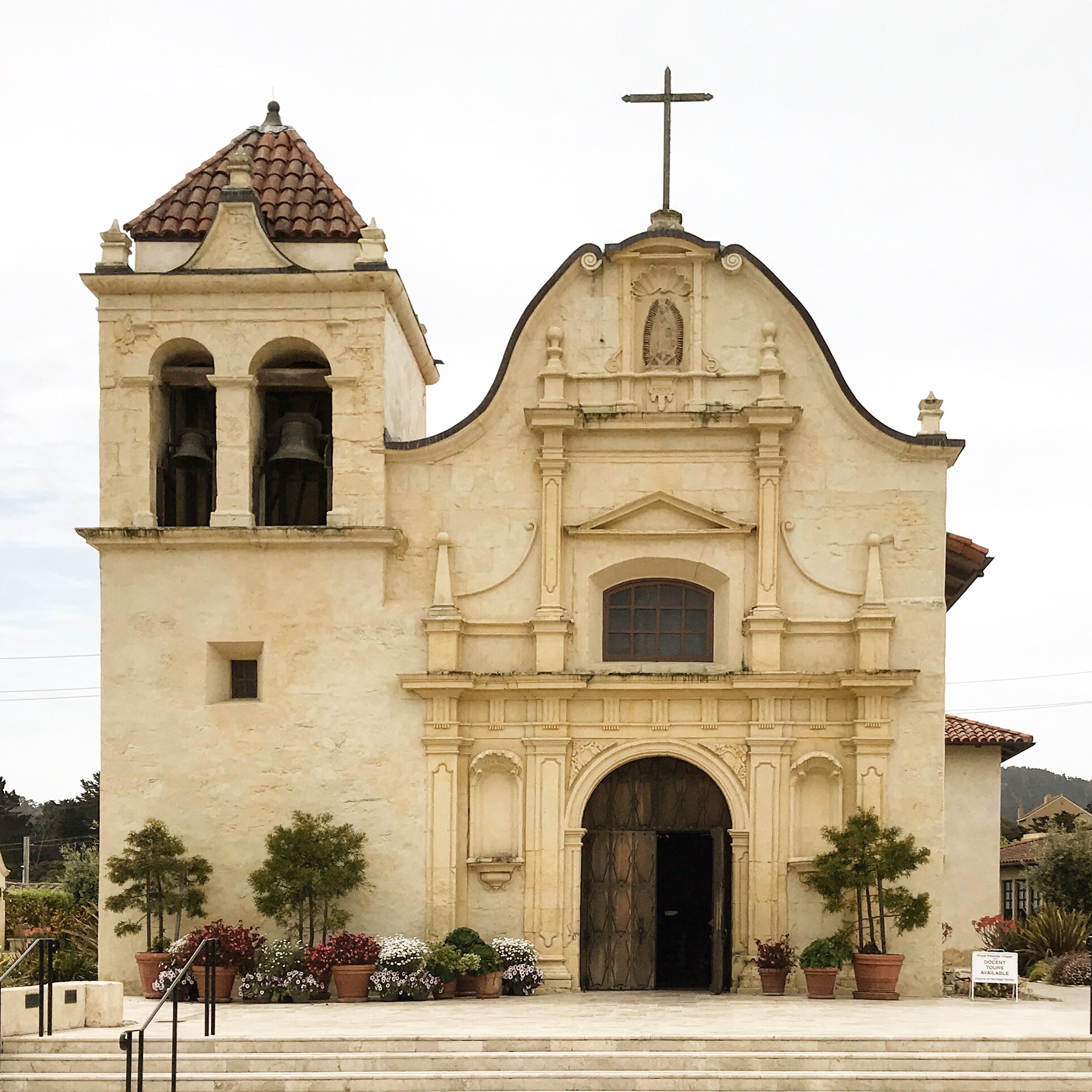
Above: One of my photos from our “field trip” to Monterey, of the presidio chapel (now cathedral) in the city’s historic center, which I discuss in the the sermon below. This Sunday was the sixth after Easter, traditionally the beginning of “Rogationtide” and now a time when the Church is especially conscious of the human vocation to tend and nurture the fruits of the earth.

Collect: O God, you have prepared for those who love you such good things as surpass our understanding: Pour into our hearts such love towards you, that we, loving you in all things and above all things, may obtain your promises, which exceed all that we can desire; through Jesus Christ our Lord, who lives and reigns with you and the Holy Spirit, one God, for ever and ever. Amen.

Readings: Acts 10:44-48, 1 John 5:1-6, John 15:9-17

In the Name of God, Father, Son, and Holy Spirit, Amen:

A friend of ours is in town this week, and on Saturday she and David and I drove down to Monterey for a brief field trip. Our first stop was the Roman Catholic Cathedral, St. Charles Borromeo, and the local history museum in the neighboring building.

You probably know better than I, that one of the things the rest of the country continually loves to criticize about California is that, “There is no history there,” meanwhile places like Boston are very proud of their Pilgrims. You also probably know better than I, that that’s hogwash. Monterey proves it — inhabited for centuries by Ohlone tribes, discovered in 1602 by the Spanish explorer Vizcaino, and finally settled in 1770, it significantly predates Washington D.C. as well as major swathes of the South, Midwest, and West. So do dozens of other sites in California including San Francisco and parts of the East Bay. There is plenty of history here, even too much history, if you ask those who have borne the brunt of it.

The cathedral we visited communicated nothing if not a continuing passage of time: its structure the long basilican form of Ancient Rome, its facade a perfect testament to classical Spanish mission, its materials the local wood and adobe hich characterize so many of the missions, while the interior decoration clearly reflects the liturgical reforms of the mid-twentieth century and the gardens our contemporary enthusiasm for succulents of all sorts. Meanwhile on the patio out front were marked the outlines of former associated buildings now gone, and inside there were cut gaps in the plaster to show off what was left of the original decoration. All the public educational signboards in town spoke of the rises and falls in the city’s fortunes over time, while the shiny modern tourist buildings of Cannery Row, built among the ruins of former sardine facilities, bear another profound witness to the continuing march of history.

And still the votive candles in the cathedral burned, every possible inch of available space taken up by these physical markers of people’s faith and prayers. Still the priest and altar guild were bustling through the sanctuary preparing for a wedding. Still a grandmother and her grandson stopped us in the aisle to say hello and make sure we felt welcome. I said to David afterwards how glad I was we started our visit to Monterey with the cathedral, and he replied by asking something to the effect, “Do you feel rooted now?” While I wouldn’t have described it that way myself, that’s exactly what it was, a feeling of being extremely moved by the whole thing: this whole orchestra of change, decay, recovery, shifting demographics, economics, politics, even liturgical priorities, and in the middle of it all, this physical testament both to the long passage of time with all its changes and to an abiding, enduring affection for the things and people and promises of God.

Why do I tell this story now this morning? Because for one thing today is Rogation Sunday, when we’re conscious afresh of our vocation to grow and to cultivate the fruits of the earth as well as the gifts we each possess as unique persons; but even more because, as our Gospel passage presents, love is both the first task and the last criteria by which we achieve our vocations. And love takes time.We’re confronted today by the need both to grow and to love, both of which simply take time.

I think a lot of times we’re tempted to think of time as a passive quality, merely the condition of our lives in which past, present, and future take shape, the long span of minutes or years which we have to endure before our tasks are complete or our lives are through. And it’s true time passes, more quickly or else more slowly than we’d like much of the time. But the candles burning in Monterey’s cathedral, or even in our own church here at St. Mark’s below the icon of Our Lady near the chapel, tell a different story. These candles are gifts of time: ours burn for six or eight hours or so, the ones they used in Monterey were larger, like the ones we use for the tabernacle, that burn for seven days. Eight hours or seven days, they are gifts of time. And they help to indicate that whatever prayer or faith we can muster in any given moment re-echoes for much longer in the presence of God.

When you work in a garden, there are certainly tasks to complete, but more than striking off a checklist of weeding or watering or pruning or whatever, you are giving the garden your time. And the result of your gift is that the garden flourishes long after you pull up the last weed or pack away the watering can to head inside.

Or if you’re a student, right now you might be in the final mad dash to finish papers and cram more facts into your head. But more than accomplishing a set of goals you are making a gift of time to the development of your self and your skills and abilities, a gift which will continue to bear fruit for years to come.

All the more so when we interact with one another. When we decide to give one another time, rather than simply spend time or guard against its being stolen or wasted, we are creating space both to be injured and to forgive, to injure and to be forgiven. When we give time, we are entering a relationship where we agree to sustain an experiment in coexistence, in cooperation, where our presence and unique personalities might exert some demands on one another, demands that may cause us to grow or develop in unexpected and maybe even painful ways — but which the gift of time ensures will not be subject to abandonment or neglect.

In short, in giving time, we are making a gift of ourselves to one another, which is why giving time is so often functionally synonymous with love. The challenge is, every new day, every new moment, is a new moment, and requires us to make a decision once again to give it away. The mystery is, that in giving it away, we find ourselves in possession of more than we thought we had in the first place.

This is also the mystery of that cathedral in Monterey, and I think of all our life of faith and love in this world. There are no things that remain the same, no monuments which can remain eternal unaffected by time, weather, or concern. There are no persons who are isolated completely from one another, no places which never change. What does remain, though, and what is finally the only thing that can, is the decision in the midst of it all to give away our time and our selves to the life we live and the people in whom it consists, across whatever days and years we find them drawing.

Let us be confident that giving it away, seemingly possessing nothing, is what roots us most firmly in the abiding love of God, is how the Holy Spirit presents us most overwhelmingly with all the riches of grace. So may our poverty be met with God’s abundance. So may our time be answered with God’s eternity. So may our gifts be multiplied in God’s love.

In the Name of God, Father, Son, and Holy Spirit: Amen.

More than the sum of our parts

The following sermon was preached at St. Mark’s, Berkeley, on April 29, 2018. It was the Fifth Sunday of Easter, but also fell on the Sunday immediately following April 25, St. Mark’s Day and our patronal feast. The day’s propers were for Easter 5, but we celebrated St. Mark in this homily, the prayers, and in the celebratory parish barbecue afterwards.

Collect: Almighty God, whom truly to know is everlasting life: Grant us so perfectly to know your Son Jesus Christ to be the way, the truth, and the life, that we may steadfastly follow his steps in the way that leads to eternal life; through Jesus Christ your Son our Lord, who lives and reigns with you, in the unity of the Holy Spirit, one God, for ever and ever. Amen.

Readings: Acts 8:26-40, 1 John 4:7-21, John 15:1-8In the Name of God, Father, Son, and Holy Spirit, Amen:

Many of you may know the story of St. Mark already, but for those who don’t, I just want to give you a few highlights. He doesn’t appear explicitly in any of the gospels, and he’s not one of the Twelve Disciples. But he was certainly among the others who followed Jesus. The Gospel that bears his name contains a tantalizing little clue: during the scene in the garden of Gethsemane, where Jesus is betrayed, there’s a weird little half verse that some scholars think reveal Mark himself. It occurs in no other Gospel, and it’s just the sort of unique clue that seems it could contain some bit of autobiographical detail: there’s a young man who runs away when Jesus is betrayed, who’s wearing only a linen cloth — his pajamas basically — and when he runs, the cloth catches on a tree and he escapes naked. A weird detail! Which makes some think, here’s Mark himself appearing in the scene. Or perhaps he wasn’t there in fact, but like the artist Michelangelo including a small self portrait in his fresco of the Last Judgement, maybe this is Mark’s way of simply assuming a little humility.

At any rate, the book of Acts and several of Paul’s epistles mention Mark, and we can piece together a little more. Somehow he ends up at Antioch, and gets sent out with Paul and Barnabas on their missionary journeys. But he and Paul have a falling out, and Barnabas takes him on alone. Eventually he and Paul reconcile, and Mark goes to Rome — where he falls in with the apostle Peter, and learns from him. Some scholars even think Mark effectively served as both muse and scribe for Peter’s remembrances of Jesus, making his Gospel as much Peter’s as Mark’s. This would partly explain why it appeals so much to an action-oriented, even hotheaded personality like Peter’s.

Peter and Paul are both martyred in Rome, but Mark escapes, and by church tradition ends up in Alexandria, where he founded the church there and became the first Patriarch of that ancient, important see. Martyrdom finally catches up with Mark in Egypt, and he faces the same death as his teachers Peter and Paul, late in his life. For centuries his remains were venerated in Alexandria, but for the last few hundred years they have resided at San Marco in Venice. You can still visit him today if you go there.

Mark is an odd saint in that in art he is depicted both as a young man, and as an old man: in icons, the Christian East often depicts him as the wise and stately, gray-headed Patriarch of Alexandria, dressed in Episcopal regalia. But the Christian West often as the young, energetic Gospel author and student of Peter, Barnabas, and Paul.

Like I said at Wednesday’s midday service, both pictures are probably true, a good reminder that in God, individuals, and the church as a whole, are always more than the sum of their parts at any given moment in time. Though he could not have known it then, the young man who ran away naked from the scene of Jesus betrayal and arrest was the great founding Patriarch of Alexandria. The wise, stately martyr was the same man who had fallen out with Paul.

The Church contains within itself both the ignominy of its many sins and the glory of its final redemption; just as this parish contains within itself both the history of good and ill as well as the seeds of all its potential in the glory of God; just as you and I bear all the inherited inclinations and temptations of our families and forebears, as well as the incalculable splendor of the full, mature image of God in which we were made and to which we are continually being drawn by the Holy Spirit.

That’s an enormous comfort, helping us to weather the challenges and pains of the present. But it’s also an enormous challenge, preventing us from ever being too satisfied, keeping us always on tiptoes striving to catch a glimpse of what’s next, dependent on forgiveness and on renewal, looking finally for the completed vision coming just up over the horizon; while in the meantime we work to be ready for when it finally appears.

Yes the church is always more than the sum of its parts at any given moment. But how? Why? Because as persons baptized into the mystical body of Christ, we live first and foremost in him — and he exists from before the foundation of the world, and unto the fulfillment of all things. His perspective is the one into which we are adopted ourselves. As we carry on in our lives in this world, his is the mercy, the love, and the joy that we strive to imitate — and in so doing, we join in our own small way in the continuing work of reconciling all persons to God and to one another, revealing the unity-in-difference which God’s love continually creates.

Jesus’ perspective is the perspective in which we too live and move and have purpose. As we celebrate today both the fifth Sunday of Easter and our own patronal feast, we come face to face again with the work we are called to do: with St. Mark himself, to grow continually more mature in the life we are given to live: to take stock of where we have been, to note where we have fallen short, and to be encouraged always by the hope that is in us: the hope of sins forgiven, of life victorious over the grave, and of the fulfillment of God-given potential.

Meanwhile, we rejoice that we are always more than the sum of our parts, that we are supported by a patron saint who was more than the sum of his parts, and that together we bear witness to a joy that is greater than we can see at any given moment, into which one day we will finally be called to step fully.

We are not alone in celebrating today. There are countless parishes, cathedrals, and institutions dedicated to St. Mark all around the world, and they all celebrate with us: from San Marco in Venice to the Egyptian Coptic Church, to South America, Indonesia, and even Siberia, all are celebrating this week. We enjoy a special kinship with them and with all who celebrate St. Mark: a saint who bears witness over a long lifetime to the possibility of growth and learning, forgiveness, hard work, wisdom, and sacrifice.

Together we celebrate St. Mark’s example and ask his prayers for us. But even more we celebrate a God who makes room for human growth and development, who calls us always further into the person, the church, the creation we were intended to be. By God’s grace and St. Mark’s help, may we do just that.

In the Name of God, Father, Son, and Holy Spirit: Amen.

The Good Shepherd

Collect: O God, whose Son Jesus is the good shepherd of your people: Grant that when we hear his voice we may know him who calls us each by name, and follow where he leads; who, with you and the Holy Spirit, lives and reigns, one God, for ever and ever. Amen.

Readings: Acts 4:5-12, 1 John 3:16-24, John 10:11-18

In the Name of God, Father, Son, and Holy Spirit, Amen:

Yesterday I was watching some of the footage of the funeral for Barbara Bush, and I was struck by one or two of the readers as they read the passages from Scripture which had been chosen for the service. It often happens at funerals that I notice this same phenomenon: the readers aren’t necessarily professionals; they aren’t trained to within an inch of their lives (as ours are here at St. Mark’s!). And yet in most cases, at funerals, they seem to get the point across — no matter how nervous they are, no matter if they happen to stumble over a word or two. Something about the task at hand causes me to be able to hear something in their words that in other circumstances I can miss.

Noticing this again in the funeral footage yesterday reminded me of a story I treasure; though I admit, in advance of telling it, that it’s probably apocryphal, and undoubtedly too warm and fuzzy for words. But I love it, so I’ll tell it anyway.

There was once a funeral for a grandmother who was much loved by her family and had many friends in the community. Her ten-year-old grandson was asked to read the Psalm, the 23rd Psalm, the one we’ve just heard ourselves. He was so nervous about the task that he’d decide to memorize it. He began trembling, “The Lord is my shepherd, I shall not want.” But he gained steam as he went on, “He maketh me to lie down in green pastures, he leadeth me beside the still waters,” and so on. When he finished reading, there wasn’t a dry eye in the whole congregation; everyone had fallen to pieces quietly weeping, while a gentle, holy quiet had settled over the church.

It just so happens there was an actor in the congregation, a friend of Grandma’s from a long time ago. He was amazed at the congregation’s response to this little boy’s reading. After the service at the reception he went up to him to offer a “Job Well Done.” But he couldn’t help himself, and went on about how dumbfounded he was: the actor said, “I must have read that Psalm a hundred different times over the years, and people never cried; they’d clap often enough, and once I got a standing ovation, but never tears, and never the silence I just experienced. How did that happen? What’s your secret?”

The little boy didn’t miss a beat and replied, “I don’t know, it sounds like you know the Psalm way better than I do, but I love my grandma, and I know the Shepherd.” The actor was duly humbled, and left him alone.

It’s a sweet story, but it makes a very good point. There is something about genuine love, both of God and of human persons, that manages to shine through despite whatever skill or professionalism we might possess or lack.

This same point was made at my own ordination to the priesthood. The Gospel reading was this same passage, Jesus the Good Shepherd. The preacher went to great lengths to communicate just how far Jesus was willing to pursue his people, and commended to us the same love as the chief task of any who were called to follow in his steps: Love the people of God, and whatever confidence or talent feels missing will be more than supplied by the Holy Spirit and the gift of grace.

But it’s an overwhelming task, both for clergy specifically and for all Christians. Love the People of God, love them to such a degree and with such a spirit that each can feel recognized and known as being of supreme worth to God and to one another, and that the life to which we are all called is one of peace and tranquility in the house of God forever.

It’s simple enough to express in the quiet of an office, obvious enough to say in the anxiety of a hospital room, and easy enough to claim in the anonymity of a newspaper or a facebook post, though such contexts have their challenges too. Much harder in the chance encounters of everyday life, and much harder still in the long, fraught relationships of family, friends, and colleagues in which our life consists: where betrayal often goes hand in hand with devotion, where we aren’t always clear about our own motivations let alone anyone else’s, and where we wind up wounding most the people we love best.

It seems that forgiveness has to go hand in hand with love, otherwise we’re all lost, stuck with high aspirations but no capacity to fulfill them, while we undermine ourselves at every turn.

This is where the Church as a whole starts to be aware of Jesus the Good Shepherd as fulfilling some basic need we all have: of clearing the way for us to return, of speaking the word of forgiveness which enables us to restore our relationships and continue moving forward. We say in the creeds, “He suffered death, he descended into hell” to seek and save the members of his flock even there. There is no place now on earth or in all creation where Jesus the Good Shepherd has not gone to find us, and that means there is no place now where we are alone, where either our own foolishness or the wickedness of others finally puts us beyond the reach of healing and restoration.

That sort of thing is fairly straightforward to say in a creed, or note down in a class; easy to affirm publicly and to celebrate: Jesus is the Church’s Good Shepherd, who lays down his life for the sheep and leads them all by name just as they hear and know his voice. What’s harder is to remember, the work of a Shepherd is personal, they go out to each lost sheep wherever it is; they can put only one lamb on their shoulders at a time, to bring them back to the fold.

What do I mean by that? Jesus the Good Shepherd comes for you and for me, and not just for sheep as a category of particularly wayward livestock. Jesus the Good Shepherd speaks your name, and mine finding us wherever it is we’ve managed to wander, whether or not we even realize we’ve wandered.

How do we recognize his voice when we hear it calling? It’s the voice of one who knows us better than we know ourselves, who leads us out of darkness into light and refreshment and peace.

But it’s never easy, and it’s always humbling. Being taken out of the brambles means having to notice the brambles in the first place, and more often than not admitting to the Shepherd that somehow I managed to get myself caught there. It means having to acknowledge, I was not on the right path after all, and despite how sure I was it only led me further away from everyone and everything I loved.

This is a vulnerable moment, and despite what we say and affirm publicly in the creeds or otherwise, it’s a scary one. What if I am punished or received harshly? What if I have to give up what I have dearly bought?

These kinds of fears, more than anything else, keep us from hearing the Good Shepherd’s voice, or if we do hear, keep us from responding. Because, too often, we simply do not place enough confidence in the mercy of God. We find it difficult to trust that being made vulnerable will be met with kindness and compassion. But while there may be consequences — the brambles may tear as we are lifted out of them — we will be free, and more than that we will be touched by a mercy that does not keep score or hold grudges, that meets us with knowing, and with love, reliably, every time.

Don’t get too distracted focusing on the brambles, and what they are or how to avoid them; there are enough of them to drive us mad if we let them. Instead just listen for the voice of Shepherd, listen for the voice who knows you better than you know yourself. Trust the kindly leading that wends through the valley of the shadow of death to the green pastures and quiet waters, to the table of God set with the overflowing chalice of his mercy.

The Good Shepherd is your shepherd as much as mine, yours individually as much as that of the church as a whole. Listen for his voice, and let him lead you into life.

In the Name of God, Father, Son, and Holy Spirit: Amen.

Peace which passes understanding

Collect: O God, whose blessed Son made himself known to his disciples in the breaking of bread: Open the eyes of our faith, that we may behold him in all his redeeming work; who lives and reigns with you, in the unity of the Holy Spirit, one God, now and for ever. Amen.

Readings: Acts 3:12-19, 1 John 3:1-7, Luke 24:36-48

In the Name of God, Father, Son, and Holy Spirit, Amen:

“Peace be with you.” Jesus’ first greeting to the disciples after his resurrection is the same greeting we’ll share with one another in a few moments. But for many, it’s one of the most painful ironies and even shortfalls of the Christian faith. How can peace be so closely associated with the central mysteries of our faith, when the world we live in is anything but peaceful? When our own lives are anything but peaceful?

I’ve been enjoying these “Coffee & Conversation” gatherings very much, but one of the more challenging themes that’s come up is how difficult it is to own our Christian identities in public spaces. Part of the reason for that is the way other Christians — and if we’re honest we ourselves — have sometimes pursued peace at the cost of global and personal well being. And part of the reason for that is that a lot of us just aren’t sure we’re very good Christians in the first place. Our lives are full of chaos and confusion, competing loyalties, and feelings in tensions with one another. We do not feel the peace that Christ gives, and we do not hear it in the Christian voices which dominate the public square.

A woman came up to me recently who said, “You know I only really felt peace once. I don’t understand why it was then and not otherwise, my life was in shambles at the time and I was making a mess of things: my marriage was on the line, along with my job and my relationships with my relatives. One Sunday I was in church singing some random hymn, a little distracted because I was going over it all in my head again for the umpteenth time. And then suddenly I felt this peace arrive, so profoundly and so unmistakably present that it was almost tangible. I stopped my anxious catalogue and I spent the rest of the hymn transfixed; somehow I knew I was going to be okay, that I was being held in a way I didn’t know possible. I’ve never felt that way before or since but it’s a moment I return to sometimes when I’m feeling down. Why can’t there be more of that kind of peace in the world? And why did it happen when my life was such a mess?”

The only thing I could think of to say was that perhaps she needed it just then. God knows we need the peace Jesus gives all the time, but more than ever when we’re in trouble. Still that kind of profound feeling is a gift, an exception, not the rule. What is this peace that passes understanding, if it appears so rarely in a person’s life? And what is it worth if it makes Christians so reluctant to own the faith which promises such peace?

Part of the problem I think comes from misunderstanding the very beginning, this moment in Luke’s Gospel when Jesus says, peace be with you. Yes he gives them his peace, but it’s more than a comfort blanket or a placebo. Remember, it might only have been Judas who betrayed him, and Peter alone who denied him, but they all forsook him and fled when he was taken away in the Garden. When Jesus says, peace be with you, it’s a moment of forgiveness, of reconciliation, when the deeds and events which broke their fellowship are forgiven and their unity restored. Jesus’ gift, “Peace be with you” is fundamentally a moment of reconciliation. We who wish we had more of that peace ourselves could do worse than to set about reconciling with one other, forgiving both the great wrongs and little slights we’ve suffered, without expecting anything in return.

But there’s also an element of humor here, or at least I think so. “Peace be with you.” Jesus is risen from the dead, and he takes his disciples by surprise where they’re gathered in a locked upper room. “Peace be with you,” he says. It’s sort of formal and a little stilted, but then what else is he supposed to say? Imagine Jesus making his way from the tomb to the upper room, trying to figure out just what he’s going to say to these people, like the hapless bachelor practicing his charm in front of the mirror in a romantic comedy. “Peace be with you.” It’s a variation on the angelic greeting, “Fear Not,” Because the strangeness of the scenario would be too much for them to bear otherwise. He even escalates the whole scenario by insisting he eat with them right then and there, just to prove he’s not a ghost.

There’s humor here, no mistaking it. And the humor breaks the power of the intense seriousness which had prevailed among them from the moment of his arrest through the ensuing days. It puts them at ease, and they can be themselves again, together. On top of forgiving them, Jesus’ peace and particularly his humor restores them to themselves, breaking the power of anxiety and calling them to participate in the joy of his resurrected life.

As anyone who has struggled with depression can tell you, there can be something marvelous and healing about just being part of a group where everyone is laughing and having a good time, sharing old memories and making new ones; something restorative about simply feeling a part of things, a part of life again, with people who understand you and can tease you good-naturedly. The humor of Jesus’ peace accomplishes this for his disciples.

But this element of humor is more than simple lightheartedness. It reveals a deeper confidence about the world and all the crazy going on outside. For the resurrected Jesus and his disciples to laugh together despite all the challenges they face and the systemic injustice of the world they live in, injustice which condemned Jesus to death among other things, is to suggest that their confidence goes deeper than all the crazy surrounding them.

Jesus has come through death itself, and none of its minions no matter how great can have any power over him any longer, and no power over those with whom he shares his peace. They laugh and rejoice, and all the crazy is revealed to be powerless.

But what about the crazy that still besets us, and the sabotage and subterfuge that Christians continue to work against one another? What about the complete apathy and downright antipathy the rest of the world shows to people of faith? What about the mother who just watched her daughter, a twenty-year-old university athlete, fall twenty feet from the climbing wall to break both legs and now face the possibility she’ll never walk again? What is Jesus’ peace in the face of all this?

We tend to think of it as a fragile thing, small and easily broken; this is partly why we receive it as such a precious gift. But the Peace of Christ is not a small thing subtly given and easily lost. It is not a fragile vase for us to dust and polish, keep safe in a cabinet and protect from thieves. It is stronger than the pillars of the earth, and larger, more spacious than the whole created order. The Peace of Christ is that love in which we live and move and have our being, which has swallowed up death and hell and destroyed them forever. That peace continues to break into our world today like it did that first Easter Day in the Upper Room, making windows onto that larger reality which contains us more than we contain it; which keeps us more than we can keep it; that larger peace which holds us and sustains us in every uncertainty and injury, and is not threatened or diminished by them.

From now on, wherever we find death and hell we can be sure that peace is nearby: above, below, and all around. Christ’s Peace is large enough for us and all our misery, gentle enough to be kind with our confusion and fear long-suffering enough to bear all our anger and resentment and scorn. We have only to be still, to look up, to be aware that this peace is everywhere, and all that’s left for us is to notice, and to bear witness.

Nothing will make it easier for us to be faithful in the midst of challenge and pain. Nothing will make it easier for us to face challenge and pain period, faith or no faith. But if we find we lack peace, let’s take it as a cue to look up, out of our own limited range of vision, and behold Jesus offering forgiveness, humor, confidence, and an invitation further into his resurrected life.

In the Name of God, Father, Son, and Holy Spirit: Amen.