Between noon and three

…spare us in the youngest day when all are shaken awake, facts are facts, (and I shall know exactly what happened today between noon and three); that we too may come to the picnic with nothing to hide, join the dance as it moves in perichoresis, turns about the abiding tree. — W.H. Auden, "Compline"

Oh no, Father, I give thanks to God…!

Collect: Almighty God, who dost govern all things in heaven and earth: Mercifully hear the supplications of thy people, and in our time grant us thy peace; through Jesus Christ our Lord, who liveth and reigneth with thee and the Holy Spirit, one God, for ever and ever. Amen.

Readings: Jeremiah 1:4-10; 1 Corinthians 13:1-13; Luke 4:21-30

“For we know in part, and we prophesy in part. But when that which is perfect is come, then that which is in part shall be done away.” In the Name of the Father, and of the Son, and of the Holy Spirit, Amen:

This is a true story:

Once there was a very old monastery on top of a very tall mountain. It was so near the peak that some parts of the monastery had to be connected to each other by means of ancient, rickety, rope plank bridges over chasms dropping far below. The community had grown old, and they had also grown just a little bit too comfortable. One day their abbot died, and the head of their order sent a much younger replacement, a new abbot full of reforming zeal.

The young abbot worked hard to get everyone in shape, and he worked especially hard on one particular brother, who had, over the years, grown several cassock sizes larger than he had been before. This brother worked very hard, and enjoyed some success, but never enough to satisfy his new abbot.

One day, he was walking from the cloister to the chapel over one of their rope bridges, when suddenly the wood underneath his feet buckled and broke, and he fell through — only stopping from certain death by getting stuck around his middle. The monk cried out for help, and his brothers with their abbot all rushed to his aid.

When they had pulled him out of the hole and gotten to safety, the abbot said, predictably, “You see, brother! You could have lost your life, you’ve just got to get in better shape!”

The monk replied, “Oh no, Father, I give thanks to God I’m this big! Because if I were skinny like you, I’d have fallen straight through that hole!”

Everyone immediately fell to pieces laughing, and they were all much gentler with their brother from then on, the Abbot chief among them.

This is a true story, about one of the communities on Mt. Athos in Greece. I was totally charmed when I heard it, and I’ve been looking for an excuse to tell it ever since. But it’s not just a charming story: friends, I submit to you that this brother’s response is the entire fulfillment of the Law, and the heart of the Gospel. This is not some sort of fuzzy, “I’m okay, you’re okay” nonsense; gluttony is a sin after all, and this brother probably could have stood to lose a few more pounds. Rather it is about the entire orientation of our lives as the giving of thanks to God the Father, including our flaws, imperfections, and yes even our besetting sins.

In today’s Gospel, the people of Nazareth are about to toss Jesus over a cliff because they are offended at his teaching. First of all, they can’t figure out the source of his inspiration: “Where did this man get all this? Isn’t he Joseph’s son?” And second of all, what he is telling them about the prophets’ mission beyond Israel goes against the prevailing conventional wisdom of their day. They were expecting a wonder worker, since they’d heard the reports from his healings in Capernaum. They were prepared for that kind of dog and pony show. But they were not prepared to hear someone – a local, even – tell them they were all wrong, and that he would be the one to set them straight.

This scene in Nazareth, from the beginning of Luke’s Gospel is a microcosm and a foreshadowing of the rest of the Gospel, particularly as Jesus falls afoul of the Pharisees, and goes to be crucified. But if we leave it here, Jesus can look to us only like the zealous, reforming abbot, demanding more than his people are able or willing to bear. And we can see ourselves as this struggling brother, aware of his need but without much direct help except in moments of acute crisis.

In reality, you and I might very well be this poor monk, struggling with whatever it is we wish to leave behind. But Jesus is not just another reforming abbot. When the Son of God became human, he assumed all of human nature into himself, including its weaknesses and imperfections. As he went to the cross he bore the sins of the whole world. And as he died there, He completed an entire life which had consisted chiefly in giving thanks to his Heavenly Father: in his own private prayer, in his preaching, in raising Lazarus from the dead, the night before at supper and again in the garden; and then even on the cross itself he finally gave his life as a final thank-offering back to the Father. He bore an enormous burden, and yet he always gave thanks.

What about you and me? It’s awfully hard to give thanks in the midst of our various challenges. Thanking God is often the last thing that comes to mind in a particular crisis, and when it does, we often give thanks for whatever good things we can find, not for the trials themselves which we face. And yet one of the great Christian paradoxes suggests we might benefit from doing just that: “O Felix Culpa,” O Happy Fault — the Church has learned to give thanks even for the sin of Adam, because by it God has given us such a savior as to save us all from sin and death forever.

Forever. However dimly we can see ourselves now, however imperfectly we understand God’s work in our lives, however incomplete the work of grace remains in us, God in Christ has knit himself to us, and his Spirit is our life. Former Archbishop of Canterbury Rowan Williams recently remarked in an interview, “There is no competition for space between God and his creatures, no either/or. And the way for you and I to be godly is not to grasp at the perfection of Divinity but to rest in the humility of being creatures.” Jesus has shown us how, and by our baptism his righteousness becomes our own. The paradox continues: the Happy Fault leads to the Godly Creature.

When we rest in the humility of being creatures, giving thanks to God for every part of our lives, we can easily look like fools. Humility doesn’t pay out in this world, and neither does gratitude. Giving thanks and living humbly is not a recipe for fame and fortune. But it is a recipe for building relationships that encourage and sustain life. It is a recipe for living into what it means to be a human creature. And it is a recipe for catching glimpses, through the glass of our mortality, into the distant realms of God’s heavenly kingdom. We do not yet see clearly how it shall be when we get there. But we know that when it comes, we will be drawn into the perfection of His love who opened its gates once for all upon the cross.

Meanwhile, with those monks on Mount Athos, let us laugh and be gentle with one another, giving thanks to God in all things.

In the Name of the Father, and of the Son, and of the Holy Spirit: Amen.
First Sunday after Christmas

nativity

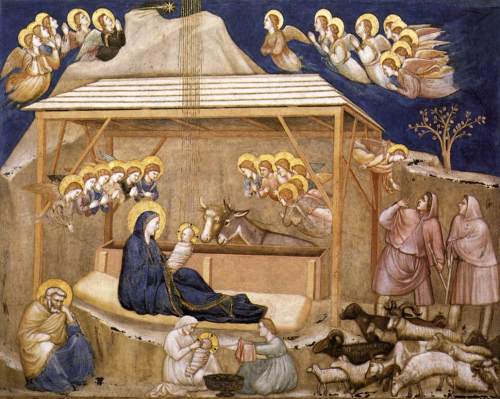
The Nativity. Giotto, c. 1320. Church of San Francesco, Assisi.

The following sermon was preached on Sunday, December 27, 2015, the first Sunday after Christmas, at the Church of St. Michael & St. George. This Sunday we reverted to the “summer” schedule of services, holding two at 8am and 10am rather than the slate of three at 8, 9:15, and 11:15. The 5:30pm service remains as usual.

Collect: Almighty God, who hast poured upon us the new light of thine incarnate Word: Grant that the same light, enkindled in our hearts, may shine forth in our lives; through the same Jesus Christ our Lord, who liveth and reigneth with thee, in the unity of the Holy Spirit, one God, now and for ever. Amen.

Readings: Isaiah 61:10-61:3; Galatians 3:23-25; 4:4-7; John 1:1-18

“In the beginning was the Word, and the Word was with God, and the Word was God.” In the Name of God, Father, Son, and Holy Spirit, Amen:

Our Gospel passage from John today is one of those several passages we get this time of year which seem to thunder out with a special resonance all their own.  You’d be hard-pressed to find a more famous passage or a more influential text than the prologue to John’s Gospel.  Beloved by philosophers and theologians, preachers and praying Christians throughout the ages, it has shaped the Church in profound ways.

For centuries, this was the so-called “Last Gospel,” read after the dismissal at the end of every mass.  It also serves as one of the chief sources for the doctrine of the Trinity, and the nature of Christ.  One of my favorite possessions is a series of commentaries on the four Gospels compiled by Thomas Aquinas in the 12th century and translated into English by John Henry Newman in the 19th: it consists of meditations on the Gospel texts by several dozen of the chief saints and doctors of the early church.  These 18 verses of the prologue to John make up slightly less than 2% of the Gospel, but so important a place did it hold in the praying lives of these ancient writers that more than 12% of their commentary is devoted to it.  This passage continues today as one of the most often-quoted summaries of Christian belief, and as one of the most inspiring of religious sentiments.  Queen Elizabeth herself quoted it in her own Christmas message this year: “The light shines in the darkness, and the darkness has not overcome it.”

For all its popularity and profundity though, this morning I only want to make two observations on this text.  First, that we’re getting it at Christmastime, and second, that we’ve gotten it twice now: once on Christmas Day, and again this morning, on the first Sunday after Christmas.  Why Christmas?  And why twice?

First of all, as I’ve often said before, here and in other contexts, Christmas can be an intensely theological, intellectual exercise, full of overlapping symbolism and densely interwoven metaphors.  The same can be said of John’s Gospel.

The Baby in the manger might very well be the answer to all our questions, the end of all our striving, the Mind of God and his eternal Word.  But there is no question he himself can answer: He cannot even speak yet!  And there is no rest he himself can offer: He cannot even sleep through the night yet.  To hear such a rarefied Gospel at Christmas is a way of reminding us that we do not come to his cradle in order to “figure him out,” or even to consider his message.  We come to Jesus’ cradle as we would come to any other cradle: to allow our affections to be warmed by the sight of a baby, and for our hearts to grow, creating a place for him in our love.  This is John’s point too: “To all who received him, who believed in his name, he gave power to become children of God.”  The cradle is the point where our striving, our figuring, stops, and our loving begins; where we ourselves are born afresh, children of this newborn baby by whom the stars were set in their courses.

But twice?  Why should we hear the same thing twice in such quick succession?  If you’ve spent any time in church at all, you will have noticed that redundancy is a fairly common occurrence.  They say preachers have only one sermon (and I’m afraid you’re getting mine yet again!).  We have two or three crosses in most processions, legion vestigial references to long-past fashions and liturgical patterns.  We bless everything multiple times in the course of a service, and we kneel, stand, sit, and cross ourselves often with seemingly inscrutable logic.

Redundancy is everywhere in the church.  But remember John’s point: Jesus’ cradle is where our striving stops and where our loving begins.  And Love is full of redundancies.

In love, how many times is too many to express affection?  How many times is too many to be patient, to be kind?  How many times is too many to forgive?  How many times is too many to act with tenderness?  Make no mistake, love is a fundamentally redundant exercise; there is nothing efficient or precise about it, there is no end product, there is no final goal, only its own fulfillment.  It is its own reward, its own product, its own end.

It sounds like a lovely thing when I put it that way, but in practice it is actually deeply unsettling.  I don’t know how many times I’ve heard couples either dating or already married say to me, that they don’t know how to recognize themselves anymore, they’re saying and doing things they never imagined themselves saying and doing.  Lots of things for good, but also lots of things that hurt each other.  The truth is that love unsettles us.

This child in the manger demanding nothing but love is a conundrum.  We may prefer the delightful poetry of love to the brass tacks of the way the world works, but at the end of the day we have to admit, it’s a relief to have metrics of efficiency and precision to fall back on, to know that we have done our duty.  Love of any sort defies those sorts of metrics.  A child does not count the number of good night kisses he receives from his parents and present them with a quarterly report.  A bride does not keep a quota of the flowers or notes she receives from her groom, to alert him when more becomes wasteful or unnecessary to her.  A widow does not track her dreams of her departed husband, or wish for them to stop, even though they cause her pain on waking.  Our favorite metrics of accomplishment and productivity do not make much sense when it comes to love.

At the cradle in Bethlehem, they fail entirely.  And that’s as it should be.  The Baby in the manger does not come to make the world a more efficient machine, more capable of producing results; at least not the kind we can analyze or sell.  He does not come to gratify our desires or to fill our appetites.  The Baby in the manger comes not to make our lives better, but to make them right; and that means that we are going to have to give up wome of our most highly cherished ways and means.  Jesus demands love, first and last, and that means that our favorite metrics will need to take a backseat to his, the chief of which is the Cross.

How willing are we to make sacrifices for the love of God?  How willing are we to make sacrifices for the people in our life?  Reputation, honor, influence, regard, possessions, even hopes and ideals; all of them are subject to the cross.  If we are tender with the Christ child at his cradle, we must be prepared to follow him to the cross.  If we are tender with each other in his name, we must be prepared to lose everything in the course of our loving, and still keep on loving all the same.

So what am I saying?  The point here is that the child who is born has come to make children of us all.  The wood of his manger leads us to the tree of his Cross; his swaddling bands lead us to his shroud in the tomb.  His life ends the death in which the world had languished long; his death brings us all eternal life.  Let us then hasten to his cradle to adore him, and, loving him in all things and above all things, find our souls refreshed and delivered, true children of God and citizens of Paradise; wounded by the same love which is our life, but in its scars beholding his glory: Glory as of the only Son from the Father, full of grace and truth.

In the Name of the Father, and the Son, and the Holy Spirit: Amen.

Advent IV

The following sermon was preached on December 20, 2015, the Fourth Sunday of Advent, at the Church of St. Michael & St. George. Lessons & Carols for Christmas took place that evening in addition to the regular 5:30 Eucharist, and the Church began preparing for Christmas.

Collect: We beseech thee, Almighty God, to purify our consciences by thy daily visitation, that when thy Son our Lord cometh he may find in us a mansion prepared for himself; through the same Jesus Christ our Lord, who liveth and reigneth with thee, in the unity of the Holy Spirit, one God, now and for ever. Amen.

Readings: Micah 5:2-5a; Hebrews 10:5-10; Luke 1:39-55

In the Name of God, Father, Son, and Holy Spirit, Amen:

Over then last few weeks, we’ve been talking a lot about preparation: preparation for Christmas.  Last week John the Baptist preached the good news of repentance to prepare for Jesus coming.  The week before, the prophets united in their witness to history itself preparing the way for Jesus.  And the first week of Advent, meditating on the Four Last Things, our own mortality, we prepared the way for considering just what kind of life the baby in the manger comes to gives us.

This week, we have a very different kind of preparation going on in our Gospel text.  Mary, pregnant with Jesus, goes to spend some time with her Aunt, who is pregnant with John the Baptist.  Together, the two of them will spend time preparing to give birth, no easy task for either of them: Elizabeth by reason of her advanced age, and Mary by reason of her youth.  It will be a challenging time for them both.  And yet from the first moment that they greet one another, their interaction is marked not by fear or uncertainty, but by overriding joy.  Listen to Elizabeth: “When Elizabeth heard the greeting, the babe leaped in her womb; and Elizabeth was filled with the Holy Spirit.”  She blesses Mary, and Mary replies by blessing God, in one of the most famous, well-loved songs of all the Scriptures: “My soul doth magnify the Lord, and my Spirit hath rejoiced in God my Savior.”  Pregnancy for Mary and Elizabeth will be a long road, full of its own unique challenges.  And yet their preparation is marked by unbridled, unalloyed joy.

What about you and me?  If we’re frank with ourselves, we’ll have to admit that sometimes our own preparations for Christmas are distinctly lacking in joy.  Why is this?  I don’t think it’s anything we need to feel guilty about, only to name and consider.  If we’re like Elizabeth, perhaps it’s because, with time’s relentless advance, it’s hard to get excited about something we’ve done or been around so frequently in the past.  Repetition can certainly lead to dryness, and the long drawing down of years can remind us of all we’ve lost: people no longer in our lives, plans foiled, hopes withered.  And not just age either, but our own personal disappointments and failures can reveal themselves in particularly stark relief at this time of year, while the sting of our own besetting sins can bite especially sharply.  All of these can stifle Christmas’ freshness, all of these can put joy far from our minds.  Add them to a noisy, frenetic holiday culture, and it’s easy to see why Elizabeth’s and Mary’s joy might seem to come just a little bit out of left field at this time of year.

Even so, Joy is absolutely the essential fourth component  of our Advent preparation.  Consider: the Four Last Things, mortality, death, and the end: merely step one in a process that leads to eternal joy.  This is a world that is passing away.  It cannot last.  While we mourn the deaths of family and friends, while we mourn our own declining skill and ability, we know that our God is eternal, he lives forever, and that his whole purpose is to join all creation to himself in unending life: as the psalmist puts it, “the singers and the dancers shall say, ‘All my fresh springs are in you.’”  Even so in God shall our own lives spring up forever in the glory of his heavenly city.  Joy is the purpose and end of our contemplating the Four Last Things.

Likewise as we consider the messages of the prophets, preparing the way for the Messiah: without exception they lived in trying times.  They proclaimed their messages in various and differing ways, but one of their common treads was that the current state of affairs was not as God intended it, and that He would correct it in a way no one anticipated.  No one anticipated the Exodus from Egypt, and yet God led his people across the Red Sea and into the Promised Land.  No one anticipated a king like David, who would unite the tribes and lead Israel into a Golden Age of peace and prosperity.  No one anticipated the exile into Babylon and the destruction of the temple as the way God would show he was serious about righteousness.  And yet in every case, the prophets had been there saying this would take place.  In every case, God used those moments to draw nearer to his people than he had ever been before, to increase their joy and show them a better way to love him.

Even so in our own day.  It’s easy to look around and wonder how we’ve gotten into this scenario, it’s easy to despair of the future.  And yet time and time again, the prophets show us that just when things look bleakest, there God is doing a new thing, drawing us closer to himself, granting us deeper joy, showing us a better way to love him.  Isaiah writes, “The people who walked in darkness have seen a great light; those who dwelt in a land of deep darkness, on them has light shined.”  Even so for us today.  Though we dwell in a land of deep darkness and every lamp go out, the promise remains true, and joy is its seal.

Likewise a third time, with the sermons of John the Baptist still ringing in our ears from last week.  “Repent, prepare the way of the Lord.”  Our sin keeps us from approaching Christmas as we ought, our failings keep us from properly being able to greet the child in the manger.  Yet joy is the purpose of repentance too: the better we know our sin, the more freely we can ask forgiveness, the more ably we can live a virtuous life.  And yet the purpose of it all is not mere fidelity to the law; the purpose is to enter without reservation into joy.  The purpose of repentance is to hear our Lord saying when we come to die, “Well done, thou good and faithful servant, enter into the joy of your master.”

Today Mary and Elizabeth show us that, more than anything else, our Advent preparation is about joy.  Joy in the eternal life of God, which Christ shares with his Father from before the foundation of the world, and into which he is preparing to admit us too.  Joy in the loving purposes of God throughout all the changes and chances of life, designed to bring us closer to him by every means necessary.  Joy in the fruit of repentance, which draws us away from our sin and into the divine fellowship for which we were created.  Far from impeding our joy, the circumstances of our lives work together with one voice to direct our way to rejoice in the coming of Christ.  Far from cutting across the grain, joy in the Christ child draws us beyond the mire of our individual pains and failings, towards the fulfillment of God’s purposes for our selves and the world.

Today Mary and Elizabeth greet each other with joy.  They bless each other and they bless God for the wondrous miracles which they carry in their wombs.  This Fourth Sunday of Advent, as Christmas approaches, let us be joyful too.  Whether it be easy or difficult, let us rejoice in the freshness of the life to which God calls us.  Let us rejoice in the beauty of his loving purposes.  Let us rejoice in the surety of his forgiveness.  So the Child in the manger will come to each of us and find in our joy a mansion prepared for himself.

In the Name of God, Father, Son, and Holy Spirit: Amen.

The Four Last Things

The following sermon was preached on the first Sunday of Advent, 2015 (Nov 29), at the Church of St. Michael & St. George. Services began with the Great Litany; Advent Lessons and Carols will occur next Sunday evening.

Collect: Almighty God, give us grace that we may cast away the works of darkness, and put upon us the armor of light, now in the time of this mortal life in which thy Son Jesus Christ came to visit us in great humility; that in the last day, when he shall come again in his glorious majesty to judge both the quick and the dead, we may rise to the life immortal; through him who liveth and reigneth with thee and the Holy Ghost, one God, now and for ever. Amen.

Readings: Jeremiah 33:14-16; 1 Thessalonians 3:9-13; Luke 21:25-36

In the Name of God, Father, Son, and Holy Spirit, Amen:

Today is the first Sunday of Advent, and we mark the beginning of a new Church year: today is New Year’s Day for the Church.  Our lectionaries shift to the next year in the cycle, and we begin to rehearse the great festal cycle of Jesus’ birth.  We’re back at the beginning.

But I’ve always found it a little ironic that we don’t seem to begin at the beginning.  We don’t talk about creation on Sundays in Advent, we don’t hear about the flood, or the promises to Abraham.  Instead we start with what looks like the end.  In our Gospel today we hear Jesus again, continuing his theme from last week and the week before about the end of the world: the signs of the times, wars and rumors of wars, fear and foreboding, the powers of the heavens shaken.

From ancient time, the tradition of the Church has been to use the season of Advent, the first season of the year, to address the Four Last Things.  The Four Last Things: a classical grouping including Death, Judgement, Hell, and Heaven.  Why do we do this?  Why do we begin our year with the End?

Our annual calendar cycle is not the only time we begin with the end.  The Church has inherited from Judaism the tradition that the next day begins at sundown of the previous day.  In that pattern, the first prayers of the new day are said as we all go to sleep.  Evening Prayer, and Compline are the first prayers of the day, not the last.  And as we go to bed we pray that we’ll be kept safe through the coming night, which is always interpreted as a figure of our own deaths.  We go to sleep as we would go to the tomb: we do not know if we’ll wake up again.  We begin the day in a figure of death, and we pray that we may come out of it again in the morning.  The sunrise becomes like the dawn of a new creation and our own rise from sleep like our own resurrection from the dead.

So every day in the church we begin with night, with death; and every year our first season of Advent begins with the Four Last Things, with Death, and the end of the world as we know it.  Isn’t this counterintuitive? Backwards? Masochistic, even?  Why do we do this to ourselves?  Christmas is coming, why on earth should we talk about death?

For two reasons.  First, because it’s important not to kid ourselves about how well we’re doing.  This year, that seems a little easier than other years.  All you have to do is turn on the news to realize we don’t exactly live in Paradise, however we might want to describe it.  Not just in our world either: in each of our hearts, in each of our lives, there are always traces of darkness, weaknesses, favorite temptations and sins, that we are loath to name, let alone give up.  Any honest examination of ourselves reveals that we are not ready for Paradise, we wouldn’t know what to do with it, even if it showed up.  Beginning the Church year with attention to death and darkness makes it clear just how great a Savior it is who is born in a manger: who comes to forgive the sins of the world, and allow us a fresh start.

Second, and even more significantly, we begin the Church year with death, with night, and the Four Last Things, because creation doesn’t actually begin with a new world, fresh with the dew of Eden.  Remember Genesis 1: in the beginning the earth was formless and void, and darkness was upon the face of the deep.  Returning to darkness at the beginning of the year is a way of remembering that God made the world from nothing, including you and me, merely by speaking into the darkness.  ‘Let there be light,’ and there was light.  Even before the first Christmas, that Word of God, speaking into the darkness, is what all creation depends on for its continued life.  From dust were we made, and to dust shall we return; except that this dust is animated by the breath of God, called into existence by his Word.

In Advent we begin with death and consider our own mortality, the mortality of all living things, and the contingency of the created world.  We are here to begin with by the Word of God.  In Advent we meditate on this dependency, giving thanks for the grace to continue on living, even in the midst of our sinful, broken world.  Meditating on this dependency, we see we have a deeper problem even than our sin: we are created from nothing, and but for the continuous grace of God, we would fly back into the nothing from which we were made, because that is the nature of created, contingent things.

Sin, death, and mortality.  A month from now, a Savior in a manger.  Focusing on the Last Things allows us to see that this Savior does much more than merely forgive us our sins.  The Baby in the manger is that Word of God, spoken into the void to create all things.  At Christmas he comes robed in human flesh to knit God himself to his creation, ending mortality and death once and for ever.  Even the grave will not be able to keep him, for he is life itself.

In light of such a Savior as this, the Incarnate Word of God come to end the night of sin and death, we see that the Four Last Things — Death, Judgement, Hell, and Heaven — last in the order in which you and I experience this life, are not last after all.  They are actually the beginning of all things.  Death: the condition of our life in this world, ended by the Incarnation of the Son of God, and eternal life the new order of the Day.  Judgement: on our sin and the sin of the world, rendered moot by the Savior who died in our stead, that Innocence might be the quality and currency of his kingdom.  Hell: its power broken, its doors thrown down, and its prince bound by the Lord of Glory who stormed its bulwarks on Good Friday.  Heaven: God and mortals reconciled, across the chasms of spirit and matter, life and death, the beginning of eternity under the reign of Christ.

Advent, the Four Last Things, darkness, death, and the End.  These are the places God speaks his Word, beginning his new work in each one of us and the world: speaking into the void, bringing all creation from nothing; born of the Virgin Mary on Christmas Day, to die for us and break the power of death; born into the heart of every Christian at their baptism, and strengthening them in the life of the Church.

One day this Word of God will come again, to finish what he started.  Time will end and eternity will begin: the end of the beginning, and the commencement of the rest of the story.  What splendors await us there we cannot know now.  But let us practice for it as we can, dying daily to sin, daily working to end the reign of death in our hearts.  This Advent, this beginning of the Church year, let us keep in mind the Four Last Things: that when it comes our time to face them at our own death, we might be prepared to open our eyes and behold all of glorious eternity stretching out before us, with Christ our Maker, Christ our Savior, Christ our King.

In the Name of the Father, and of the Son, and of the Holy Ghost: Amen.

The end of the world?

This sermon was preached on Sunday, November 15, 2015, at the Church of St. Michael & St. George. This Sunday was the first Sunday following the series of coordinated ISIS terrorist attacks in Paris which killed well over a hundred people. There was a baptism at the 9:15 service. Music included one of my favorite hymns, “All my hope on God is founded,” which was also sung at my ordination to the priesthood.

Collect: Blessed Lord, who hast caused all holy Scriptures to be written for our learning: Grant that we may in such use hear them, read, Mark, learn, and inwardly digest them; that, by patience and comfort of thy holy Word, we may embrace and ever hold fast the blessed hope of everlasting life, which thou hast given us in our Savior Jesus Christ; who liveth and reigneth with thee and the Holy Spirit, one God, for ever and ever. Amen.

Readings: Daniel 12:1-3; Psalm 16; Hebrews 10:11-25; Mark 13:1-8

There will be wars and rumors of wars, but the end is still to come. This is but the beginning of the birth pangs. In the name of God, Father, Son, and Holy Spirit, Amen:

Wars, rumors of wars, famines, earthquakes: the end of the world. Do you remember the supposed Mayan apocalypse from a few years ago? Or the apocalyptic preacher in Times Square a year after that? People were so taken in by these predictions of the world’s end that they quit their jobs, got married, got divorced, moved overseas, or racked up enormous credit card debt with crazy purchases. Who cares how much debt you’re in when the world is ending? Who cares how many people you hurt if you’re not going to be there to pick up the pieces when it’s over? There are plenty of cults — and whole religions too — which play off our fascination with the end of the world. And yet the one common denominator of our life here on earth is that the world seems to go on, time keeps on ticking, no matter the predictions of when it will end.

On a darker note, there are also plenty of times when you and I might start to feel as if the world were ending, or at least when we realize that it cannot carry on this way much longer: events like this Friday’s coordinated terrorist attacks in Paris, or the breakdown of common life in our own country, or the establishment of vicious foreign societies like ISIS bent on the world’s destruction. If the world isn’t ending, it can sure feel like it at times; or at the very least like maybe it should.

The truth is, that despite both the silly and the sad ways the end of the world presents itself in our culture, there is something in us — an instinct maybe — which is fascinated by the idea of The End. Of course you and I will never pay attention to a street preacher, we will never be hoodwinked by the books which predict an end in our time, we are much too sophisticated for that. But, somewhere far back in our minds, there is an instinct that suggests there might be something to it after all. Like children reading a story book, we are convinced there must be an end to the story: something that will make everything that’s happening make sense, something that will prove that good guys actually do finish first, and that evil doesn’t go unpunished. When we hear the radio commentator predict the end of the world — yet again! — we laugh. But something in us hopes it might be so, if only so that everything might finally be set to rights.

Our Gospel reading this morning is one that is constantly used in predictions about the end of the world. There are people out there who make vast fortunes tracking famines and wars and earthquakes, selling books updating their fans on their latest assessment of creation’s progress towards the end times. Of course none of these authors quite realize that nowhere in this passage is the end of the world even in question. Jesus says nothing about the world’s end. He makes a very specific statement that the buildings of the temple will be thrown down, and in response to his disciples’ question, he offers some reflections on his own coming again. This isn’t the end of the world.

But for the disciples, like so many families in Paris today, it is the end of their world. The temple, thrown down? Jerusalem, in ruins? Wars and famines and earthquakes? It’s not the end of the world, but it is certainly the end of everything the disciples had understood to be permanent, and Jesus insists it is only the beginning. It’s not a happy picture. And so they ask him, ‘When will these things be? When we will we know the end of the story?’

Jesus answers them not with a date or a time, not with any suggestion of what to look for when he returns, but instead by saying, “Do not be alarmed,” Do not be afraid, “These things are but the beginning of the birth pangs.” Do not be afraid. These things are but the beginning of the birth pangs. With his answer, Jesus deflects attention away from the kind of ends we’re used to imagining: do not be afraid, these are the beginning of the birth pangs. It’s the end of the temple, the end of life as they knew it, but there’s really no threatening language here: no sense of any final annihilation, no suggestion of a final moment in which all of them must decide. The earth doesn’t open and swallow the wicked, fire doesn’t rain down from heaven, judgement is nowhere to be found. Rather the command, “Do not be afraid,” and birth pangs.

Jesus reveals that the operative question here is not “When will we reach the end of the story?” but “What is God doing in the world, and when will it finally be ready to begin?” Think of the other times we hear “Do not be afraid” in Scripture: when Moses trembles before the burning bush, and receives the news that God will bring his people out of Egypt. When the archangel Gabriel visits Mary, and tells her that she will bear the Son of God. When Jesus at the last supper tells his disciples that he will be taken from them on the next day, as he goes to the cross to work their salvation.  

Do not be afraid. This command always heralds something new and wonderful that God is about to do in the world. Do not be afraid. These are only the beginning of the birth pangs.

If we are stuck thinking about the end, we are asking the wrong question. God is actually not all that interested in endings to begin with. In fact his chief purpose is to put an end to all endings. We read in the Scriptures, the last enemy to be destroyed is death itself, and in Christ’s resurrection from the dead he breaks the grave’s stranglehold on life and opens the way for us to eternity. When he comes again it will be the final end to death, the final end to all endings, and the beginning of eternity with God.

If our world is still rocked by wars and rumors of wars, earthquakes, famines, and violence, it is because death still struggles to have the last word. But we who are baptized are born anew, born by water and the Holy Spirit, into Our Lord’s deathless life. We do not have the luxury of sitting idle and waiting for the world to end, waiting for Christ to come back and fix it once and for all. We, the members of his body, are the vanguard of his kingdom. And it is our task not to wait for the end, but to be busy about the beginning: the beginning of the kingdom of God.

We have work to do. We cannot buy into the culture of fear that assumes everything is a zero-sum game of win or lose, eat or be eaten, have or have not. It is tempting, because that culture can build great monuments, great temples to human industry that people admire and aspire to imitate. But there is a hidden cost to monuments to human achievement, there is a hidden cost to the pursuit of power and dominance, and that cost is always human blood. Instead our work, as members of Christ’s Body, is to cultivate love in the midst of ruin and failure and despair. Our work is to cultivate humility in a landscape planted thick with competing prides. Our work is to go, with our Lord, willingly to our deaths, even in the face of injustice and false accusation, so that innocence might shine all the brighter.

Make no mistake, this work will make us all look like fools, and no one will build great monuments for its achievement. But ruin and despair and failure and even death are the places where Jesus says, “Do not be afraid.”  

Even though the stones of the temple fall, even though every monument be pulled down and all is devoted to destruction, He is there. And where He is, there the Resurrection holds sway, the forgiveness of sins, the raising up of what had fallen. Where Jesus is, there creation meets its appointed end: eternal life in the glory of God forever.

In the Name of the Father, of the Son, and of the Holy Spirit: Amen.

Blind Bartimaeus

This sermon was preached on Sunday, October 25, 2015, at the Church of St. Michael and St. George.

Collect: Almighty and everlasting God, give unto us the increase of faith, hope, and charity; and, that we may obtain that which thou dost promise, make us to love that which thou dost command; through Jesus Christ our Lord, who liveth and reigneth with thee and the Holy Spirit, one God, for ever and ever. Amen. 

Readings: Jeremiah 31:7-9; Psalm 126; Hebrews 7:23-28; Mark 10:46-52

In the Name of the Father, and of the Son, and of the Holy Spirit, Amen:

Blind Bartimaeus. This is one of the shortest of many short miracle stories in Mark, and it’s often cited as a perfect example of Mark’s style: short, and to the point. But don’t be fooled. The brevity of Bartimaeus’ healing masks a much more profound meaning. Even a profound series of meanings.

The early church fathers, along with monks, nuns, theologians, and all sorts of others, found a great deal to ponder here. For some, Bartimaues is a commentary on the Gentiles, and the way they come to faith. For others, Bartimaeus is a commentary on the people of Israel, and how they will come to know the Messiah. For still others, Jesus’ encounter with the blind beggar is an important step on the road to his passion and death.

My own task this morning is to say something about stewardship, in the midst of all these meanings and more. But before we get there, I’ll take just a few minutes to observe how Bartimaues teaches us about prayer.

First, Bartimaeus is blind. This is important, because it forces him to listen, to use his hearing as his chief sense. You and I may flatter ourselves that we can see better than Bartimaeus, but when it comes to prayer we are all just as blind, if not more so. If I had a nickel for every time someone said to me that they have a difficult time seeing the presence of God in their prayer life, I’m sure I’d be able to triple the parish endowment instantly. It’s hard to see the presence of God, especially when life has brought so many challenges this last year or two, both here in St. Louis and around the world. Some of you have known recent tragedies, others bear the scars of old wounds. Our experience and our memories both tend to obscure the presence of God, and we find it difficult to see his peace or his love at work.

That’s where you and I can take a lesson from blind Bartimaeus. In those kinds of scenarios, our chief task is to listen: listen for the assurance of what we cannot see ourselves. Bartimaeus hears that Jesus is coming up the road, he has heard that this Jesus of Nazareth can heal the sick, that he has healed the blind. Bartimaeus hears the crowd shouting Hosanna. And even though he can’t see them, even though he is a beggar, destitute, he believes: that this Jesus is his Savior too.  

You and I, our first task in prayer is to listen like blind Bartimaeus. We cannot see as we would like. But if we listen to the crowd, if we listen to those who have witnessed what Jesus has done, we will know that despite our blindness, he can heal us too.

Second of all, Bartimaues makes a nuisance of himself by shouting, louder even than the crowd, “Jesus, Son of David, have mercy on me!” Bartimaeus has heard the crowd shouting Hosanna, and he knows that this is a royal antiphon: this Jesus is the Son of David and the rightful king of Israel. Bartimaues calls out to Jesus with wild, almost crazy abandon. And despite an earnest attempt by more respectable people to make him be quiet, he shouts all the more, “Jesus, son of David, have mercy on me!”

Bartimaeus’ words, despite coming from the lips of someone you and I might consider deranged, are at the heart of all our praying. We cannot see as we ought, and our blindness prevents us from even the right kind of polite response to Jesus. You and I can do nothing but cry out with Bartimaeus, ‘Son of David, have mercy on me.’ Sometimes we embarrass ourselves with how silly we feel when we pray, and sometimes we are driven to it as if we can do nothing else. Sometimes it’s both at the same time. We don’t know what to say, but we say ‘Have mercy on me,’ and hope that God will respond with kindness.

Lucky for Bartimaeus, and for us, Jesus does exactly that: hearing Bartimaeus calling wildly to him, Jesus stops and calls back, calls for Bartimaeus to be brought near. This is the third comment I’ll make about prayer: that Jesus always responds to our prayer by calling us closer to himself.

No matter how wild our prayer, no matter how desperate our need, the first thing he does on hearing us is to call us to him. Bartimaues hears, and the people who had scolded him now help him answer Jesus, bringing him to the Lord. What about you and me? From where we sit, where does Jesus stand? And how might we respond to his call? With Bartimaeus we may stumble, we may need help to get to him. But when we pray, he always calls us closer to himself.

However difficult it is to get there, when we respond to Jesus’ call to draw nearer to him, with Bartimaeus we find our eyes opened, and we notice all of a sudden that we are in the middle of the road. Bartimaeus, with his sight restored, does nothing else but follow Jesus. At this point in Mark’s Gospel Jesus is traveling the last leg of his journey, into Jerusalem for the last time, where he will be betrayed and crucified, and where he will rise from the dead. Bartimaues can see now, and the first thing he does is follow Jesus on the road to Calvary. This is my fourth and last comment on prayer: as we draw near to Jesus, responding to his call to us, we find our sight restored, we can see him; but he is on the road going beyond us even further, and we must follow.  

Having our sight restored, and our souls healed — like Bartimaeus’ eyes — is almost beside the point. His sight was restored and he followed Jesus. The same goes for us. However it is that God heals us, it is only so that we might follow all the more clearly, all the more intently, on Jesus’ road to Calvary.

This is prayer: to listen for what we cannot see ourselves; to cry out with whatever abandon we can muster for God to have mercy on us too; to answer Jesus’ call closer to himself; and, our soul healed, to follow him to the cross and behold him resurrected in glory. This is prayer, to have our senses healed and our hearts brought to the knowledge and love of God. This is but one of the many things which Bartimaeus teaches us.

So what about Stewardship? When Jesus calls Bartimaeus, the beggar throws off his cloak as he rushes to answer him. Bartimaeus did not have a penny in this world, he had only a cloak to keep him warm. And in the rush of responding to the Lord he drops even that to follow his Savior. You and I must do no less. We are just as blind as Bartimaeus, unable to see as we ought or as we’d like. What comforts do we cling to, and what must we drop in order to respond to Jesus?  

We often think of stewardship as being responsible with all the things that God has given us, careful and measured in every exchange, every transaction. And that’s true as far as it goes, Responsibility is a good thing. But until we are willing to give away our possessions with as reckless an abandon as Bartimaeus throws off his cloak; until we can call to God with as embarrassing an intensity as this blind beggar on the road from Jericho to Jerusalem; until we can follow Jesus to death and beyond, our prayer will always come up short of its goal.

Let us call to Jesus with every fiber in us, let us give up everything which clings to us, and follow him to his passion and cross. So might we share with him in the glory of his resurrection; so might our vision rest always on the goodness of our God.

In the Name of the Father, and of the Son, and of the Holy Spirit: Amen.

“My tears have been my food day and night.”

A sermon on the feast of St. Mary Magdalene, in response to the shooting in Aurora on July 20, 2012, which I preached at St. John’s Cathedral in Denver, Colorado on the Sunday following that event. This was published soon afterwards in a paper which has proved short-lived, and can no longer be found there. Given last night’s events in Paris, it seemed timely to me to re-post it here, in a new format.

Collect: Almighty God, whose blessed Son restored Mary Magdalene to health of body and mind, and called her to be a witness of his resurrection: Mercifully grant that by your grace we may be healed from all our infirmities and know you in the power of his unending life; who with you and the Holy Spirit lives and reigns, one God, now and for ever. Amen.

Judith 9:1, 11-14; Psalm 42; 2 Corinthians 5:14-18; John 20:11-18
________________________
“My tears have been my food day and night, while all day long they say to me,‘Where now is your God?’” In the Name of God, Father, Son, and Holy Spirit,Amen.

Today we keep the feast of St. Mary Magdalene, and it’s fitting that we do. She is a figure of great extremes: completely overcome with joy to hear the words of grace spoken to her; or throwing herself at the feet of Jesus before he went to die, anointing him with her tears; or sitting in rapt attention listening to Jesus’ every word; or in the garden on Easter Sunday morning, so inconsolable in her grief that she does not recognize the risen Jesus, thinking him the gardener instead. In art she’s often depicted as unkempt, her long hair in tangles, arms outstretched, robes aflutter, absorbed utterly in the emotional demands of the moment.

Many of us today are still reeling from the news of the shooting in Aurora late Thursday night, at a midnight showing of the new Batman film. I have spoken with some of you between then and now, and with many friends and colleagues around the church. Everywhere people are in shock. They are horrified. They are angry. They are deeply saddened. I for one have tried time and again to imagine myself in that theater. And yet I simply cannot. In my imagination I cannot get past the entrance of a masked man through an emergency exit, staring quietly at a packed house. That’s it. My imagination stops there. Ceases to work.

Underlying all of this, of course, like a menacing, barely discernible pedal stop on an organ, there sounds the note of similar events in our past; most notably the Columbine shooting, which undid so many people across the country, and was so close to this community.

For many of us, these events have the capacity to unleash a storm of emotional energy. For others, events such as these do not stir up passion but create anxiety in the conscience by the very lack of passion. For still others, they are left unable to speak at all, with no words to say.

For all of us, these events occur on top of the whole world of feeling and memory which our spirits contain at any given point, emotions born of our own life’s experience: loneliness, heartbreak, despair; joy, peace, happiness; hardship, fruitfulness, stoicism; enduring memories of failure, success, and loss. Events like Friday’s shooting hit us amidst all these pressing realities, and our reactions vary accordingly.

“My tears have been my food day and night, while all the day long they say to me,‘Where now is your God?’” It’s not often that preachers reflect on the Psalm in sermons; but today I think it’s singularly appropriate. It’s been the tradition in the Church, and in Israel long before the Church came to be, that the Psalms are the prayer book and hymnal of the whole people of God. The Psalms are full of every emotion and every situation conceivable under the sun.

Today’s is one of the most celebrated and most beautiful of them all. “As the deer longs for the water-brooks, so longs my soul for you, O God.” “My tears have been my food day and night, while all day long they say to me,“Where now is your God?” All the extremes are present here. Every experience, every emotion. Indeed the Psalms often trouble us with the violent language some of them use, and with the intimate romantic language that others use. But in the context of Holy Scripture, these words are for us to make our own. In situations where we have no words to say, the Psalms give them to us. In situations where our emotions are too strong for any thoughtful consideration, the Psalms speak for us, channeling our experience into subject, verb, object; metaphor, symbol, analogy. The Psalms give us a language to speak when we cannot speak ourselves; and they give us words to say which otherwise we would not dare to speak.

Why? Why be that vulnerable? Why bother to expose ourselves to God in such a clear, glaring way? Because in doing so we admit to ourselves our own humanity. And in expressing it to God, we take hold of that humanity, and are given grace to fulfill everything that we are: our thoughts, our emotions; our fears, our hopes. To rage in the words of the Psalms is to strip naked, and stand before God with nothing but ourselves and a plea for God to look at us; and in the looking to have mercy. In this way he clothes us with his love, and makes us whole. This is what prayer is all about, standing before God, hiding nothing, but offering our whole selves — cold, hot, clean, messy — to his loving care.

So: 12 are dead in Aurora, 49 are wounded. We can be angry. We are allowed to be sad. We can be confused. Be stunned. Be silent. To do these things is to be human. And it is to embrace that fragility of our nature which is one of humanity’s chief beauties. To do this is to be like Mary Magdalene, who hid nothing from the God she loved.

But in the throes of our emotions, let us not be fooled into being blinded to other things; let us not fall prey to self-centeredness and self-pity and self-righteousness. Instead, with Mary Magdalene, let the rage and roar of each of our human passions prompt us to look up and behold the Cross.

The Cross:“tow’ring o’er the wrecks of time,” and “on which the Prince of Glory died,” as the old hymns have it. There, on the Cross, all our human emotions — and not our emotions only, but all the wickedness too: in your heart and in mine and in the man who shot into the crowd Thursday night — all our human emotions and all human wickedness hang together, in the body of one innocently condemned to death. And in that Body, all emotions, all wickedness, and all humanity are caught up and transfigured by God’s amazing grace. Where before there was strife and discord and violence, there is peace and unity and love. Because he who died a human on that cross is the same One who spoke into the void and created the cosmos, and whose love sustains the stars in their courses. He who died on that cross went into the grave and harrowed hell, that forgiveness might now rule over justice; peace over destruction; and love over hate.

Let the events of this past Thursday night, and each of our emotions, prompt us to look up and behold that Cross, on which Life begins: life for all, together, in the communion of the saints: which spans every place, and every time, and every pain, and every joy; united by the one prayer of the one Spirit, flowing among each of us, through the Son, to the Father.

Amen.

St. Michael & All Angels

Paris, Latin Quarter: La Fontaine Saint-Michel

The following sermon was preached at 8am, 9:15am, 11:15am, and 5:30pm on Sunday September 27, at CSMSG. This was “St. Michael’s Sunday,” the Sunday closest to the feast of St. Michael & All Angels, which we keep as our patronal feast. Music included the Bullock setting of “Christ, the fair glory” and Sidney Campbell’s “And there was war in heaven,” a setting of verses from Revelation 12.

Collect: O everlasting God, who hast ordained and constituted the ministries of angels and men in a wonderful order: Mercifully grant that, as thy holy angels always serve and worship thee in heaven, so by thy appointment they may help and defend us on earth; through Jesus Christ our Lord, who liveth and reagents with thee and the Holy Spirit, one God, for ever and ever. Amen.

Readings: Genesis 28:10-17; Psalm 103:19-22; Revelation 12:7-12; John 1:47-51

In the Name of God, Father, Son, and Holy Spirit, Amen:

How did St. Michael’s get its name? If you’ve heard the story, you know it’s almost an accident. John Tyler tells how it happened in his parish history: When the Skinker family gave land for a new church at the point between Ellenwood and Wydown, no one knew what to call it. Isabella, the Skinkers’ daughter, looked through the Prayer Book for a solution (she was a good Episcopalian!): she noticed that every major feast of the church year had a corresponding parish in St. Louis, all except for St. Michael & All Angels. And so the church got its name.

Who is St. Michael, and who are all the angels? In art, and poetry, and Scripture, we see the Angels surrounding the throne of God, moving back and forth between heaven and earth, ministers of God to his creation. We see the high drama of heavenly battle: Michael with his sword and shield casting the devil out of heaven: Satan, formerly chief of the angels, corrupted by pride, defeated by Michael, leader of the heavenly host. Milton attributes to Satan the battle cry, “Better to reign in hell, than serve in heaven.” And so he falls, to tempt the earth.

No doubt about it: this is high, epic drama. It had a strong pull on Christian imaginations for centuries. Today, though, we don’t think much of angels, and we pay even less attention to the devil. But it doesn’t mean angels are any less significant — they’re not like Peter Pan’s fairies, who disappear when people don’t believe. And the devil is no less dangerous. Maybe you know the film, “The Usual Suspects.” An FBI informant describes the exploits of an infamous mobster, nicknamed The Devil, saying, “The greatest trick The Devil ever pulled was convincing the world he didn’t exist.”

But the devil does exist, and today he works the same evil he has always worked. Not by assaulting heaven, but quietly, personally: in the Garden of Eden, he tempts Eve with his own special temptation: disobey, eat the fruit, and you will be like God. Adam and Eve are already like God, they are made in his image. But they are tempted by mastery, authority, being peers with their creator. And so Paradise is Lost: in the moment of grasping at the temptation to be like God, Satan, and we ourselves, grab hold only of idolatry, corruption, and decay.

In a world like ours, where Satan does not risk open assault but works quietly and individually, how does Michael keep him out of heaven? How does the archangel defeat his schemes? The same way he has always done. Michael’s name, literally translated, is a question: Micha-el, “Who is like God?” It is the exact inversion of the Serpent’s temptation, “You will be like God.” Michael asks, “Who is like God?” A rhetorical question, no one is like God except God himself. At its heart, this is worship: to render to God what is God’s, starting with his own nature.

Michael’s humble worship, not claiming for himself what properly belongs to God, is what defeats the Devil. Our own humble worship is what keeps Satan at bay in our own lives. But there’s a great irony here: Michael’s name can also be translated, “He who is like God.” By his humble worship, Michael is granted what he could never have claimed for himself: a place to stand for ever in the very presence of God, enjoying his grace and love, being present in his counsels, and aiding in the execution of his will: truly, one who is like God.

Michael the archangel is our great patron here at CSMSG, he is both our defender and our example. But he is not the only angel. The Old Testament and the New are full of stories of the ministry of the angels: revealing God’s purposes to mortals, aiding them in their need, rejoicing at the manger, weeping at the cross, gathering the harvest at the end of the age, and sharing with us in the joy of God’s kingdom come. As our collect today puts it, God has “ordained and constituted the ministries of angels and men in a wonderful order.”

We pray that “as they always worship and serve [God] in heaven, so by [his] appointment they might help and defend us on earth.” This ministry of the angels is none other than Michael’s own ministry: rendering to God pure and spiritual worship, in all humility. When they come to help us, they do not abandon their reward in the splendor of God, but share it with us wherever on earth they find us, helping us to see the glory of the Hope to which we are called, and strengthening us to pursue it with every fiber we can muster.

In this way, the angels do their part in knitting together the fellowship of heaven and earth. Are you sensing a theme yet? Since I’ve come to this church, I don’t know how many times I’ve heard someone say, one way or another, from one source or another, “It’s all about relationships.” I’m glad you all think so, because if nothing else, and there’s a lot else, our patrons, St. Michael and all the angels, get relationship with God right. Where does it start but in worship? Who is like God? That kind of worship always keeps Satan in check.

Worship. It’s what we do here every Sunday, and throughout the week. It’s the best, clearest way we have of relating to God and to each other for that matter. Why do we stand and kneel, why do we bow to one another, why do we get all dressed up? Because in church we step, with Michael and all the angels into the heavenly court. And like any other stately court, we adopt manners and courtesy befitting the Lord we approach and the dignity of his servants who attend him. It’s all about relationship: a relationship Satan’s pride would fragment.

In church we are all God’s servants, working towards the same end, rendering to God that which is God’s: Each of our lives, and all creation. It is an act of generosity, of thanks-giving, of sacrifice. More than this, the God we worship does not sit like an idle tyrant merely receiving the gifts his people offer. He has given himself to all and to each, even to death on a cross. What we offer God in worship is what He has already given each of us: Our lives and our world, but chief of all his own Son.

At the altar, by the Holy Spirit, we join Christ’s own offering of himself to the Father, and we are received by God into Christ’s own Sonship. When we make our communions, we do not receive “a holy snack,” but we come with our fellow Christians to God’s table in heaven, where we join Michael, all the angels, the Blessed Virgin Mary, the holy martyr George, and all the redeemed from every age in one divine fellowship. Now we experience in part, then we will know in full: the unmediated splendor of God who fills all things with his love.

“It’s all about relationships!” Isabella Skinker may have chosen our name in a process of “fill-in-the-blank,” but she could not have chosen better. St. Michael and all the Angels get their relationship with God right. By living it out in humble worship, they put Satan to flight, enjoy the nearer presence of God forever and get their relationship with us right too. With patrons like these, you and I are constantly reminded of the need to give our all to worshiping God: in all humility, to getting that relationship right, and relationships with our neighbors right too.

“It’s all about relationships.” Satan still stands at our doors and in our ears, whispering to obey him and be like God. Let us resist his pride wherever it tempts us, aided by all the legions of heaven. His way leads not to God but only to fragmentation, isolation, and death. He wishes to reign in hell: let him reign over a silent, dead kingdom. You and I, let us rather serve in heaven, and do our part, with the angels, of knitting together heaven and earth in one communion and fellowship. So God shall be all in all forever.

In the Name of God, Father, Son, and Holy Spirit: Amen.

Heaven

The following sermon was preached at 5:30pm on Friday August 7, 2015, at St. George’s Chapel of St. George’s School in Newport, Rhode Island. This was a service of Choral Evensong as part of the Royal School of Church Music summer course in Newport, for which I serve as chaplain with Fr. Dane Boston. Music for the evening included Responses by Craig Philips, Canticles from the Evening Service in E by Herbert Murrill, Bairstow’s setting of the medieval text “Blessed City, Heavenly Salem,” and Bainton’s setting of Revelation 21:1-4, “And I saw a new heaven.”

Collect: O God, whom saints and Angels delight to worship in heaven: be ever present with us your servants who seek through music to perfect the praises offered by your people on earth; and grant to us even now glimpses of your beauty, and make us worthy at length to behold it unveiled for evermore; through Jesus Christ our Lord. Amen.

Readings: Acts 19:21-41; Mark 9:14-29

“Lord I believe, help my unbelief.” In the Name of God, Father, Son, and Holy Ghost, Amen.

Sometimes, heaven can sound a little disappointing. If you’re like me, you might be worried that all those angels might not turn out to be the most fun company, and that all those clouds might be just a little bit too plain. Even singing praise to God, while a lot of fun, can also be exhausting — and maybe, if that’s all we’ll be doing, maybe it might be just the tiniest bit boring.

Our theme for this year’s course is heaven, and you all have been singing beautiful psalms and hymns and spiritual songs about heaven. You’ve heard Canon Boston preach a sermon about the ways we can see heaven even now, at work among us. But all that notwithstanding, sometimes it really is hard to see just what all the fuss is about to begin with.

The father in this evening’s Gospel is a good example of what I’m talking about. His son is in need of healing. It’s not a complicated need, and Jesus has performed lots of similar healings. The father has every reason to believe that when he brings his Son to Jesus, he will be healed. But Jesus is away when he arrives, so he asks the disciples for their help instead. They have performed similar healings too. This one shouldn’t be difficult. But for some unknown reason, they can’t heal this man’s son.

Their failure causes an argument in the crowd, and this is when Jesus arrives on the scene. The father is sadly losing patience: his son is still sick, his hopes are disappointed, and on top of it all, he finds himself at the center of a very public scene. This is not what he wanted.

Most of us know what it’s like to have our hopes disappointed. It’s always a hard thing to experience. But it’s especially hard when our hopes are high, and when the thing we hope for is good and right. The father in our Gospel passage only wants his son to be made well. Maybe you have some examples of your own, of good hopes disappointed. This is why, when we’re talking about heaven, that it’s important to speak frankly about our desires, and about why the images of heaven we see in cartoons and greeting cards leave so much to be desired. (Hard as it may seem to believe, I’ve never met a single person who loves harp music so much they want to sit listening to Angels play it all day, every day, for all eternity!)

The things you and I desire are usually much more, well, down to earth than the popular portrayals of heaven. We want to live in peace with family and loved ones. We want to be free from the limitations of bodily life, we want to be able to do what’s right. These are all things we try to accomplish even while we’re still here on earth. And it always feels pretty crummy when we can’t manage to do it.

The father in our reading wants to take care of his son. He brings him to Jesus, and Jesus’ disciples can’t help. Jesus himself seems only to scold him: “All things are possible for the one who believes.” The father’s response is the hinge, the key to the whole episode. He says, “I do believe! Help my unbelief.”

It’s important because by saying this, the father surrenders the outcome to Jesus. No longer is he asking for a service to be performed for his son. Now he makes a prayer, that he himself be brought to greater faith, greater trust, greater peace. It’s a remarkable surrender, and no longer insists on any outcome but the one Jesus is willing to give. Jesus responds by healing his son. The crowd marvels, and father and son go on their way together, restored.

When you and I face disappointments and failed hopes, the Christian faith asks us to surrender them to Jesus. This is close to the heart of what prayer is all about to begin with: surrendering things, people, projects, goals, hopes, to Jesus; offering them to him, allowing him to do with them according to his own purpose. Only in this way do we get ourselves sufficiently out of the way to allow God to do his work in us.

The Christian faith doesn’t ask us to surrender only disappointments to Jesus either, but every part of our selves: every desire, every hope, every good wish and noble goal. This allows Jesus to work in us and in the world. And it gets us near to him by the act of surrender.

What does all this have to do with heaven, with clouds, and with Angels playing harps? If heaven is going to be more for us than merely a disappointing litany of unsatisfying images, we have to surrender it to Jesus too. Offer all our ideas, all our fondest hopes, all our nagging fears about the kingdom of heaven, to Jesus, to whom that kingdom belongs.

“Lord, I believe, help my unbelief!” Once we make that surrender, our Lord will make haste to help us. He will welcome us into his kingdom, and help us to see how its contours spread over the whole earth and encompass the heights of heaven. When we surrender what we want out of heaven, our Lord is free to give us what it really is and means: not a reward for good behavior, but eternal life in his nearer presence for ever, with Angels, archangels, apostles, prophets, martyrs, and all the faithful departed; where the mysteries of grace continually unfold, and we are brought to the fullness of the stature of Christ himself, our master and our friend.

In the Name of God, Father, Son, and Holy Ghost, Amen.

The Good Shepherd

The following sermon was preached at 8am, 10am, and 5:30pm on Sunday July 19, at St. Michael & St. George.

Collect: Almighty God, the fountain of all wisdom, who knowest our necessities before we ask and our ignorance in asking: Have compassion, we beseech thee, upon our infirmities, and those things which for our unworthiness we dare not, and for our blindness we cannot ask, mercifully give us for the worthiness of thy Son Jesus Christ our Lord; who liveth and reigneth with thee and the Holy Spirit, one God, now and for ever. Amen.

Readings: Jeremiah 23:1-6; Psalm 23; Ephesians 2:11-22; Mark 6:30-34, 53-56

“Woe to the shepherds, who scatter and destroy the sheep of my pasture!” In the Name of God, Father, Son, and Holy Spirit, Amen:

In seminary many of us knew about Jeremiah 23, and frankly we were all just a little bit terrified. Jeremiah is talking about priests and prophets, religious leaders who in his day had sold out to the idols of Egypt, Phoenicia, and Aram. They had set up images of those gods in the towns and villages, even in the temple itself; and they took the people’s offerings and made sacrifices to these other gods. Whatever was left they kept for themselves.

Why did they do it? It’s hard to say for sure, but likely it was a combination of all sorts of things. Like all people at all times, they needed allies, and adopting foreign religious practices is an effective way to prove good faith to potential friends. The people themselves may have been enticed by the novelty of multiple deities, and no doubt there was a market for importing exotic religion into daily life.

By Jeremiah’s day, many centuries had passed since Moses had led the people out of Egypt, and it was even a few hundred years after David and Solomon. It would have been easy to forget the urgency of those shepherds’ devotion to God, and the significance of a whole people devoted to his service. What did it matter if the priests sacrificed to Asherah, if the royal prophets counseled alliances at any cost, if fraud and deceit and corruption were the order of the day rather than accountability to the Law?

However it all happened, Jeremiah holds the shepherds accountable. They are the ones to whom it had been given to look after the people, and keep them in the service and love of God. For anyone who is called “pastor,” or anyone else whose responsibilities include leading people, Jeremiah’s words today are very harsh. It’s a good thing the prophet offers an alternative, in one of the most famous and well-beloved images in the Bible. God says, “I myself will gather the remnant of my flock . . . and I will bring them back to their fold, and they shall be fruitful and multiply.” God declares himself his people’s shepherd.

It’s fitting we also heard the 23rd Psalm this morning, “The Lord is my shepherd, I shall not want.” We love this image, of the Lord being our shepherd. For my part, it’s a welcome relief to consider that even pastors have a pastor, the same One who is shepherd to us all. It’s no surprise that Jesus makes extensive use of the same image to describe his own ministry, and the Gospel writers continually make the same point.

In our Gospel today, Jesus looks with compassion on the crowd because they are “like sheep without a shepherd.” And even though he was on his way to escape the crowd for a bit, he tends to their needs instead. The theme of Jesus the Good Shepherd was so beloved by the early church that it was among the first things they painted in the Catacombs, an inspiring image even while they faced persecution.

But what does it mean for all of us to be under the care of the Good Shepherd? It’s not always as bucolic as it might seem. First of all it means our lives are fundamentally nomadic. No matter how much we might be at home in a particular pasture, we will always need to leave it before too long. Shepherds move their sheep constantly, in order to bring the flock to fresh pasture, and also in order not to overgraze the land.

On this earth you and I are always guests and sojourners, being led by our Shepherd finally to our true and lasting home in heaven. Heaven always stretches before us. And even when we depart this life for that one, we will continue in our pilgrimage, never stopping but traveling further into the mysteries of the grace of God.

Even our church services imitate this constant movement: along this long nave here at St. Michael and St. George, every week we start at the back and move forwards, towards the altar, finally receiving a foretaste of the heavenly banquet before returning to our lives in the world.

Second of all, following the Good Shepherd on our nomadic track means recognizing we do so with lots of other sheep. Sheep get a bad rap because they often blindly follow one another, which can get them into trouble. But another way to look at it is to see that sheep trust each other implicitly, and rely on each other to get where they need to go. When one makes an error, many others are affected — not because they are stupid (though why might be!) — but because they would rather be led into error than break the bonds of fellowship and trust which unite the flock.

If you and I are to be reliable guides for our fellow members in the flock of God, we must do everything in our power always to be listening for the voice of the Shepherd. Only when the whole flock listens for his voice with one accord will we be led in safety to the place where we are going. In other words, we have a responsibility to one another to listen carefully to Jesus’ voice, and to do everything in our power to remain within earshot. Come to the Daily Office and the weekday Eucharist; attend each other’s events, participate in our outreach ministries. Look after one another, and pray together. The whole church is strengthened by each individual’s devotion, and the integrity of the whole Body is built up by each member acting in concert with one another, under the Shepherd’s direction.

Finally, the third point I want to highlight about living under a common Shepherd: the metaphor is about sheep and their Shepherd, but it doesn’t stop there. Our Good Shepherd is not only a shepherd, but is also the perfect Lamb of God. What does that mean? He is himself the final sacrifice which takes away the sin of the world. And while he comes from the courts of heaven to all the dustbins of earth, to your heart and mine, he does not come as a condescending lord, but as a brother, a lamb among sheep, to make us members of his own household for ever.

There are very few things in religion more wonderful than considering the Good Shepherd, how he calls to each of us and how we might respond to his voice. But it is a risky life! There is no final security in homes or possessions, but a nomadic journey from earth to heaven. There is no striking out on our own paths, but accountability to the rest of our Shepherd’s flock, and a responsibility to be reliable guides for one another as we listen to his voice. We follow him not to fulfill our own designs but to be forgiven where we have gone astray from his designs, and to share his kingdom, his power, his glory, forever.

Let us be careful, then, of trying to be our own shepherds. Let us pay attention to the voice of Him who is the Good Shepherd of us all.

In the Name of God, Father, Son, and Holy Spirit, Amen.